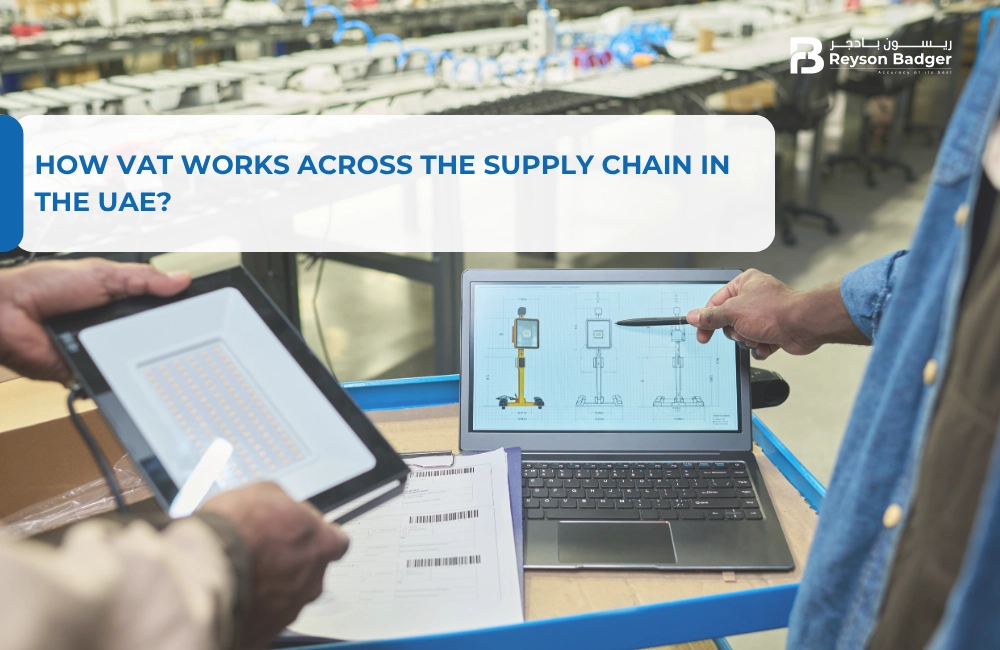


Value Added Tax (VAT) in the UAE is applied at every stage of the supply chain, from production to final sale. Businesses collect VAT when they sell goods or services and pay VAT when they make purchases. This system ensures that tax is recorded and tracked throughout the economic cycle.
Although VAT is charged at multiple points, businesses do not bear the final cost. Instead, the end consumer ultimately pays the VAT, while businesses act as intermediaries that collect and remit tax to the government.
Understanding how the VAT supply chain UAE works is essential for managing input VAT and output VAT correctly and ensuring full VAT compliance UAE.
How VAT Works Across the Supply Chain?
VAT is applied at each stage where value is added to a product or service. As goods move through the supply chain, every business charges VAT on its sales and can recover VAT paid on its purchases.
The typical flow looks like this:
Manufacturer → Wholesaler → Retailer → Consumer
At each stage:
- The business adds value (through production, packaging, distribution, or retailing)
- VAT is charged on the selling price
- The business claims credit for VAT already paid
This step-by-step taxation ensures transparency while avoiding double taxation.
Output VAT in the Supply Chain
Output VAT is the tax a business charges on the sale of goods or services.
For example, when a wholesaler sells goods to a retailer, VAT is added to the invoice. This VAT collected from the customer is known as output VAT.
Businesses are responsible for:
- Charging VAT on taxable supplies
- Issuing proper tax invoices
- Reporting output VAT in their VAT returns
Output VAT represents the amount a business collects on behalf of the government.
Input VAT and VAT Credit
Input VAT refers to the VAT a business pays on purchases made from suppliers.
For instance, when a retailer buys goods from a wholesaler, VAT is included in the purchase price. This VAT is considered input VAT.
Businesses can generally recover input VAT, provided:
- The purchase is for business purposes
- The supplier has issued a valid tax invoice
- The expense relates to taxable supplies
This recovery mechanism allows businesses to claim VAT credits, ensuring they are only taxed on the value they add. Managing input VAT and output VAT properly is key to maintaining accurate VAT compliance UAE.
VAT Remittance to the Federal Tax Authority
At the end of each tax period, businesses calculate how much VAT they need to pay to the government.
The calculation is straightforward:
VAT Payable = Output VAT – Input VAT
- If output VAT exceeds input VAT, the business pays the difference
- If input VAT is higher, the business may carry forward the credit or request a refund
This amount is reported through VAT returns and paid to the Federal Tax Authority.
Accurate calculation and timely submission are essential to meet VAT compliance UAE requirements.
Example of VAT Flow in a Supply Chain
Let’s look at a simple example to understand how VAT flows across the VAT supply chain UAE:
- Manufacturer sells goods for AED 100 + AED 5 VAT
- Wholesaler buys for AED 105, then sells for AED 150 + AED 7.5 VAT
- Retailer buys for AED 157.5, then sells to the customer for AED 200 + AED 10 VAT
At each stage:
- The business collects VAT on sales (output VAT)
- It deducts VAT paid on purchases (input VAT)
- Only the value added is taxed
In the end, the consumer pays the full AED 10 VAT, while each business only remits the portion related to its value addition.
Importance of Proper Documentation
Maintaining proper documentation is critical for ensuring VAT compliance UAE.
Businesses must:
- Issue valid tax invoices for all taxable supplies
- Maintain records of purchases and sales
- Keep supporting documents for VAT claims
- Retain records for the required compliance period
Proper documentation supports accurate VAT calculations and helps businesses during audits or tax reviews.
Conclusion
VAT in the UAE is designed to operate smoothly across the entire supply chain. From manufacturers to retailers, each business plays a role in collecting and reporting VAT while claiming credits for tax already paid.
Although VAT is charged at multiple stages, the system ensures that only the final consumer bears the cost. For businesses, understanding how the VAT supply chain UAE works and managing input VAT and output VAT effectively is essential for maintaining strong VAT compliance UAE. Professional VAT Services in UAE can help businesses manage these obligations, while VAT Registration in Dubai ensures eligible businesses meet their registration requirements.
By keeping accurate records, issuing proper invoices, and filing returns on time, businesses can ensure smooth operations and avoid compliance risks. With expert support from Reyson Badger, companies can streamline their VAT processes, stay compliant with regulations, and focus on sustainable growth.