E-Invoicing Coming to the UAE: What Businesses Should Know in 2026
23-Jan-2026
Prepare Free Zone E-Invoicing with Reyson Badger
Stay compliant with UAE e-invoicing. Reyson Badger helps Free Zone
companies upgrade systems and transition smoothly.
E-Invoicing for Free Zone Companies in UAE
The UAE is introducing e-invoicing as part of its digital tax transformation, changing the way businesses create, exchange, and store invoices. Instead of traditional PDF invoices, companies will gradually move to structured electronic invoices that can be validated and processed automatically.
Although the rollout will happen in phases, Free Zone companies should start preparing early. Businesses operating across multiple jurisdictions, dealing with mainland customers, or managing international transactions may need to update their invoicing systems, review VAT processes, and improve data accuracy before the mandate applies.
At Reyson Badger, we help Free Zone businesses assess their current systems, identify compliance gaps, and prepare for a smooth transition to UAE e-invoicing.
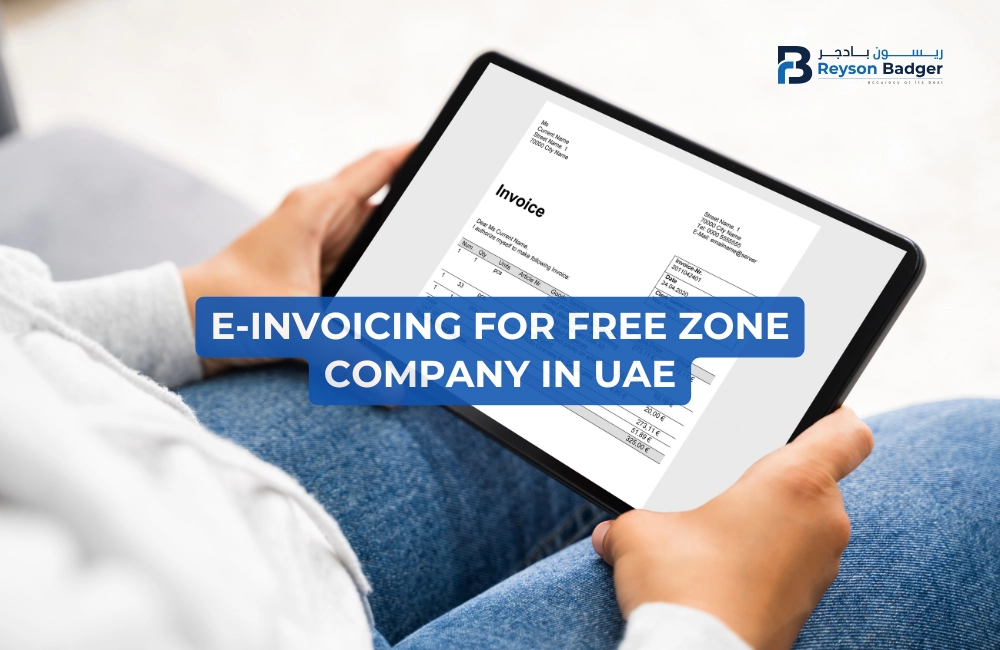
Free Zone E-Invoicing Requirements
Free Zone businesses must prepare for UAE e-invoicing compliance because waiting for the final phase can leave you with system gaps, invoice errors, and avoidable delays. Free Zone businesses are not exempt from the UAE’s move toward e-invoicing. Although implementation is expected to roll out in phases, Free Zone entities will eventually need to comply with the same digital invoicing framework as mainland companies. The Ministry of Finance is driving the wider e-invoicing framework, while the Federal Tax Authority (FTA) is expected to play a key role in tax administration and operational guidance. As the rules are finalized, businesses should also expect technical requirements around structured formats, Accredited Service Provider (ASP) connectivity, and standards such as PINT AE rather than simple PDF-only invoicing. References to models such as the 5-corner model and post-audit model are part of the current market discussion, so your business should validate the final operating model before go-live.
Are Free Zone Companies in the Initial Compliance Phase?
The UAE plans to introduce e-invoicing gradually across industries and business categories. Free Zone companies are expected to be included in later phases, but preparation should begin now to ensure readiness when the mandate becomes compulsory.
Early preparation allows businesses to update systems, train staff, and avoid rushed implementation later.
Mandatory Invoice Formats and Structured Data
Unlike traditional PDF invoices, e-invoices contain structured digital data that can be read automatically by accounting software and tax systems. Every invoice is expected to include standard business information together with VAT details, allowing invoices to be exchanged electronically with minimal manual processing.
Key elements typically include:
- Seller and buyer information
- VAT registration details
- Invoice number and issue date
- Description of goods or services
- Taxable value and VAT amount
- Digital validation and authentication
Mainland vs Free Zone E-Invoicing Obligations
Although Free Zone companies may enjoy certain tax benefits, their invoicing obligations are expected to follow the national e-invoicing framework. Businesses supplying goods or services to mainland customers, other Free Zones, or overseas clients should ensure their invoicing processes meet UAE VAT and documentation requirements.
UAE E-Invoicing Rollout Timeline for Free Zone Companies
The rollout timeline matters because if your Free Zone business starts late, you may need urgent ERP changes, manual workarounds, and extra review costs. Official milestone dates should be checked against Ministry of Finance announcements, Ministerial Decision No. 244 of 2025, and any FTA guidance issued closer to implementation.
| Business category | Current position | What your business should do now |
|---|---|---|
| Free Zone companies | Expected to fall within the phased UAE e-invoicing rollout; confirm your phase once official notices are issued. | Review billing systems, invoice fields, VAT data quality, and archiving rules now so you don't rush later. |
| VAT-registered businesses | Likely to face earlier operational readiness pressure because invoice and tax reporting data already feed into VAT obligations. | Map taxable supplies, credit notes, customer master data, and ERP outputs. |
| Non-VAT registered entities | Scope should be verified against final official guidance because assumptions here can cause unnecessary spend or missed obligations. | Check whether your entity will need receipt capability, issuer capability, or both. |
| Group structures with intercompany billing | Higher risk area due to multiple entities, transfer flows, and internal charging. | Test intercompany invoice rules early so group reporting doesn't break at go-live. |
E‑Invoicing Scope for Free Zone Companies in UAE
Scope determines whether your business must issue, receive, or store e‑invoices. Getting this wrong can lead to unnecessary costs or missed legal obligations.
For Free Zone companies, the key point is that Free Zone status does not exempt you from e‑invoicing requirements. If your business issues tax invoices, deals with mainland customers, trades across borders, or operates within a group structure, you should review your scope carefully.
- VAT‑registered businesses must check invoice data, credit note handling, and record‑keeping practices to ensure compliance.
- Non‑VAT‑registered businesses should not assume they are out of scope until the final rules are confirmed.
In short, every Free Zone entity should prepare early to avoid compliance gaps once e‑invoicing becomes mandatory.
Compliance Scenarios and Special Considerations
Free Zone businesses often deal with diverse transaction types that require special attention during e-invoicing implementation.
Transactions Between Free Zone and Mainland Entities
Many Free Zone companies supply goods or services to mainland customers. These transactions typically fall within VAT scope and must be documented accurately using compliant invoices.
Export and Import Transactions
Free Zone businesses frequently engage in international trade. E-invoicing will help standardize documentation for cross-border transactions and improve record-keeping for VAT reporting.
Intercompany Billing and Group Structures
Companies operating across multiple jurisdictions must ensure invoices between related entities follow standardized formats and compliance rules.
E-invoicing helps create consistent documentation across supply chains and simplifies financial reconciliation.
VAT and E-Invoicing UAE Free Zones
VAT treatment affects invoice content, reporting, and audit risk, so if your transaction coding is wrong, you can end up with rejected invoices or incorrect VAT returns.
| Transaction type | What to review | Why it matters |
|---|---|---|
| Free Zone to mainland | Check VAT treatment, customer tax data, and invoice field accuracy. | If the invoice is wrong, reporting and customer deductions may be affected. |
| Free Zone to Free Zone | Review supply nature, documentary evidence, and whether the transaction is taxable, zero-rated, or otherwise treated under the rules. | Wrong coding can create tax mismatches across entities. |
| Exports and other cross-border supplies | Check evidence, customer details, and structured invoice mapping. | Missing support can cause VAT position disputes later. |
| Exempt supplies | Review whether the transaction still requires the same data handling and storage standards. | Assuming exempt means no record control can create audit issues. |
| VAT group transactions | Confirm internal billing treatment, reporting logic, and document flow between entities | Poor setup can distort group records and delay close |
E-Invoice Software UAE
Your software must produce the right data and keep the right records, or your staff will end up fixing invoices manually and chasing payment delays.
For E-invoice software UAE readiness, businesses should review ERP outputs, invoice field mapping, tax code logic, validation checks, transmission capability, and archive retrieval. The right setup should help you generate structured invoice data, connect with the required exchange route, and keep documents available for audit. If your current system only creates PDFs or spreadsheet-based invoices, it may not be enough for full UAE e-invoicing compliance.
How to Implement E-Invoicing for Free Zone Companies
E-invoicing implementation UAE starts with gap testing, because if your current setup is wrong, you end up fixing invoices after go-live instead of before it. Preparing for e-invoicing requires both technical upgrades and process changes. A structured approach ensures a smooth transition.
- Assess Current Billing Systems: The first step is evaluating existing invoicing tools, ERP systems, and accounting workflows to identify gaps in compliance readiness. You should review master data, tax codes, customer records, and invoice output fields so hidden errors don't carry into the new setup.
- Integrate with Standardized E-Invoicing Platforms: Businesses must upgrade or integrate systems that can generate structured electronic invoices in the required format. If your platform can't handle structured data exchange or archive retrieval, you'll face delays and manual corrections.
- Testing and Verification: Before full implementation, pilot testing ensures systems can generate, transmit, and store compliant e-invoices without errors. Testing should include issue dates, tax amounts, buyer details, credit notes, and failed message handling so you know what breaks before customers do.
- Go-Live and Ongoing Monitoring: Once ready, businesses transition to live e-invoicing and establish monitoring processes to maintain compliance as regulations evolve. You should assign ownership for rejected invoices, resubmissions, archive checks, and VAT data review so issues don't sit unresolved.
- Common Challenges and How to Overcome Them: Free Zone companies may face challenges such as system integration, staff training, and process changes. Early planning and professional support help minimize disruption.
Many businesses work with experienced advisors such as Reyson Badger to ensure a smooth and compliant e-invoicing implementation. We're here to help you review the setup before it affects billing, VAT reporting, or collections.
What Free Zone Companies Should Do Before Go-Live
Before go-live, you should fix data, roles, and system gaps, or the first failed invoices will affect revenue and reporting.
- Confirm which entities, branches, and transaction types are in scope.
- Review invoice templates, tax fields, and customer-supplier master data.
- Check whether your ERP or billing tool can support structured invoice output.
- Plan for issuing and receiving workflows, including rejected invoices and electronic Credit Notes.
- Test archive access, document retrieval, and internal approvals.
- Get advice early if your business has VAT group transactions, intercompany billing, or mixed cross-border activity.
Why Choose Us?
E-invoicing is set to become a key part of UAE tax compliance, and Free Zone companies must start preparing now. Early adoption helps businesses avoid last-minute disruptions, improve accuracy, and streamline financial processes.
By upgrading systems, aligning workflows, and ensuring compliance, Free Zone companies can approach the upcoming e-invoicing timeline with confidence and stay ready for the UAE’s digital tax future.
Reyson Badger help you assess gaps, review invoice data, and prepare for Electronic invoicing for Free Zone businesses without leaving your team to fix errors after go-live. If your company operates in Dubai or elsewhere in the UAE and needs practical help with UAE e-invoicing compliance, we're ready to support your next steps before FTA-facing obligations start affecting daily operations.
FAQs
1. Are Free Zone companies exempt?
No, Free Zone status should not be treated as an automatic exemption, and if you assume it is, your business can be left unprepared when the mandate reaches your category.
2. Do non-VAT registered entities fall in scope?
Maybe, and your business should verify this against final official guidance because scope assumptions can lead to missed work or unnecessary software spend.
3. Can invoices be archived outside the UAE?
This should be checked against the final FTA storage and record access rules before you choose a hosting location, because the wrong archive setup can create problems during a tax review.
E-Invoice
Related Blogs
UAE E-Invoicing Timeline & Deadline
28-Jan-2026
E-Invoicing Solutions For Financial Institutions
28-Jan-2026Request a Quote
We’ll get back to you shortlyFAQs
Currently, e-invoicing is not fully mandatory across all sectors, but the UAE is moving toward structured e-invoicing under its digital tax framework. E-Invoicing for Free Zone Companies in UAE will likely become essential as regulations evolve, especially for VAT-registered entities.
E-Invoicing for Free Zone Companies involves generating, sending, and storing invoices in a structured electronic format. These invoices can be integrated with accounting systems and, in the future, may need to comply with government-approved platforms for real-time reporting.
Yes, if a free zone company is VAT-registered, it must ensure that its e-invoices comply with UAE VAT regulations, including proper documentation, tax details, and record-keeping requirements.
Latest Blogs
05
Oct
How Auditors Identify Financial Errors in Business Records?
READ MORE →
29
Sep
How Non-Residents Can Open a Bank Account in the UAE
Understand the key requirements for non-residents seeking to open and manage a bank account in the UAE
READ MORE →
29
Sep
How UAE Trading Companies Can Prepare for E-Invoicing: A Guide for Importers & Exporters
This guide explains what UAE importers and exporters should know about e-invoicing and the practical steps trading businesses can take to prepare.
READ MORE →
25
Sep
How to Choose an Auditor in Dubai: What to Check Before You Hire
A practical guide to choosing the right auditor in Dubai, what to check, questions to ask and red flags to avoid.
READ MORE →
24
Sep
Step-by-Step Guide to Getting a Commercial Brokerage Licence in the UAE
A practical guide to setting up a commercial brokerage business and obtaining the required UAE licence
READ MORE →
22
Sep
Disciplined Accounting: The Most Effective Approach for Long-Term Business Success
Accounting Services in Dubai can provide growing Dubai businesses with structured bookkeeping, reporting and financial support.
READ MORE →
22
Sep
Excise Tax vs VAT in the UAE: What Dubai Businesses Need to Know
Understand the key differences between Excise Tax and VAT in the UAE, including applicability, rates, registration, compliance, and what Dubai businesses need to know.
READ MORE →
22
Sep
Common Mistakes Businesses Make Before Their Annual Audit in Dubai
A practical guide to the 8 most common annual audit preparation mistakes Dubai businesses make, and how proper preparation and the right auditors can make your next annual audit faster and stress-free.
READ MORE →
16
Sep
How to Calculate VAT in UAE 2026: Complete Guide
Learn how to calculate VAT in the UAE in 2026, including VAT formulas, taxable amounts, input VAT, output VAT, and practical calculation examples.
READ MORE →
15
Sep
How to Choose an Accredited Service Provider for UAE E-Invoicing?
An e-invoicing service provider helps businesses create, process, transmit and manage electronic invoices through systems designed to support the applicable e-invoicing framework.
READ MORE →