E-Invoicing Coming to the UAE: What Businesses Should Know in 2026
23-Jan-2026
Healthcare E-Invoicing UAE | Reyson Badger
Prepare your healthcare business for UAE e-invoicing.
Reyson Badger helps ensure compliance, accurate VAT
treatment, and smooth system integration.
E-Invoicing in UAE for Healthcare Sector
The UAE is moving toward mandatory e-invoicing, and the healthcare industry is one of the sectors expected to experience a major transformation. Hospitals, clinics, pharmacies, diagnostic centres, and pharmaceutical distributors manage thousands of transactions every day. These transactions often involve insurance claims, regulated pricing, and complex VAT treatment.
E-invoicing in UAE aims to create a more transparent and efficient tax environment by enabling real-time reporting, reducing fraud risks, and improving VAT compliance. For healthcare providers that work with specialist E-invoicing Services in UAE, this change becomes manageable, and you avoid last-minute system upgrades under regulatory pressure. This shift also represents an opportunity to modernise billing systems and improve operational efficiency.
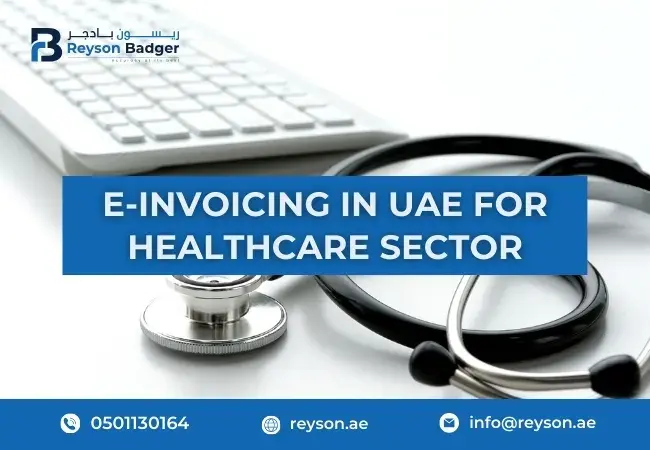
E invoicing in UAE for Healthcare
E invoicing in UAE for healthcare means your invoices are created, sent, and stored in a structured electronic format so they can be read by tax and regulatory systems without manual intervention. If your invoices stay in scattered PDFs or paper, you’ll struggle to meet future UAE e invoicing rules and you risk gaps during reviews.
For hospitals, clinics, and pharmacies, Healthcare e-invoicing UAE links your billing, insurance, and VAT treatment into one traceable trail, so you can show exactly who you charged, for what service or medicine, and at which tax rate whenever authorities or insurers ask.
Why E-Invoicing Is Critical for Healthcare Providers?
Healthcare billing is far more complex than standard invoicing. Providers deal with insurance companies, patients, suppliers, and regulatory authorities simultaneously. Even small billing errors can lead to claim rejections, payment delays, or compliance risks.
UAE e-invoicing helps healthcare organisations:
- Reduce billing errors and eliminate duplicate invoices
- Improve audit readiness and financial traceability
- Ensure compliance with VAT and future clearance requirements
- Streamline invoicing between insurers, patients, and suppliers
By moving to automated and structured invoicing systems with the right Healthcare e-invoicing UAE setup, you cut manual data entry, reduce disputes, and avoid last-minute reconciliations before audits.
Who Must Comply with E-Invoicing in UAE Healthcare?
E-invoicing will apply across the entire healthcare value chain. This includes:
- Hospitals and multi-specialty clinics
- Medical centres and diagnostic laboratories
- Pharmacies and pharmaceutical distributors
- Healthcare supply and medical equipment providers
Early adoption is important because the transition to e-invoicing will be phased. If you wait until the last phase, you’ll end up rushing system changes, staff training, and data migration at the same time, which usually leads to billing disruption and avoidable penalties. Businesses that prepare in advance can avoid operational disruptions and compliance risks.
E-Invoicing Requirements for Healthcare Businesses
Healthcare entities must ensure their invoicing systems meet specific technical and regulatory requirements.
- Structured Invoice Format: Invoices must follow standardized digital formats containing mandatory fields such as supplier details, patient or insurer information, VAT treatment, and service descriptions. If key data is missing or stored only in free-text notes, you’ll face disputes and time-consuming clarifications.
- Accurate VAT Treatment: Healthcare services may be taxable, zero-rated, or exempt depending on the nature of the service. E-invoicing systems must correctly categorize transactions to ensure accurate tax reporting.
- Secure Data Storage and Audit Trails: Healthcare invoicing data must be securely stored with full audit trails to ensure traceability and regulatory compliance.
- Integration with Existing Systems: E-invoicing solutions must integrate with hospital information systems (HIS), ERP platforms, and billing systems to ensure smooth workflow without disrupting patient services.
Compliance therefore requires both technology readiness and internal process alignment.
How E-Invoicing Works Across Healthcare Businesses in UAE
E-invoicing in UAE for healthcare works by connecting your billing, patient, and insurance data into a single digital invoice flow that can be tracked from service to payment. If each department runs its own spreadsheets and manual templates, you’ll see mismatches between what was treated, what was billed, and what insurers agree to pay.
E-invoicing for hospitals in UAE
E-invoicing for hospitals in UAE ties together in-patient, out-patient, surgery, pharmacy, and diagnostics billing with insurer approvals. Without a structured E-invoicing Services layer, hospitals often face claim rejections because invoice line items don’t match approvals or coding rules, which blocks cash flow and strains finance teams.
E-invoicing for clinics in UAE
E-invoicing for clinics in UAE focuses on quick out-patient visits, repeat consultations, and smaller procedure bills. If your clinic still prints invoices from basic software, you’ll spend more time fixing VAT errors and re-issuing invoices than treating patients, especially once insurers and authorities expect structured data.
E-invoicing for pharmacies UAE
E-invoicing for pharmacies UAE must handle high-volume retail sales, prescription medicines, OTC products, and frequent returns. Where pharmacies don’t have proper UAE e invoicing setups, price controls, discounts, and batch details are often recorded inconsistently, which creates reconciliation headaches with suppliers and tax reporting.
| Healthcare Business Type | Main E-Invoicing Use Case | Risk if not addressed |
|---|---|---|
| Hospitals | High-value in-patient and surgery invoices linked to insurers | Delayed settlements, cash-flow gaps, and disputes with payers |
| Clinics / Medical centres | Fast-turnover outpatient billing and repeat visits | Manual errors, wrong VAT codes, and write-offs on small bills |
| Pharmacies | Retail medicine sales, prescription billing, and returns | Stock mismatches, wrong pricing, and VAT reporting issues |
Pre-Implementation Checklist for Healthcare E-Invoicing in UAE
Before you start a Healthcare e-invoicing UAE project, you need a clear view of your current records and systems so you don’t discover gaps halfway through integration. If this groundwork is skipped, you’ll hit delays, extra costs, and frustrated teams.
- Updated customer, patient, and insurer master data (names, TRNs where relevant, contacts)
- Supplier and distributor records with correct VAT registration details
- List of existing billing, HIS, ERP, and pharmacy systems in use
- Current invoice templates and credit note formats
- Internal VAT mapping for services, packages, and medicines
- Documented approval flows for high-value or insured invoices
We help you review these items at the start so your UAE e invoicing rollout doesn’t stall when technical teams ask for data that doesn’t exist or isn’t clean.
Step-by-Step E-Invoicing Implementation Process for Healthcare Providers
A clear implementation approach helps your business adopt e-invoicing without stopping billing or delaying patient services. If you jump straight into software purchase without a plan, you’ll often pay for features you don’t use and still miss key compliance points.
- Readiness assessment: We review your existing invoicing, VAT treatment, and systems to spot gaps that could trigger future issues.
- Design of the e-invoicing model: We map how invoices should flow between your HIS, ERP, pharmacy, and insurance systems.
- System selection and configuration: We help you choose suitable E-invoicing Services and configure them around your healthcare workflows.
- Data cleansing and migration: We clean and align your master data so invoices don’t fail because of basic errors.
- Testing with sample invoices: We run test scenarios so you can see how UAE e invoicing will work before going live.
- Staff training and go-live: We train your finance, billing, and front-office teams so they know exactly what to do on day one.
- Post go-live review: We monitor early invoices and fix issues quickly so they don’t become systemic problems.
E-invoicing Services in UAE for Healthcare Businesses
Healthcare providers often need expert support to transition smoothly to e-invoicing systems. Our dedicated E-invoicing Services in UAE for healthcare are designed so your team doesn't have to guess how to interpret requirements or redesign billing alone.
Services typically include:
- E-invoicing readiness assessment
- System selection and integration support
- Data validation and compliance checks
- Staff training and implementation guidance
- Ongoing compliance monitoring and support
Professional implementation ensures healthcare organisations can adopt e-invoicing without disrupting patient care or billing cycles. You keep your focus on treating patients, while we handle the technical and regulatory side of UAE e invoicing.
Benefits of Professional UAE E-Invoicing Support
With expert guidance, healthcare providers can:
- Minimise compliance risks and penalties
- Improve operational efficiency and billing accuracy
- Stay aligned with evolving UAE tax regulations
- Focus on core healthcare delivery and patient care
Working with a specialist on Healthcare e-invoicing UAE means you’re not experimenting on live patient invoices; you’re following a tested approach that reduces errors, protects revenue, and keeps you ready for future FTA-driven changes.
Common E-Invoicing Challenges in Healthcare
Healthcare providers often struggle with e-invoicing because clinical, finance, and IT teams don’t always speak the same language. If these gaps aren’t addressed, your UAE e invoicing project can drag on for months and still leave critical risks open.
- Multiple systems that don’t talk to each other (HIS, ERP, pharmacy, insurance portals)
- Unclear VAT mapping for mixed supplies (consultations, diagnostics, medicines)
- Incomplete master data for insurers, suppliers, and referring doctors
- Staff resistance to new billing screens or approval steps
- Limited internal bandwidth to manage vendors and testing
Our E-invoicing Services help you address these issues up front so you don’t learn about them only after invoices start failing or insurers push back.
How to Choose E-Invoicing Software or Service Support in UAE?
Choosing the right partner for Healthcare e-invoicing UAE is important because the wrong choice locks you into tools that don’t fit your workflows. If you pick based only on price or generic features, you may still need heavy customisation later.
- Check that the provider understands healthcare billing, not just generic invoicing.
- Confirm integration options with your HIS, ERP, and pharmacy systems.
- Ask how VAT scenarios specific to healthcare will be handled and tested.
- Review how data will be secured and retained for audits.
- Look for clear training and post go-live support, not just initial setup.
At Reyson Badger, we specialise in E-invoicing Services in UAE with a clear focus on healthcare businesses so you get a partner who understands your billing complexity, not just a software vendor who hands you a manual and walks away. We help you evaluate your options, design an e-invoicing approach that fits your existing systems, and stay with you through implementation, testing, and post go-live support so your team is never left figuring things out alone.
Why Choose Us?
E-invoicing in UAE for healthcare is becoming a critical requirement for hospitals, clinics, pharmacies, and medical suppliers. Preparing early helps organisations avoid compliance risks, reduce billing errors, and improve operational efficiency.
With the right planning and expert support, healthcare providers can transition smoothly to digital invoicing and remain fully compliant with future regulations. Businesses often work with experienced partners such as Reyson Badger to implement secure, compliant, and future-ready e-invoicing systems while continuing to focus on quality patient care.
FAQs
1. Do small clinics also need to prepare for e-invoicing?
Yes, if your clinic is VAT-registered and issues tax invoices, you should plan for UAE e invoicing, otherwise you may have to change systems at short notice.
2. Can we use our existing accounting software?
In many cases you can, but only if it can generate structured electronic invoices and connect to your other healthcare systems; if it can’t, your staff will end up doing manual workarounds.
3. How long does an e-invoicing project usually take?
Timeframes vary by size and complexity, but hospitals and larger groups should plan several months so testing isn’t rushed and billing doesn’t stop.
If you’d like specific guidance for your hospital, clinic, or pharmacy, our team can walk you through what Healthcare e-invoicing UAE would look like for your setup.
E-Invoice
Related Blogs
UAE E-Invoicing Timeline & Deadline
28-Jan-2026
E-Invoicing Solutions For Financial Institutions
28-Jan-2026Request a Quote
We’ll get back to you shortlyFAQs
E-Invoicing in UAE for Healthcare refers to the digital generation, exchange, and storage of invoices for medical services in a structured format such as XML. This ensures accurate billing, compliance with Federal Tax Authority (FTA) regulations, and seamless integration with hospital and insurance systems.
Yes, under the upcoming mandate, healthcare providers must adopt E-Invoicing for Healthcare in UAE for B2B and B2G transactions. The rollout begins in 2026 with full compliance required in phases from 2027.
Insurance companies are a critical part of E-Invoicing in UAE for Healthcare, as invoices often involve third-party payers. The system ensures accurate alignment between patient billing, insurer approvals, and financial records.
Latest Blogs
29
Sep
How Non-Residents Can Open a Bank Account in the UAE
Understand the key requirements for non-residents seeking to open and manage a bank account in the UAE
READ MORE →
29
Sep
How UAE Trading Companies Can Prepare for E-Invoicing: A Guide for Importers & Exporters
This guide explains what UAE importers and exporters should know about e-invoicing and the practical steps trading businesses can take to prepare.
READ MORE →
25
Sep
How to Choose an Auditor in Dubai: What to Check Before You Hire
A practical guide to choosing the right auditor in Dubai, what to check, questions to ask and red flags to avoid.
READ MORE →
24
Sep
Step-by-Step Guide to Getting a Commercial Brokerage Licence in the UAE
A practical guide to setting up a commercial brokerage business and obtaining the required UAE licence
READ MORE →
22
Sep
Disciplined Accounting: The Most Effective Approach for Long-Term Business Success
Accounting Services in Dubai can provide growing Dubai businesses with structured bookkeeping, reporting and financial support.
READ MORE →
22
Sep
Excise Tax vs VAT in the UAE: What Dubai Businesses Need to Know
Understand the key differences between Excise Tax and VAT in the UAE, including applicability, rates, registration, compliance, and what Dubai businesses need to know.
READ MORE →
22
Sep
Common Mistakes Businesses Make Before Their Annual Audit in Dubai
A practical guide to the 8 most common annual audit preparation mistakes Dubai businesses make, and how proper preparation and the right auditors can make your next annual audit faster and stress-free.
READ MORE →
16
Sep
How to Calculate VAT in UAE 2026: Complete Guide
Learn how to calculate VAT in the UAE in 2026, including VAT formulas, taxable amounts, input VAT, output VAT, and practical calculation examples.
READ MORE →
15
Sep
How to Choose an Accredited Service Provider for UAE E-Invoicing?
An e-invoicing service provider helps businesses create, process, transmit and manage electronic invoices through systems designed to support the applicable e-invoicing framework.
READ MORE →
16
Sep
How to Get a UAE Residence Visa: Step-by-Step Guide
Learn how to apply for a UAE residence visa, including visa types, eligibility, required documents, application steps, costs, and common mistakes to avoid
READ MORE →