
VAT Registration Services in Sharjah
Expert VAT Registration Services in Sharjah
Fast processing, accurate documentation, and
complete compliance for growing businesses.
VAT Registration Services in Sharjah
If you need VAT Registration Services in Sharjah, we can help you prepare the application, review your documents, and submit the details correctly so you don't risk delays, rejection, or FTA penalties. Businesses running in Sharjah need to check in for VAT if they meet certain standards based on their annual turnover. VAT registration is obligatory for agencies that meet positive income thresholds and also voluntary for small businesses. Many companies choose professional VAT services in Sharjah to simplify the process and ensure accuracy. If you’re working for an enterprise in Sharjah, VAT registration is a vital step because missing the threshold or filing the wrong details can cost your business time and money.
What is VAT in Sharjah?
VAT in Sharjah is a 5% tax charged on most taxable goods and services, and if your business crosses the registration threshold, you must register or you risk penalties and backdated tax exposure.
For most business owners, the real issue isn't the definition. It's whether your sales, imports, and taxable supplies mean you should already be registered, whether you can claim input tax credits, and whether your paperwork will hold up if the FTA asks questions later. That's where we step in.
VAT Regulations in Sharjah
VAT regulations in Sharjah follow the UAE VAT rules administered by the Federal Tax Authority, so if your registration data, returns, or records are wrong, your business can face fines, blocked refunds, or audit issues.
We review your turnover, taxable supplies, imports, and supporting records before submission so you don't file based on guesswork. Where relevant, your registration should also align with the FTA rules set under Federal Decree-Law No. 8 of 2017 on Value Added Tax.
Why VAT Registration is Crucial for Businesses
VAT registration is crucial because if you should be registered and you aren't, you can be fined, lose the right to issue proper tax invoices, and create problems with customers, suppliers, and future audits.
- Input tax credits: If your business is registered and your records are in order, you may recover VAT on eligible purchases instead of absorbing that cost.
- Commercial credibility: Many customers and counterparties expect a valid TRN, and if you can't provide it, deals can stall.
- Cash flow control: Proper VAT handling helps you avoid unexpected tax bills that hit your margins later.
- Audit readiness: Good registration records make VAT audits less painful and reduce the chance of disputes over your filing position.
VAT Registration for New Companies in Sharjah
New companies in Sharjah can register for VAT if their figures meet the required threshold or if voluntary registration makes commercial sense, and it's best to get this right early so your start-up doesn't fix errors after trading starts.
For start-ups and new companies, the FTA may ask for clear records that show the business is real and active. That can include projected revenue, contracts, invoices, bank statements, proof of business premises, and identification documents for owners or managers. If these don't match the application, approval can slow down or the file can come back for clarification.
We help you assess whether voluntary registration is worth it, especially if your business wants to recover input tax credits on eligible costs and present a VAT-registered profile to customers from the start.
VAT Registration
VAT registration is mandatory or voluntary depending on your business’s revenue. Registration for VAT ensures compliance with UAE tax laws, allows businesses to collect and remit VAT, and enables them to claim VAT on eligible purchases. Here are the two types of VAT registration services in Sharjah
Mandatory VAT Registration in Sharjah: Mandatory VAT registration is needed in Sharjah for businesses with annual sales exceeding AED 375,000. If your business falls into this category it should register with the Federal Tax Authority (FTA) to conform with UAE tax legal guidelines. This registration lets you accumulate VAT from your clients at 5% on most goods and services and you can also reclaim VAT paid in your business purchases. Failure to register when required can lead to penalties, so whilst your enterprise reaches turnover thresholds it is critical to make certain it is well registered.
Voluntary VAT Registration in Sharjah: Voluntary VAT registration in Sharjah is a choice for corporations with annual income between AED 187,500 and AED 375,000. If your business falls within this range, you could select to register for VAT although it’s no longer mandatory. By doing so, you may gather VAT from your clients and reclaim the VAT you’ve paid on your business charges. This can enhance your cash glide and reduce expenses. Additionally, being VAT-registered complements your enterprise’s credibility and permits you to attract larger customers or contracts that choose to paint with VAT-registered suppliers. Voluntary registration is a clever move if you anticipate a boom or need to set up a professional image in the market.
The main difference between these two types is that registration based on rules is mandatory, whereas mandatory voluntary registration allows companies to elect or claim certain benefits to deal with taxes.
Benefits of VAT Registration Services in Sharjah
- Legal Compliance: Registering guarantees that your enterprise complies with UAE tax regulations and avoids fines or consequences for non-compliance.
- VAT Recovery: Registered organizations can get better the VAT paid on eligible business charges (enter VAT), reducing operational charges.
- Business Credibility: VAT registration services signal economic transparency and complement the trustworthiness of your enterprise, making it more appealing to customers, providers, and investors.
- Access to New Opportunities: VAT-registered groups are often preferred by using large organizations and government corporations, which can result in more contracts and partnerships.
Who Needs to Register for VAT in Sharjah?
1. Mandatory Registration:
Businesses with Annual Turnover Exceeding AED 375,000: If your enterprise’s taxable elements and imports exceed AED 375,000 in a year, you're required to check in for VAT with the Federal Tax Authority (FTA).
2. Voluntary Registration:
Businesses with Annual Turnover Between AED 187,500 and AED 375,000: If your taxable components and imports are between AED 187,500 and AED 375,000, you can opt for voluntary VAT registration. This allows you to reclaim VAT on business purchases and gather VAT from your clients.
3. Exemptions:
Businesses in Certain Sectors: Some sectors, which include healthcare, training, and residential actual property, can be exempt from VAT or have zero-rated supplies. Businesses that simplest deal in exempt materials do not need to register for VAT.
4. Foreign Businesses:
Foreign Companies Providing Goods or Services: If a foreign employer affords items or offerings inside the UAE and meets the turnover thresholds, it's also required to check in for VAT.
How to Calculate VAT Turnover for Registration in Sharjah
When identifying whether or no longer your industrial enterprise desires to register for VAT in Sharjah, you ought to calculate your annual taxable turnover. This calculation helps identify if your turnover exceeds the required registration threshold of AED 375,000 or falls within the voluntary registration range of AED 187,500 to AED 375,000. Here’s a manner to calculate your VAT turnover for registration:
Identify Taxable Supplies
- Taxable Supplies: These are goods and offerings that might be subject to VAT at the usual rate of 5%. This consists of income from products, offerings furnished, and some other transactions where VAT is relevant.
- Exempt Supplies: These are goods and services that aren't subject to VAT, consisting of positive healthcare and academic offerings. These need not be included in the turnover calculation.
Include All Relevant Income
- Total Revenue: Calculate the total revenue from all taxable supplies, including sales of goods and services, deemed supplies, and imports.
- Exclusions: Do not include exempt supplies or any non-taxable income in your calculation.
Calculate Annual Turnover
To calculate your annual taxable turnover, follow these steps:
1. Sum Up Sales: Add up all your taxable sales for the past 12 months. This includes:
- Sales of goods.
- Sales of taxable services.
- Income from deemed supplies.
- Income from imports is subject to VAT.
Formula: TOTAL TAXABLE TURNOVER = SALES OF GOODS + SALES OF SERVICES + INCOME FROM DEEMED SUPPLIES + VAT APPLICABLE IMPORTS
2. Assess Your Position:
- If your total taxable turnover is above AED 375,000, you must register for VAT.
- If it is between AED 187,500 and AED 375,000, you can choose to register voluntarily.
- If it is below AED 187,500, you are not required to register.
3. Regular Monitoring
Annual Review: Regularly monitor your taxable turnover to ensure compliance. If your turnover approaches the registration threshold, be prepared to apply for VAT registration in Sharjah.
Example Calculation:
- Sales of Goods: AED 250,000
- Sales of Services: AED 120,000
- Income from Deemed Supplies: AED 30,000
- VAT-Applicable Imports: AED 10,000
Total Taxable Turnover: 250,000 + 120,000 + 30,000 + 10,000 = AED 410,000
In this example, since the total taxable turnover is AED 410,000, the business must register for VAT.
VAT Declaration Letter
1. Business Details:
- Business Name: Clearly state the name of your company.
- Address: Provide the full address of the business.
- Tax Registration Number (TRN): Include the unique tax registration number assigned by the Federal Tax Authority (FTA).
2. VAT Registration Status:
- Confirm whether the business is registered for VAT or not. If registered, specify this status.
3. VAT Registration Number:
- Mention the VAT registration number issued by the FTA.
4. Effective Date of Registration:
- Indicate the date from which the business is required to charge VAT on taxable goods and services.
5. VAT Obligations:
Outline the obligations of the business under VAT regulations, which include:
- Filing VAT returns (usually quarterly or monthly).
- Paying VAT amounts due to the FTA.
- Maintaining proper VAT records for a minimum period, as required by UAE law.
6. VAT Exemption:
- State whether the business is exempt from VAT or not. If the business is exempt, explain the nature of the exemption.
7. Signature and Stamp:
- Provide the authorized signature of the person responsible for VAT compliance within the business.
- Affix the business stamp to authenticate the document.
This structured VAT declaration letter is submitted to the Federal Tax Authority to ensure compliance and to declare VAT-related details accurately.
Required Documents for VAT Registration in Sharjah
When applying for VAT registration in Sharjah, businesses must provide the Federal Tax Authority (FTA) with the necessary documents. These documents are essential to prove the legitimacy, financial standing, and eligibility of the business for VAT purposes. If your file is incomplete or inconsistent, the application can be delayed and your business can miss key trading deadlines. Below is the list of documents required for VAT registration specifically in Sharjah:
- 1. Trade License: A copy of the valid Trade License issued by the Sharjah Economic Department. This document confirms that the business is legally allowed to operate in Sharjah.
- 2. Emirates ID and Passport Copy: Copies of the Emirates ID and Passport for the business owner(s) and all partners involved, proving their identity and authority to register the business for VAT. This may also extend to relevant managers or authorised signatories where needed.
- 3. Financial Statements: Audited or non-audited financial statements showing the business's financial performance for the past 12 months. These help determine if the business meets the VAT registration threshold.
- 4. Bank Account Details: The bank account details of the business, including the IBAN, where VAT-related transactions will be managed. Recent bank statements may also help support the commercial activity shown in the application.
- 5. VAT Registration Form: The official VAT Registration Form is completed as part of the application process. This is the form businesses submit to request inclusion in the VAT system.
- 6. Proof of Business Activities: Detailed documentation or reports explaining the business activities, such as contracts, invoices, and business descriptions. This ensures that the business is involved in VAT-applicable activities.
- 7. Customs Registration Number (if applicable): For businesses involved in importing or exporting goods, provide the customs registration number from Sharjah Customs to demonstrate that the business handles cross-border transactions.
- 8. Self-Prepared Calculation Sheet (for Taxable Supplies): A self-prepared calculation sheet based on financial records, detailing taxable and zero-rated supplies.
- 9. Revenue Forecast: A revenue forecast supported by documents such as local purchase orders or contracts, to provide an estimate of the taxable supplies over the next 12 months.
- 10. Monthly Turnover Declaration: A turnover declaration, signed and stamped by an authorized signatory, which outlines the monthly turnover. This must be on the company's official letterhead.
- 11. Supporting Financial Documents: Additional financial documents such as invoices, contracts, tenancy agreements, or title deeds to further substantiate the financial standing of the business. These records can also work as proof of business premises where the authority asks you to show that the company is operating from a real location.
For Taxable Expenses:
- 12. Expense Budget Report: A detailed budget report showing the expenses the business expects to incur, providing clarity on VAT-related costs. This can matter if your business wants to support a voluntary registration position and future input tax recovery.
Additional Documents (if applicable):
- 13. Articles of Association/Partnership Agreement: If the business is a partnership or company, provide the Articles of Association or Partnership Agreement to explain the ownership structure.
- 14. Certificate of Incorporation: For incorporated businesses, provide the Certificate of Incorporation.
- 15. Ownership Information: Ownership documents outlining the shareholders or partners involved in the business.
- 16. Power of Attorney: If someone is acting on behalf of the business owner(s), include the Power of Attorney document.
- 17. Charity or Association Documents (if applicable): For non-profit organizations or associations, provide registration documents and copies of any government decrees.
Supporting Forms for Application:
- Turnover Declaration Template for Taxable Supplies: A document detailing the turnover from taxable activities.
- Turnover Declaration Template for Taxable Expenses: A document outlining the business's VAT-related expenses.
- Turnover Declaration Letter Form: A letter confirming the business's financial standing, signed by an authorized representative.
Step-by-Step Process for VAT Registration in Sharjah, UAE
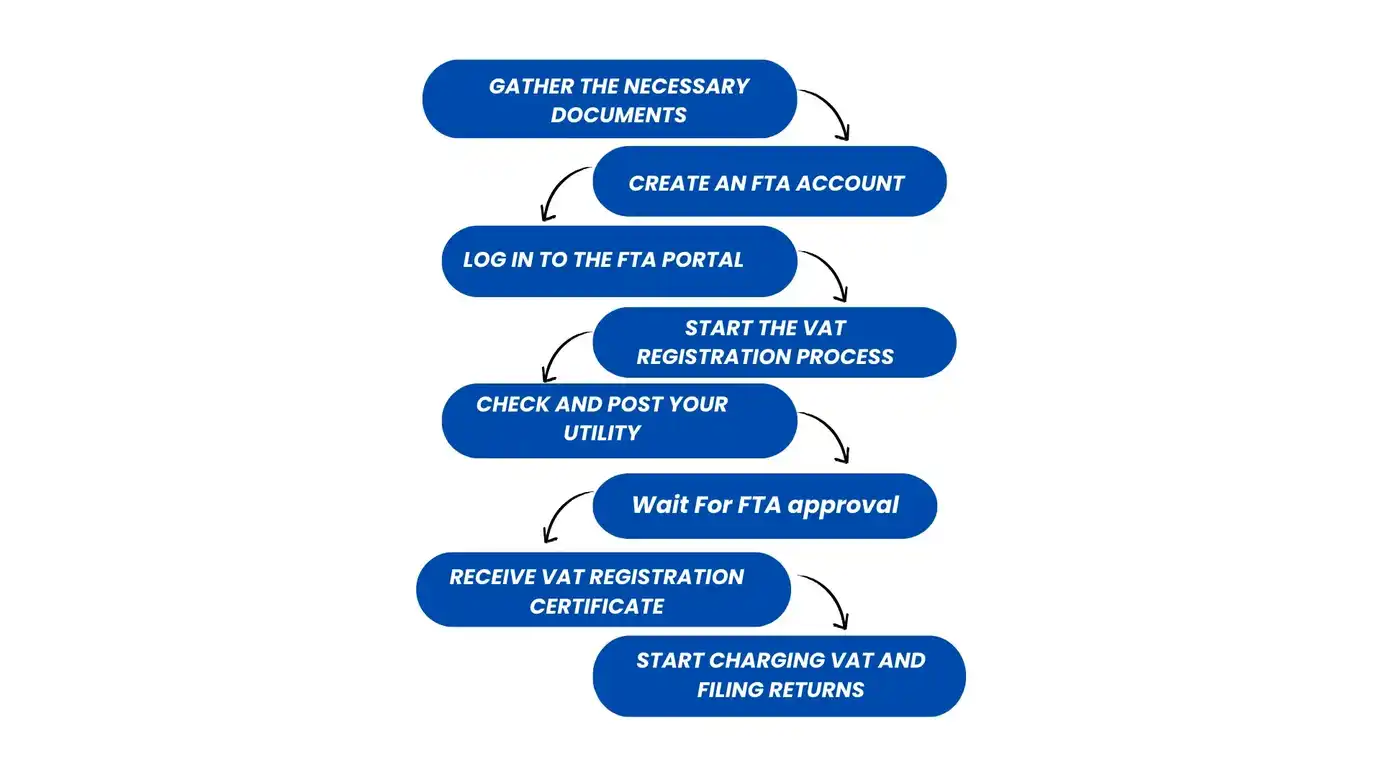
VAT registration in Sharjah, UAE, is a crucial step for businesses that meet the eligibility standards under the Federal Tax Authority (FTA). If the form is filed with missing figures or weak documents, your application can stall and your business can lose time it can't afford. The method is easy and can be carried out online. Below is a step-by-step manual to help you complete your VAT registration in Sharjah.
Step 1: Gather the necessary documents
Before you start your registration, make sure you have all the necessary files ready, including:
- Trade license copy
- Emirates ID and passport copies of business owner(s) and partners
- Financial statements (last 12 months)
- Bank account record (IBAN).
- Customs Registration number (if applicable)
- Evidence of business activities(contracts, invoices, etc)
- Proof of business premises
- Recent bank statements where needed to support business activity
- Details of owners, partners, or managers who are authorised to act for the business
- Other supporting files as needed(e.g. Articles of association, letter of support)
Step 2: create an FTA account
To apply for VAT registration you need to create an account on the Federal Tax Authority (FTA) portal:
- Check out the FTA e-service portal
- Click on sign up to create a new account
- Fill out the necessary information, such as your e-mail address, and create a username and password.
- Confirm your registration via the link sent to your email
Step 3: Log in to the FTA Portal
Once your account is created, log in to the FTA e-services portal using your credentials.
Step 4: Start the VAT registration process
- Once logged in, go to the VAT registration section
- Click on register for VAT to start the application process
- Fill in the VAT registration form with the following details:
- Business details: Name, trade license number, and contact information
- Bank details: IBAN and bank account details.
- Business Activity: Provide details of business activity (e.g. taxable goods/services).
- Financial Information: Provide annual sales, taxable items, and imports/exports (if applicable).
- Customs Registration Number (if applicable).
- Supporting Documents: Upload necessary documents such as financial statements, contracts, Emirates ID, and passport photos.
Step 5: Check and post your utility
- Check all the information provided in the application carefully.
- Make sure all mandatory fields are finished and all required documentation is attached.
- Once you're satisfied with the information, submit the VAT registration application.
Step 6: Wait for FTA approval
Once you've submitted your application, the FTA will evaluate your VAT registration request. This manner can take several days, depending on the way you complete your utility.
- You will receive an e-mail confirming your application.
- FTA will contact you if additional statistics or documentation is needed.
TRN Issuance
TRN issuance happens after the registration is approved, and if your documents don't match the activity or turnover stated in the application, you can face extra queries before the number is issued.
We review your file before submission so you're less likely to lose time answering avoidable questions from the FTA.
Step 7: Receive VAT Registration Certificate
Once your VAT registration is accepted, the FTA will issue you a VAT Registration Certificate. The certificate will include:
- Tax Registration Number (TRN): A unique number assigned to your business.
- Effective Date of Registration: The date from which you are required to price VAT on your goods and services.
Step 8: Start Charging VAT and Filing Returns
Once registered, you should follow UAE VAT legal guidelines, including:
- Charging VAT on taxable goods and services at the standard 5% rate.
- Filing VAT returns (quarterly or monthly, depending on your business) through the FTA portal.
- Paying any VAT because of the FTA by the required deadlines.
VAT Return Submission
VAT return submission starts after registration, and if you file late or report the wrong figures, your business can face fines and a bigger problem during VAT audits.
We don't just help with registration. We can also help you keep records ready, track return deadlines, and reduce the risk of mistakes after your TRN is active.
Our VAT Registration Services in Sharjah
Our VAT Registration Services in Sharjah cover the filing work that causes delays, errors, and follow-up notices if it's done without proper review.
- Reviewing whether your business should register on a mandatory or voluntary basis.
- Checking turnover figures, taxable supplies, imports, and supporting records before submission.
- Preparing the registration file and helping you organise documents for the FTA portal.
- Assisting with clarifications if the authority asks for more information.
- Helping you understand what happens after approval so you don't get caught out on returns and recordkeeping.
If you're unsure whether your file is ready, we can review it before submission and help you avoid a preventable rejection.
How to Choose VAT Registration Companies in Sharjah
VAT Registration Companies in Sharjah should help you file correctly, not just send you a checklist and leave you to deal with the risk.
- Check file review depth: If a provider doesn't review your turnover logic and documents, you may end up submitting weak information.
- Check post-registration help: Registration is only the start, and if nobody explains returns or recordkeeping, problems show up later.
- Check communication: If you can't get clear answers before filing, you'll likely face the same issue when the FTA asks for clarification.
- Check relevance: Work with a team that understands Sharjah business activity and the practical issues around VAT registration.
We're focused on helping you get the application right the first time so your business doesn't lose time fixing avoidable errors.
Related VAT Services
Related VAT services matter because registration is only one part of the work, and if the next step is missed, your business can still face fines or refund issues.
- VAT compliance: We help you keep records and filings in order so you don't create problems after registration.
- VAT return filing: We help you prepare and submit returns so missed deadlines don't turn into penalties.
- VAT audits: We help you get records ready if your filings are reviewed and you need to explain figures clearly.
- VAT advisory: We help you understand the effect of VAT on transactions before mistakes hit your margins.
- VAT deregistration: We help you assess whether deregistration is required so you don't keep an inactive file open or make the wrong exit.
- Tax agent services: If your case needs authorised representation, we can guide you on the next steps and documentation.
VAT Registration Guide for Non-Residents in Sharjah
Non-residents can register for VAT in Sharjah under specific conditions. Below is a detailed explanation of the process and requirements for VAT registration for non-residents in Sharjah:
Eligibility
Non-residents are required to register for VAT in Sharjah if they meet the following criteria:
- They have a business or economic activity in Sharjah that involves taxable supplies.
- They do not have a place of residence or fixed establishment in the UAE.
Requirements for Non-Resident VAT Registration in Sharjah
- Tax Agent: Non-resident businesses must appoint a Tax Representative (A UAE resident approved by the FTA) to act on their behalf regarding VAT matters in the UAE.
- Tax Identification Number (TIN): Non-resident businesses need to collect a Tax Identification Number (TIN) from the FTA in Sharjah through their appointed tax agent.
- VAT Registration Application: The non-resident business needs to submit a VAT registration application to the FTA via the tax agent. This application has to include important files proving the business’s activities in Sharjah and the appointment of the tax agent.
Procedures for Non-Resident VAT Registration
Appointment of Tax Agent:
- The non-resident business appoints a tax agent who will manage all VAT-related duties, which include registration, submitting VAT returns, and ongoing compliance with the FTA.
TIN Application:
- The tax agent applies for a Tax Identification Number (TIN) for the non-resident industrial organization from the FTA in Sharjah.
VAT Registration Application:
- The tax agent submits the VAT registration application to the FTA on behalf of the non-resident business. The utility includes:
- Proof of business activities in Sharjah.
- The appointment letter of the tax agent.
- Other supporting documents are required by the FTA.
Verification and Approval Process
- Once the VAT registration application is submitted, the FTA in Sharjah will verify the provided information. The FTA may conduct further checks if necessary.
- If all requirements are met, the FTA approves the VAT registration for the non-resident business.
Ongoing Compliance After Registration
After VAT registration, non-resident businesses must observe all VAT laws in Sharjah, including
- Filing VAT Returns: File the VAT return with the FTA as per the specified deadlines, typically quarterly.
- VAT expenses: Ensure timely payment of VAT dues to the FTA to avoid penalties.
- Records Maintenance: Keep accurate and complete records of all VAT-related transactions, invoices, and different supporting files.
- VAT duties: The appointed tax agent will assist the non-resident business in fulfilling all VAT obligations, which include filing returns and paying VAT dues.
How to Stay Compliant After VAT Registration in Sharjah
To remain compliant after VAT registration, non-resident businesses have to:
Charge VAT: Apply VAT at the ideal price (5% or 0% for responsibility-loose items) on all taxable goods and services.
To problem a VAT-compliant invoice: Ensure VAT invoices include:
- Tax Register Number (TRN).
- Amount of VAT.
- Other important information along with dates and delivery info.
- File VAT returns on time: File VAT returns via the FTA portal before the required deadline.
- Pay VAT dues promptly: Pay VAT dues on time to avoid penalties.
- Maintain VAT records: keep detailed records of all VAT transactions inclusive of invoices, receipts, and payments.
- Display the TRN: Include the TRN with all invoices, receipts, and different business files.
- Update the accounting machine: Ensure that the business’s accounting software is VAT compliant.
- Train employees: Educate employees about VAT rules and make sure they observe accurate VAT procedures.
- Follow FTA regulations: Keep updated with FTA guidelines and make sure you comply with all VAT-associated guidelines.
Non-residents conducting taxable business activities in Sharjah are required to register for VAT, appoint a tax agent, and comply with the ongoing VAT obligations. Following the proper registration steps and ensuring VAT compliance is critical for non-resident businesses operating in Sharjah.
VAT Group Registration in Sharjah
VAT Group Registration is a process that allows multiple businesses in Sharjah to register as a single entity for VAT purposes. This simplifies VAT compliance and reduces administrative burdens for related businesses operating within the UAE.
Conditions for VAT Group Registration
To sign up as a VAT group in Sharjah, the following criteria must be met:
- Related Businesses: The businesses ought to be linked, such as:
- Parent and subsidiary companies under common control or management.
- Parent and subsidiary companies under common control or management.
- Residency: All businesses in the VAT group must be residents of the UAE.
- Turnover Requirement: The combined annual turnover of the businesses meets or exceeds AED 375,000.
VAT Group Registration Process in Sharjah
The steps to register as a VAT group include:
- Identify Group Members: Determine which businesses might be part of the VAT group and clarify their relationships.
- Appoint a Representative: One business, known as the representative member, is chosen to deal with all VAT-related matters on behalf of the group.
- Submit VAT Group Registration Application: The representative member submits the VAT group registration application via the EmaraTax platform.
- Required Documents:
- Business registration certificate.
- Trade licenses.
- Proof of enterprise address.
- Bank account information.
- FTA Approval: The Federal Tax Authority (FTA) reviews the application, and once approved, the businesses are registered as VAT groups.
Benefits of VAT Group Registration
- Simplified VAT Compliance: VAT group registration reduces the complexity of handling VAT for multiple entities.
- Reduced Administrative Burden: All group members are treated as one entity, which means only a single VAT return is filed.
- Improved Cash Flow: VAT payments and refunds are streamlined, potentially enhancing cash flow management for the group.
Note that VAT group registration is a challenge to FTA approval, and extra documentation or information may be required. Consulting a tax expert or the FTA for further guidance is recommended.
VAT Registration Certificate in Sharjah
A VAT Registration Certificate is issued by the FTA in Sharjah, confirming a business’s registration for VAT. This certificate, also referred to as a VAT Registration Letter, contains the following details:
- Business name and address
- VAT Registration Number (VRN).
- Effective date of VAT registration.
- Business activity and registration type (e.g., vast, zero-rated, exempt).
- FTA's logo and signature.
Purpose of the VAT Registration Certificate
The VAT Registration Letter is typically issued within 10 running days after the FTA approves the VAT registration application. It is used for diverse purposes, which include:
- Opening a VAT account with a bank.
- Issuing VAT-compliant invoices.
- Claiming VAT refunds.
- Complying with VAT audits and inspections.
- Updating business records and licenses.
Businesses must safeguard their VAT Registration Certificate as it serves as evidence of VAT registration and is required for VAT-related transactions.
VAT Registration Number (TRN) in Sharjah
In Sharjah, the following terms are used interchangeably and refer to the same thing:
- VAT Number.
- TRN Number (Tax Registration Number).
- VAT Tax Number.
- VAT Identification Number.
- VAT Registration Number.
Format and Usage of the VAT Registration Number (TRN)
The TRN is a unique 15-digit range assigned to a business through the FTA after successful VAT registration. This number is essential for VAT-related activities and must appear on VAT invoices, returns, and other documents.
The TRN layout within the UAE is:
123456789012345
Where:
- The first 3 digits (123) represent the tax authority (FTA).
- The next nine digits (456789012) are the business's unique identifier.
- The remaining three digits (345) are check digits.
Businesses must show their TRN on all VAT-related files, such as invoices, receipts, and credit notes, to validate their VAT registration and follow UAE VAT guidelines.
This process ensures that businesses in Sharjah are compliant with VAT rules and simplifies VAT administration for related entities through group registration.
Timeframe for VAT Registration
The time required to process a VAT registration application in Sharjah, UAE, can vary depending on several factors. These include the accuracy and completeness of the application, the workload of the Federal Tax Authority (FTA), and whether additional information is required. Here's an outline of the VAT registration process and estimated timeframes:
1. Submission: You submit the VAT registration form along with all required files to the FTA, either directly or through a tax agent.
2. Review by FTA:
- The FTA will review the application to ensure that all the necessary information is provided and accurate.
- If the FTA requires additional facts, they may request clarification or supporting documents, including business activity details or financial records. This may also slightly postpone the approval process.
3. Approval:
- Once the FTA has all the required details and verifies the information, they will approve the VAT registration.
- After approval, the FTA will difficulty a Tax Registration Number (TRN), which is necessary for VAT-related transactions.
Generally, the method can take anywhere between 10 to 20 working days, depending on how well the application is ready and if any follow-up is needed.
VAT Registration Deadlines in Sharjah
Once a business exceeds the mandatory registration threshold of AED 375,000 in taxable supplies or imports, it must register for VAT within 30 days of exceeding the threshold. There will be severe penalties if you don't register by this deadline.
Some products and services in Sharjah are VAT-free, including:
- Healthcare Services: Hospital fees, physician fees, and medical treatments.
- Education Services: Tuition expenses, schools, universities, and associated services.
- Residential Real Estate: Except for commercial real estate, residential property sales and leases.
- Local Passenger Transport: Taxi services, bus fares, and metro expenses.
- Certain Food Items: Basic food staples like rice, bread, milk, and meat (excluding luxury or processed foods).
- Healthcare Goods: Medicines, clinical systems, and related products.
- Charitable Activities: Donations and charity work offerings.
- Religious Services: Services supplied by mosques, churches, and temples (excluding items like religious books).
- Government Services: Parking and municipal fees are included in public services.
- Financial Services: certain financial services (not including insurance and reinsurance), bank interest, and loans.
These VAT exemptions make it easier for companies to adhere to VAT regulations while assisting important industries by lowering the tax burden on necessities in Sharjah.
Consequences of Failing to Register for VAT in Sharjah
Not registering for VAT in Sharjah when you are required to can lead to several serious consequences, both financial and legal. Here are the potential penalties and issues businesses may face:
- Monetary Fines: Failure to register for VAT on time can result in financial penalties. The length of the delay and the seriousness of the non-compliance determine how much these fines are. The fines may increase with the length of time a business waits to register.
- Legal Repercussions: Businesses that fail to register for VAT when necessary may face legal action from Sharjah's Federal Tax Authority (FTA). This could include formal warnings, and in severe cases, legal proceedings, especially if the business continues operating without fulfilling its VAT obligations.
- Business Restrictions: Non-registration can restrict your ability to conduct certain business activities. For instance, a business that is not registered for VAT may be unable to:
- Issue tax invoices.
- Obtain government contracts.
- Participate in other key business activities where VAT registration is required.
- Tax Liability: Even if a business fails to register for VAT, it is still liable to pay taxes on taxable substances. Businesses who postpone VAT registration are still required to pay VAT. Additional penalties and interest on past-due taxes should result from this.
- Damage to Reputation: A company's reputation may suffer if VAT regulations are not followed. Partners, suppliers, and customers could be reluctant to collaborate with a company that is not following the law's tax rules, which could result in missed opportunities.
Penalties for Non-Registration under UAE VAT in Sharjah
Voluntary Disclosure:
- 5% of the tax payable if registration is completed within 30 days from the date of notification.
- 10% of the tax payable if registration is done between 31 to 60 days from the date of notification.
- 20% of the tax payable if registration is done after 60 days from the date of notification.
Mandatory Disclosure:
- 50% of the tax payable if the FTA notifies the taxpayer of their obligation to register.
Additional Penalties for Non-Compliance in Sharjah
- Failure to register: Failure to apply for mandatory registration within the specified time frame is subject to a fixed fine of AED 10,000.
- Failure to submit VAT returns on time is subject to a fixed fine of AED 1,000 (increasing to AED 2,000 for repetition).Failure to pay VAT due on time is subject to a mandatory, tiered penalty starting at 2% of the unpaid tax, followed by a 4% monthly penalty.
Other VAT-Related Offenses and Penalties
The FTA can impose further penalties for issues such as:
- Failure to maintain proper records.
- Failure to issue tax invoices.
- Failure to pay VAT due.
- Engaging in tax evasion or fraud.
Why Choose Reyson Badger for VAT Registration Services in Sharjah?
Choosing Reyson Badger in your VAT registration services in Sharjah means you have the advantage of professional guidance to meet the unique requirements of VAT compliance within the UAE. We're here to help you file correctly so you don't lose time on rejected submissions, missed thresholds, or avoidable FTA issues.
Here's why Reyson Badger is the excellent desire for your VAT registration services in Sharjah:
Expert Guidance: We offer professional advice to help you navigate the complex VAT guidelines in Sharjah, ensuring that each component of the registration procedure is handled with precision.
Document Preparation: We assist you in collecting and filing all the required documents, minimizing the chances of mistakes or omissions that could delay your registration.
Compliance Assurance: By working with us, you reduce the risk of wrong submissions, missed deadlines, and follow-up issues that can end in fines or extra scrutiny.
Personalized Solutions: We offer tailored guides based totally on your business's specific needs, making sure that you meet the VAT registration criteria and satisfy all necessary duties.
VAT registration in Sharjah requires accurate form submission and compliance with strict rules. Failing to check in or comply can bring about consequences. We're ready to help you avoid common registration errors and move forward with more confidence. Reyson Badger guarantees that your business is completely compliant, saving you time, attempt, and potential economic chance. You can rely on our knowledge to help you navigate the process smoothly and avoid frequent registration errors.
FAQs
Do I need VAT registration if my business is new?
You may need VAT registration even if your business is new, and if your expected taxable turnover supports registration, delaying the decision can slow invoicing and tax recovery.
Can start-ups apply for voluntary VAT registration in Sharjah?
Yes, start-ups can apply for voluntary VAT registration if they meet the relevant threshold, and it's often useful if your business wants to recover eligible VAT on costs and deal with larger clients early.
What documents usually delay a VAT registration application?
Missing turnover support, unclear business activity records, weak proof of business premises, and inconsistent bank statements are common reasons applications get delayed.
Why do businesses work with VAT Registration Firms in Sharjah?
Businesses work with VAT Registration Firms in Sharjah because filing errors can lead to delays, rejected applications, late registration exposure, and avoidable fines.
Can you help after the TRN is issued?
Yes, we can help after the TRN is issued, because if returns, invoices, and records aren't handled properly, registration alone won't protect your business from VAT problems.
FAQs
Latest Blogs

Disciplined Accounting: The Most Effective Approach for Long-Term Business Success
Accounting Services in Dubai can provide growing Dubai businesses with structured bookkeeping, reporting and financial support.
READ MORE →
Excise Tax vs VAT in the UAE: What Dubai Businesses Need to Know
Understand the key differences between Excise Tax and VAT in the UAE, including applicability, rates, registration, compliance, and what Dubai businesses need to know.
READ MORE →
Common Mistakes Businesses Make Before Their Annual Audit in Dubai
A practical guide to the 8 most common annual audit preparation mistakes Dubai businesses make, and how proper preparation and the right auditors can make your next annual audit faster and stress-free.
READ MORE →
How to Calculate VAT in UAE 2026: Complete Guide
Learn how to calculate VAT in the UAE in 2026, including VAT formulas, taxable amounts, input VAT, output VAT, and practical calculation examples.
READ MORE →
How to Choose an Accredited Service Provider for UAE E-Invoicing?
An e-invoicing service provider helps businesses create, process, transmit and manage electronic invoices through systems designed to support the applicable e-invoicing framework.
READ MORE →
How to Get a UAE Residence Visa: Step-by-Step Guide
Learn how to apply for a UAE residence visa, including visa types, eligibility, required documents, application steps, costs, and common mistakes to avoid
READ MORE →
Accounting Software in UAE: How to Choose the Right Accounting Software for Your Business
Professional Accounting Software Consultant in Dubai or Accounting Software Consultant in UAE services can help you compare suitable options and make a more informed decision.
READ MORE →
How to Register Copyright in the UAE: Requirements, Fees, and Timeline
A practical guide explaining how to register copyright in the UAE, covering requirements, fees, process, timeline, and key benefits for individuals and businesses.
READ MORE →
What Does an Audit Service in Dubai Actually Include? A Full Breakdown
Not sure what an audit actually covers? This guide breaks down the full audit process step by step, from financial checks to reporting and explains what to expect from professional Audit Services in Dubai.
READ MORE →
How Businesses Can Stay VAT Compliant in 2026
Learn how businesses can stay VAT compliant in 2026 through proper registration, accurate filing, record keeping, invoicing, and regular compliance checks.
READ MORE →