

The UAE has emerged as one of the world’s leading hubs for virtual businesses, remote companies, and digital entrepreneurs, thanks to its business-friendly regulations and advanced digital infrastructure. In 2026, the introduction of streamlined online licensing systems, unified government portals, and clearly defined corporate tax and VAT rules has made the UAE virtual business setup process more accessible, faster, and fully transparent for both residents and non-residents. This guide explains how to set up a virtual business in the UAE in 2026, covering virtual company licence options, eligibility requirements, setup costs, tax obligations, banking challenges, and future expansion opportunities, in simple, practical language designed to help entrepreneurs confidently launch and grow a UAE virtual company from anywhere in the world.
What Does “Virtual Business” Mean in the UAE Context?
A virtual business in the UAE in 2026 refers to a fully licensed and legally recognised company that is registered with a UAE authority, such as a Department of Economic Development (DED) or an approved Free Zone Authority, and is permitted to operate without leasing a traditional physical office. Instead, the company uses a registered virtual address, flexi-desk, or shared workspace to meet regulatory requirements while carrying out its core operations online or remotely from anywhere in the world. This model is designed for modern entrepreneurs and remote companies and includes the issuance of a valid UAE trade licence, allowing the business to legally sign contracts, invoice clients, and operate internationally. Under current regulations, a UAE virtual business setup in 2026 remains fully compliant with local laws, tax regulations, and digital governance frameworks, while offering maximum flexibility and lower operational costs compared to traditional office-based businesses.
Why the UAE Is Ideal for Virtual & Remote Businesses?
The UAE continues to be a top global hub for virtual company formation due to:
- 100% foreign ownership for most activities
- No personal income tax for business owners
- Low corporate tax (9% only on profits above AED 375,000)
- Strong international business credibility
- Fully digital business setup and renewal process
- Advanced banking and fintech ecosystem
- Strategic location connecting Europe, Asia, and Africa
Key Regulatory Updates Affecting Virtual Businesses in 2026
Before setting up a virtual business in the UAE, entrepreneurs should be aware of the following changes:
- Corporate Tax is fully implemented
- Mandatory Ultimate Beneficial Owner (UBO) registration
- Economic Substance Regulations (ESR) clarified
- Gradual rollout of mandatory e-invoicing
- Improved digital verification and onboarding
- Unified licensing platforms across the Emirates
Virtual Business Licence Options in the UAE
Different emirates offer virtual business licences under various structures:
Abu Dhabi Virtual Licence
- Designed for non-resident entrepreneurs
- No physical office or Ejari required
- Fully digital application process
- Limited to remote-friendly activities
- No visas included
Dubai Virtual & Free Zone Options
- Dubai Virtual Commercial City (VCC)
- Free Zones such as IFZA, Meydan, DMCC (activity-based)
- Flexi-desk or virtual office arrangements
- 100% foreign ownership
- Recognised UAE trade licence
Mainland Virtual Setup
- Requires a DED licence
- Flexi-desk or shared office mandatory
- Greater access to UAE mainland clients
- Higher compliance and cost
- Easier future scaling and visa options
Who Can Apply for a Virtual Business Licence?
- UAE residents and non-residents
- Individual entrepreneurs
- Digital nomads and international founders
- Online service providers
Allowed Activities
- Consulting & advisory services
- IT & software development
- Digital marketing
- E-commerce (online-only)
- Online education and coaching
Restricted Activities
- Manufacturing and industrial work
- Healthcare and medical services
- Construction and on-site services
- Real estate brokerage
Costs & Timelines
- Virtual licence cost: AED 6,000 – AED 15,000
- Free Zone setup: AED 7,000 – AED 18,000
- Mainland setup: AED 12,000 – AED 25,000
Licensing time:
- Free Zones: same day to 5 working days
- Mainland: up to 4 weeks
Step-by-Step Setup Process (2026 Workflow)
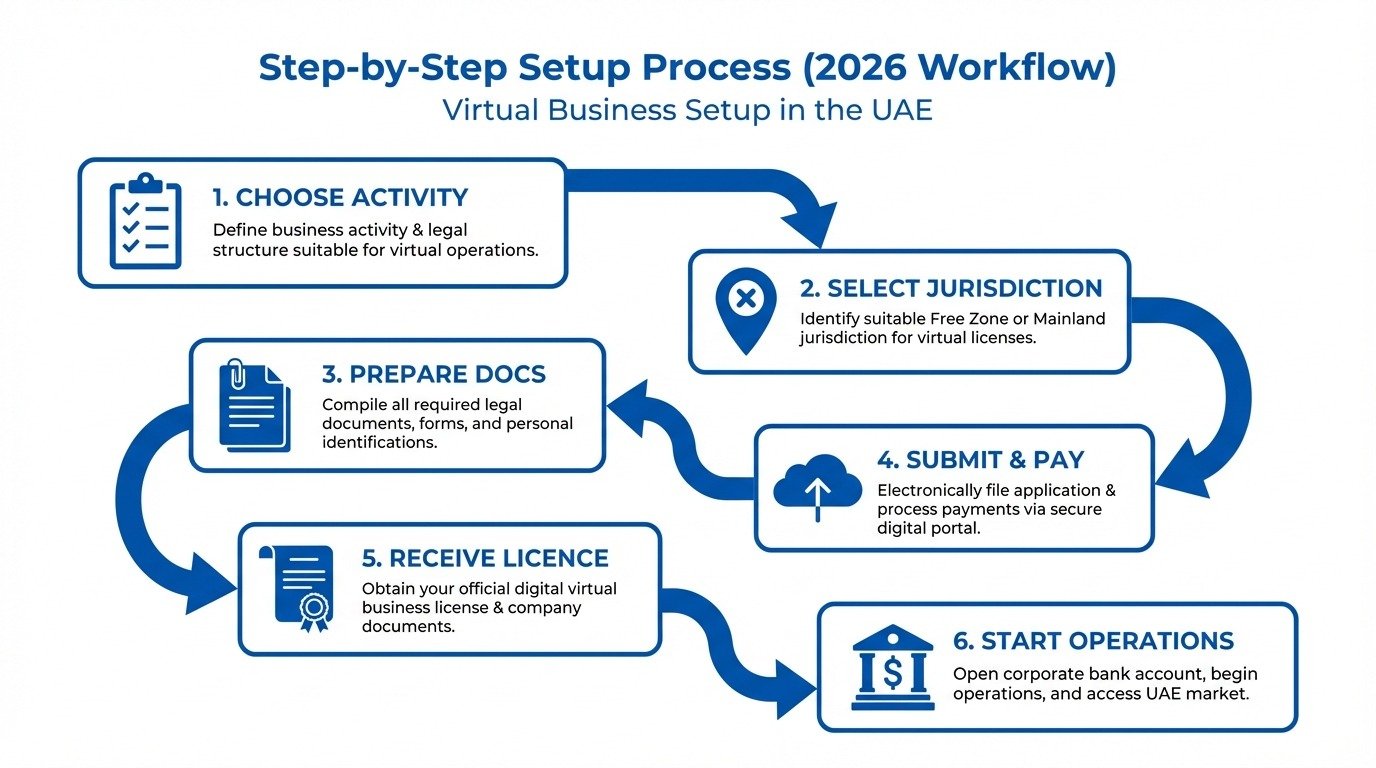
- Decide Your Business Activity & Legal Structure
- Choose Jurisdiction (Virtual License vs Free Zone vs Mainland)
- Prepare Required Documents (Passport, Photo, Activity Details)
- Submit Application Online & Pay Fees
- Receive Digital Trade License & Commence Operations
Banking, Visas & Compliance Reality
- Corporate bank accounts are possible but not guaranteed
- Banks require strong documentation and proof of activity
- Virtual licences usually do not include UAE residency visas
- Visa eligibility becomes available after upgrading to Free Zone or Mainland setups
Tax Obligations for Virtual Businesses
Corporate Tax
- 0% up to AED 375,000 profit
- 9% above AED 375,000
- Mandatory registration and annual filing
VAT
- Mandatory above AED 375,000 turnover
- Digital VAT-compliant invoicing required
- Quarterly filings (as assigned)
Virtual Office vs Virtual Business Licence
Many entrepreneurs confuse a virtual office with a virtual business licence, but they serve very different purposes in the UAE.
Virtual Office
- Provides a registered business address only
- Used mainly for licensing, compliance, or correspondence
- May include mail handling or meeting room access (limited)
- Does not allow you to trade or issue invoices
- Cannot generate revenue on its own
- Always linked to an existing trade licence
- Acts as a supporting facility, not a business entity
Virtual Business Licence
- A legally registered UAE business
- Issued by a Free Zone, DED, or government authority
- Allows you to trade, invoice clients, and earn revenue
- Recognised by banks, tax authorities, and regulators
- Can operate fully online or remotely
- May use a virtual office or flexi-desk to meet address requirements
- Subject to corporate tax, VAT, UBO, and compliance rules
Tips for Success
- Choose the right jurisdiction early
Each emirate and free zone has different rules. Picking the right one from the start saves time and money later. - Plan your taxes from the beginning
Virtual businesses must follow UAE tax rules. Set up basic accounting early to avoid problems in the future. - Get help from experienced consultants
UAE business setup rules can be confusing. Professional guidance helps you avoid mistakes and delays. - Prepare for bank account opening
Corporate bank accounts can take time. Having clear documents and a proper business plan improves approval chances. - Think about future growth
A virtual licence is a first step. Choose a setup that allows you to add visas, staff, or an office when needed.
Conclusion
Setting up a virtual business in the UAE in 2026 offers entrepreneurs unmatched flexibility, global credibility, and a future-ready regulatory environment but choosing the right structure from the start is critical. With evolving corporate tax rules, digital compliance requirements, and multiple virtual licensing options across free zones and the mainland, expert guidance can make the difference between a smooth launch and costly mistakes. Reyson Badger helps entrepreneurs and international founders navigate UAE virtual business setup with clarity, compliance, and confidence, ensuring your business is structured correctly today while remaining scalable for tomorrow.