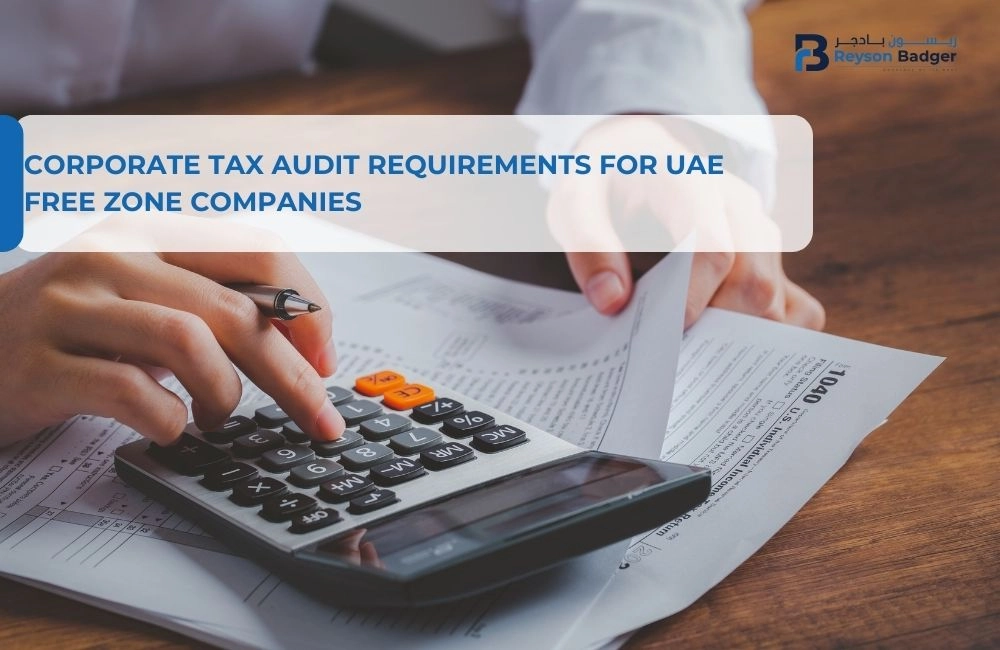


The introduction of corporate tax in the UAE has significantly reshaped the compliance landscape for businesses, including Free Zone entities that previously operated in a largely tax-free environment. While Free Zones continue to offer competitive tax advantages, these benefits are now conditional upon meeting specific regulatory requirements.
A UAE Free Zone corporate tax audit plays a critical role in ensuring that companies maintain compliance and preserve their preferential tax treatment. For many Free Zone entities, audit readiness is no longer optional it is a strategic necessity.
This article explains the regulatory framework, who the requirements apply to, the key Corporate tax audit requirements in the UAE Free Zone, the audit process overview, risks of non-compliance, and how businesses can prepare effectively.
Regulatory Context: UAE Corporate Tax & Free Zone Framework
Overview of the UAE Corporate Tax System
The UAE corporate tax regime was introduced to strengthen transparency, align with international tax standards, and enhance fiscal sustainability. The system is administered by the Federal Tax Authority (FTA), which oversees compliance, filings, and audit procedures.
Under this regime, businesses are required to:
- Register for corporate tax
- Maintain proper financial records
- File corporate tax returns
- Comply with documentation standards
Free Zone entities are not exempt from compliance; they are subject to specific conditions that determine whether preferential tax rates apply.
Free Zone Tax Treatment Explained
Qualifying Free Zone Person (QFZP)
Free Zone companies may benefit from a 0% corporate tax rate on qualifying income if they meet the conditions to be classified as a Qualifying Free Zone Person (QFZP).
To maintain QFZP status, companies must:
- Derive qualifying income as defined by law
- Maintain adequate substance in the Free Zone
- Comply with transfer pricing regulations
- Maintain proper audited financial statements
Failure to meet these conditions may result in loss of preferential treatment.
Why Audit Readiness Matters
Regulatory scrutiny is increasingly data-driven. The link between compliance, documentation accuracy, and audit exposure is direct. A properly structured UAE Free Zone corporate tax audit ensures that:
- Financial statements align with tax filings
- Qualifying income is properly supported
- Transfer pricing documentation is available where required
- Corporate governance standards are maintained
Without strong documentation, even eligible companies may face challenges in preserving their 0% tax benefits.
Who This Applies To: Applicability Guide
Companies Likely to Require a Corporate Tax Audit
Certain Free Zone entities face higher audit relevance:
- QFZPs claiming 0% corporate tax benefits
- Businesses exceeding specified revenue thresholds
- Entities conducting mainland transactions
- Companies engaged in related-party or cross-border transactions
These profiles attract greater regulatory attention due to the complexity of qualifying income determination.
Situations Where Requirements May Differ
Some Free Zone businesses may experience different compliance expectations:
- Entities eligible for Small Business Relief
- Companies earning only limited or non-qualifying income
- Dormant entities with minimal activity
However, even in such cases, record-keeping obligations remain in place.
Key Audit Requirements for UAE Free Zone Companies
Understanding the UAE Corporate tax audit requirements for the Free Zone is essential for compliance.
Mandatory Audit Categories
Audit reviews may be triggered by:
- Claims of 0% tax status under QFZP rules
- High levels of related-party transactions
- Revenue fluctuations or inconsistencies
- Cross-border activity
Audits are risk-based and may arise from analytical review by the Federal Tax Authority.
Documentation & Record-Keeping Requirements
Strong documentation is the foundation of audit readiness. Many Free Zone companies use professional corporate tax advisory support to ensure their financial records, transfer pricing documentation, and tax filings meet regulatory standards.
Free Zone companies must maintain:
- Audited financial statements
- General ledgers and trial balances
- Supporting schedules and reconciliations
- Contracts and invoices
- Transfer pricing documentation (if applicable)
- Evidence supporting qualifying income classification
Documentation must clearly demonstrate how income qualifies for preferential treatment.
Accounting Standards and Compliance Expectations
Free Zone companies are expected to follow recognized accounting standards, such as IFRS (where applicable). Consistency between accounting treatment and tax reporting is critical.
Authorities look for:
- Clear audit trails
- Proper revenue recognition
- Transparent expense classification
- Reconciliations between financial and tax records
Inconsistencies often trigger additional review.
Reporting Timelines and Obligations
Free Zone companies must:
- File corporate tax returns within statutory deadlines
- Maintain audited financial statements where required
- Respond to authority requests promptly
Timely compliance reduces audit exposure and strengthens credibility.
Corporate Tax Audit Process & Timeline
Although covered in detail in our previous audit timeline guide, the Free Zone audit process generally includes:
- Internal readiness review
- Collection and submission of requested documentation
- Audit testing and clarification requests
- Resolution of findings
- Final reporting
Auditors may conduct independent verification of financial statements and assess compliance with QFZP conditions.
The typical duration ranges from two to six weeks, depending on transaction complexity, documentation quality, and responsiveness.
Common Challenges and Practical Solutions
Typical Challenges
Free Zone companies often face:
- Incomplete or inconsistent documentation
- Misinterpretation of the qualifying income rules
- Weak internal reconciliation processes
- Limited in-house tax expertise
Errors in determining qualifying vs non-qualifying income are particularly common.
Practical Preparation Strategies
To strengthen audit readiness, businesses should:
- Conduct internal compliance assessments
- Maintain structured documentation repositories
- Regularly reconcile financial and tax records
- Review transfer pricing policies
- Engage professional advisors early to ensure proper compliance, tax planning, and documentation. Many Free Zone companies rely on Corporate Tax Advisory Services to prepare for corporate tax audits and maintain regulatory compliance.
Proactive preparation significantly reduces risk and disruption.
Penalties & Risks of Non-Compliance
Financial and Regulatory Consequences
Failure to meet audit requirements may result in:
- Administrative penalties
- Additional tax assessments
- Increased scrutiny in future audits
Non-compliance can also affect regulatory credibility.
Risk to Free Zone Tax Benefits
The most significant risk for Free Zone entities is the potential loss of preferential tax status.
If QFZP conditions are not met or cannot be substantiated, the company may:
- Lose eligibility for 0% corporate tax
- Become subject to standard corporate tax rates
- Face retrospective adjustments
The financial impact can be substantial.
UAE Free Zone Corporate Tax Audit Readiness Checklist
For quick reference, Free Zone companies should ensure:
- Updated financial statements are prepared
- Supporting schedules and reconciliations are completed
- Transfer pricing documentation is ready (if applicable)
- Evidence supporting qualifying income is compiled
- Internal compliance reviews are conducted
- Audit files are organized for prompt submission
A structured compliance framework simplifies audits and preserves tax advantages.
Conclusion
Understanding Corporate tax audit requirements UAE Free Zone is essential for maintaining compliance and safeguarding valuable tax incentives. A UAE Free Zone corporate tax audit is not merely a regulatory formality it is a mechanism that verifies eligibility for preferential treatment.
Proactive preparation reduces risks, prevents operational disruptions, and ensures smoother audit outcomes. Strong documentation, consistent accounting practices, and timely responses are central to preserving Free Zone tax benefits.
With extensive experience in UAE tax compliance and audit readiness, Reyson Badger supports Free Zone companies through structured compliance reviews, documentation management, and end-to-end advisory solutions. Businesses seeking clarity and confidence in meeting corporate tax audit requirements are encouraged to consult experienced professionals to protect both compliance status and tax advantages.