

The Federal Tax Authority (FTA) has introduced a new feature on the EmaraTax portal, allowing businesses to make advance payments toward their future Corporate Tax liabilities.
This initiative helps businesses manage their cash flow more effectively and reduces the risk of penalties caused by late payments. By paying early, companies can stay better prepared for upcoming tax obligations and avoid last-minute pressure.
Is Advance Tax Required?
No, Advance tax payment is optional. Businesses can choose to pay in advance as a smart way to improve compliance and financial planning.
What is Advance Tax Payment?
An advance tax payment is a voluntary payment made before filing your next tax return. Instead of waiting until the due date, businesses can deposit funds into their FTA account in advance.
These funds are not lost or locked — they are held securely and automatically used when your next return is submitted.
Key Purpose of Advance Payments
Advance tax payments are designed to:
- Improve compliance and reduce payment risks
- Support better cash-flow planning
- Reduce the chance of late payment penalties
- Provide a financial buffer before filing deadlines
Once the return is filed, the advance payment is automatically adjusted against the liability. Any remaining balance is carried forward and applied to future dues.
Where to Find the Advance Payment Option in EmaraTax
Inside EmaraTax, the process is straightforward:
Path:
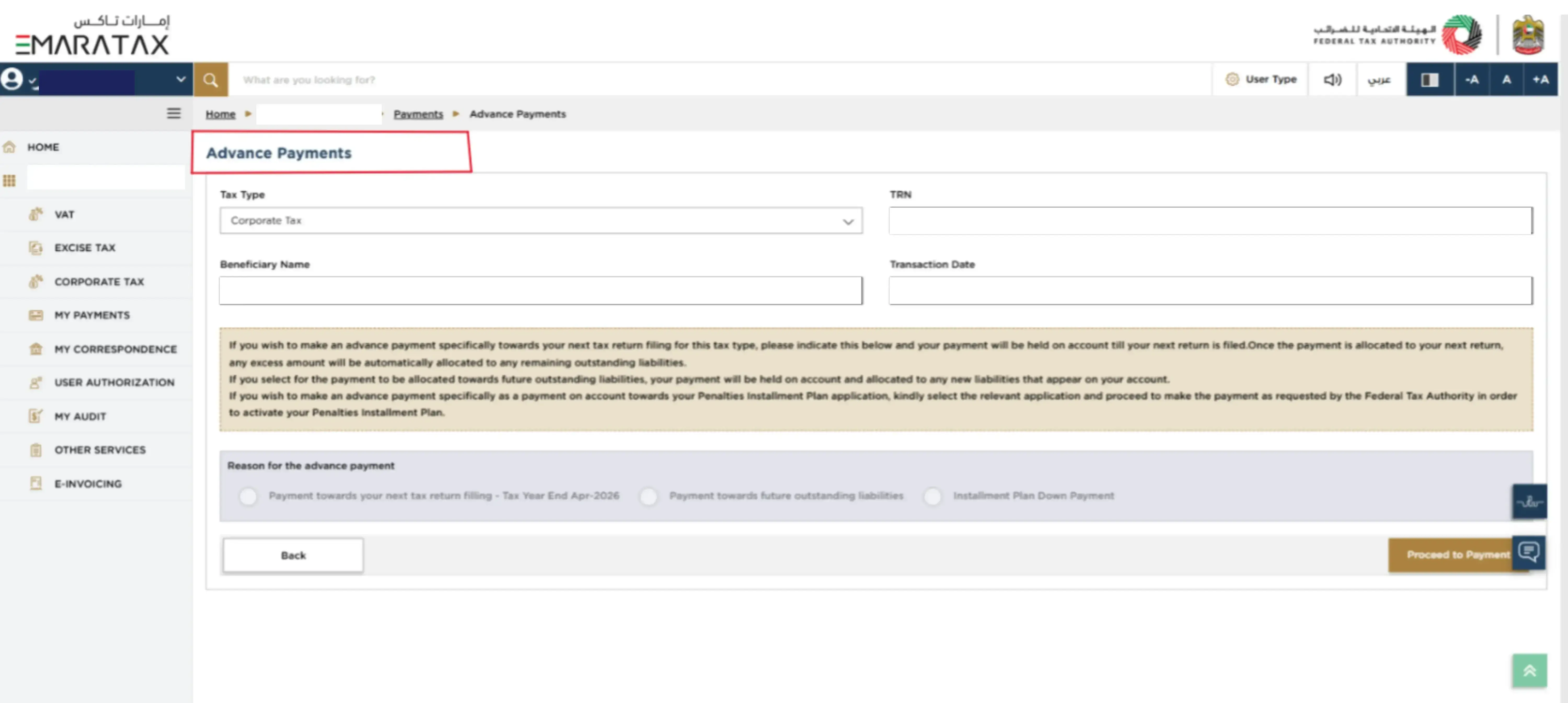
EmaraTax → My Payments → Advance Payment
This section allows businesses to deposit funds into their FTA account even before a tax liability is formally generated.
How Advance Payment Allocation Works?
Understanding allocation is important so businesses know exactly how their money will be used.
When you make an advance payment:
- The payment is held in your FTA account.
- Once the next tax return is filed, the system automatically applies the payment.
- If there is any excess amount, it will be applied to:
- Future tax liabilities
- Outstanding liabilities (starting from the oldest due amount)
The FTA clarifies that advance payments are applied to the immediate next return first, and any remaining balance is used for other dues.
This automated allocation removes the need for manual adjustments.
Types of Advance Payment Options Available
EmaraTax offers structured payment choices depending on your needs.
1) Payment Towards the Next Tax Return
This option reserves funds specifically for the immediate upcoming filing period.
It is useful when:
- You already know your upcoming tax exposure
- You want to set aside funds early
2) Payment Towards Future Liabilities
Funds are automatically used for future tax dues once they arise.
This option is ideal for:
- Businesses with consistent tax obligations
- Companies wanting to maintain a tax reserve
3) Instalment Plan Down Payment (When Applicable)
If a business has an approved penalty instalment plan, advance payments can be used as the down payment.
This helps businesses:
- Manage penalties in structured instalments
- Reduce financial pressure
Together, these options allow businesses to plan payments proactively instead of reacting to deadlines.
Example: How It Works in a Monthly Tax Period
Let’s simplify this with a practical example.
Imagine your December return is already filed.
If you now make an advance payment:
- The payment cannot be applied to December.
- Instead, it will automatically apply to the January period.
If you still owe tax for December, you must use the “Select and Pay” option to settle that liability.
This is an important rule:
Advance payments apply only to future returns, not already filed returns.
Advance Payments via GIBAN
Businesses making payments through bank transfer must follow one key step.
Before transferring funds, you must generate a unique payment reference number.
Why this matters:
- Ensures correct allocation of the payment
- Prevents delays or misapplied payments
- Required by the FTA for GIBAN transfers
Skipping this step can result in payment processing issues.
Is Advance Tax Payment Mandatory?
No advance tax payment is not mandatory in the UAE. However, it is strongly recommended as a risk-management and compliance tool. Even if advance payment is made, businesses must still ensure the full tax liability is paid by the official deadline.
Think of it as preparation, not replacement.
Benefits of Making Advance Tax Payments
Businesses that use this feature gain several advantages.
- Avoid Late Payment Penalties: Having funds ready inside the FTA account reduces the risk of missing deadlines.
- Reduce Last-Minute Banking Risks: Payment delays can happen due to:
- Banking cut-off times
- Technical portal issues
- Approval delays
- Advance payments eliminate these risks.
- Improve Financial Planning: Setting aside tax funds early improves:
- Cash-flow forecasting
- Budget discipline
- Financial stability
- Strengthen Compliance Management: Businesses can shift from reactive compliance to proactive tax planning.
Conclusion
Advance tax payment in EmaraTax is more than just a feature it is a smart way to manage your taxes. Paying early helps businesses lower risks, avoid penalties, manage cash flow better, and stay organized with tax deadlines. When used properly, advance payments make tax time less stressful and more predictable. Getting support from experts like Reyson Badger can make the process even easier. They can help you plan payments correctly and make sure your business stays fully compliant with UAE tax rules.