
The UAE is moving toward a fully digital invoicing ecosystem as part of its broader tax and digital transformation strategy. A key element of this transition is the introduction of accredited third-party e-invoicing service providers. These providers will play a central role in enabling businesses to generate, exchange, and store structured electronic invoices in compliance with UAE regulations.
Accreditation ensures that e-invoicing service providers, software vendors, and platform operators meet strict technical, security, and regulatory requirements before offering services in the UAE market. For both businesses and technology providers, understanding this accreditation framework early is essential to prepare for the upcoming e-invoicing mandate.
Accreditation Framework & Regulatory Basis
The authorities have introduced an accreditation framework to ensure that only qualified and compliant providers can offer e-invoicing services in UAE. This framework is designed to create a standardized, secure, and interoperable invoicing ecosystem across the country.
Purpose of the Accreditation Framework
The accreditation model aims to:
- Maintain high data security and privacy standards
- Ensure interoperability between invoicing platforms
- Guarantee compliance with tax and regulatory requirements
- Support seamless invoice exchange and reporting
Governing Bodies and Regulatory Oversight
UAE regulators will oversee the accreditation process and ensure providers meet required standards. Accreditation is expected to become a mandatory requirement for any organization offering e-invoicing services in the UAE.
This means businesses will need to work with accredited providers once the e-invoicing mandate is fully implemented.
Documents Required for Accreditation of Service Providers
To obtain accreditation, e-invoicing providers must submit detailed documentation demonstrating their legal, technical, and security capabilities.
- Legal and Corporate Documentation: Providers must present valid trade licenses and corporate registration documents to confirm their legal eligibility to operate in the UAE.
- Technical Capability Disclosures: Authorities require providers to demonstrate their system’s ability to generate structured e-invoices, integrate with other platforms, and handle secure data exchange.
- Data Security and Compliance Certifications: Since invoicing involves sensitive financial data, providers must show strong cybersecurity practices and compliance with data protection standards.
- System Architecture and Integration Details: Providers must submit technical architecture documentation explaining how their platforms connect with ERP systems, accounting software, and regulatory platforms.
Accurate and complete documentation significantly speeds up the accreditation process and reduces approval delays.
Accreditation Process for E-Invoicing Service Providers
The accreditation lifecycle involves several stages designed to ensure only qualified providers enter the UAE e-invoicing ecosystem.
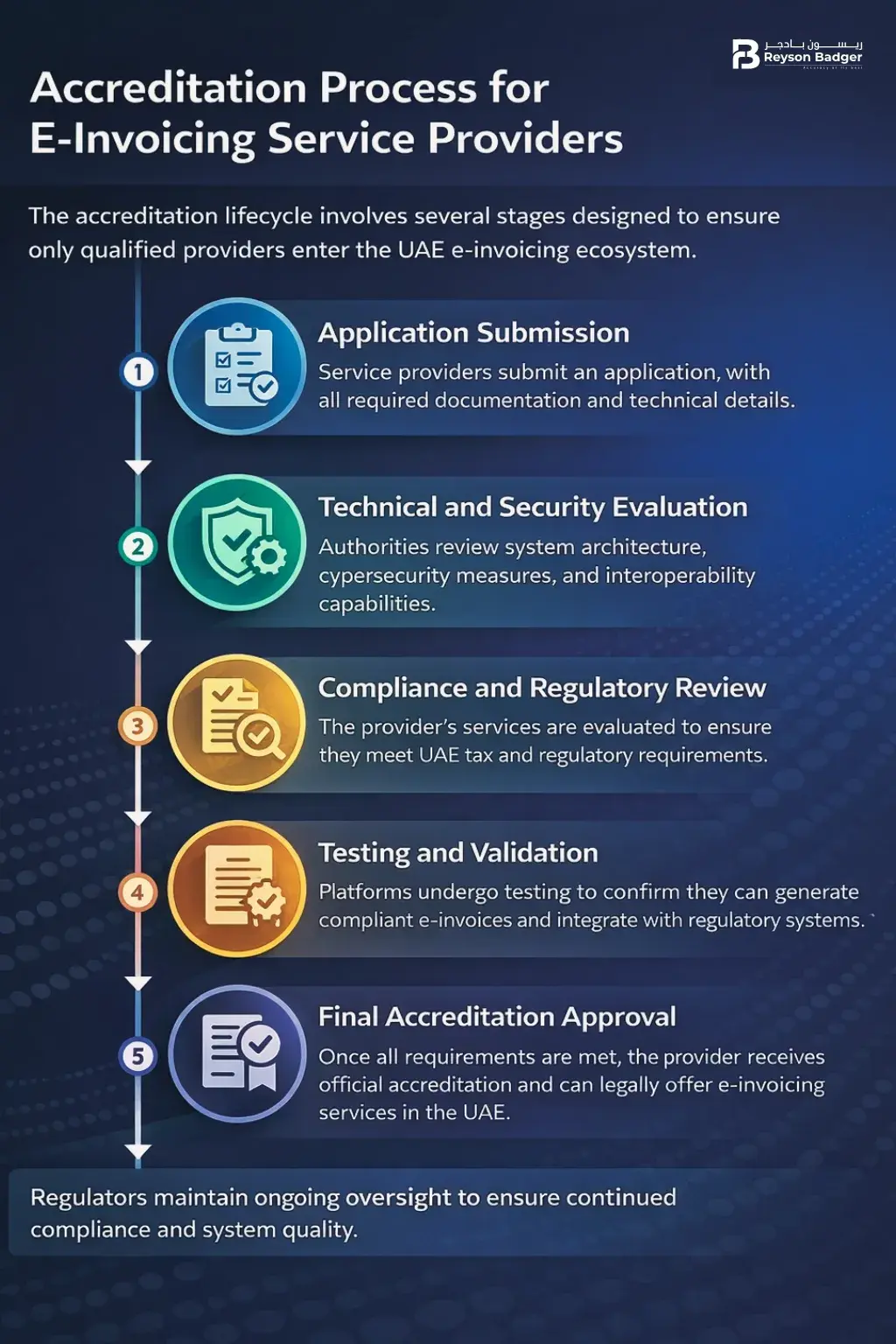
- Application Submission: Service providers submit an application with all required documentation and technical details.
- Technical and Security Evaluation: Authorities review system architecture, cybersecurity measures, and interoperability capabilities.
- Compliance and Regulatory Review: The provider’s services are evaluated to ensure they meet UAE tax and regulatory requirements.
- Testing and Validation: Platforms undergo testing to confirm they can generate compliant e-invoices and integrate with regulatory systems.
- Final Accreditation Approval: Once all requirements are met, the provider receives official accreditation and can legally offer e-invoicing services in the UAE.
Regulators maintain ongoing oversight to ensure continued compliance and system quality.
Factors Businesses Should Consider Before Choosing an Accredited Service Provider
Selecting the right provider will be critical once e-invoicing becomes mandatory.
- Regulatory Compliance and Accreditation Status: Businesses must verify that the provider is officially accredited and compliant with UAE regulations.
- System Compatibility: The platform should integrate smoothly with existing ERP, accounting, and billing systems.
- Data Security and Confidentiality: Strong data protection measures are essential to safeguard financial information.
- Scalability and Transaction Capacity: The system must handle growing transaction volumes as the business expands.
- Support and Ongoing Updates: Providers should offer training, technical support, and regular updates as regulations evolve.
Role of Accredited E-Invoicing Service Providers
Accredited providers will serve as the bridge between businesses and the UAE’s digital tax infrastructure.
- Structured Invoice Generation: They enable businesses to create invoices in the required standardized format.
- Real-Time Reporting and Exchange: Providers facilitate invoice exchange and reporting to authorities where required.
- Compliance Verification and Audit Trails: Their systems help maintain secure records and audit-ready documentation.
These services will play a key role in enabling widespread adoption of e-invoicing across the UAE.
Conclusion
Accreditation of e-invoicing service providers is a critical step in the UAE’s digital tax transformation. It ensures that only qualified and secure platforms support businesses in meeting compliance requirements.
As demand for compliant e-invoicing services grows, technology providers should prepare for accreditation, while businesses should begin identifying trusted partners. Working with experienced advisors such as Reyson Badger can help organizations prepare for the transition and choose the right e-invoicing solutions.
The move toward accredited providers marks an important milestone in the UAE’s journey toward a fully digital, transparent, and efficient tax ecosystem.
FAQs
1. What is accreditation of e-invoicing providers in UAE?
Accreditation is an official approval process through which the UAE authorities verify that e-invoicing service providers meet strict technical, security, and regulatory requirements before they can legally offer e-invoicing services in the country.
2. What documents are required for e-invoicing provider accreditation in UAE?
Providers must submit valid trade licences, corporate registration documents, technical capability disclosures, data security and compliance certifications, and system architecture details explaining how their platform integrates with ERP and accounting systems.
3. Do businesses need to use accredited e-invoicing providers in UAE?
Yes. Once the UAE e-invoicing mandate is fully implemented, businesses will be required to work only with officially accredited e-invoicing service providers to ensure their invoices are compliant with UAE tax and regulatory requirements.