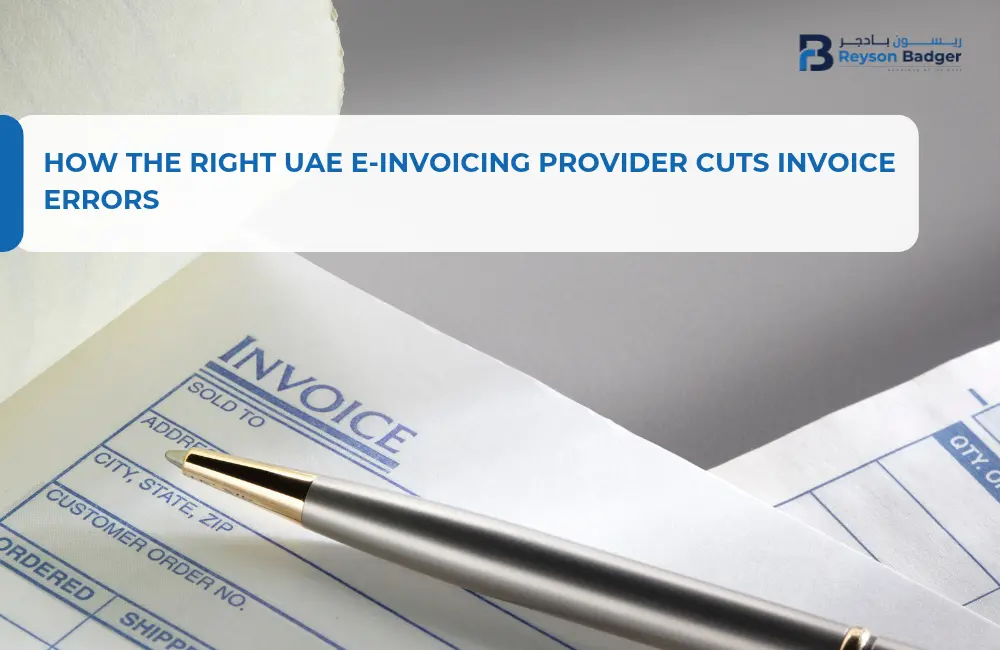


Invoice errors may look small, but repeated mistakes can create bigger problems for a business. An incorrect Tax Registration Number, wrong VAT treatment, duplicate invoice number, missing information, or delayed invoice can lead to rejected transactions, payment delays, additional manual work, and compliance concerns.
Manual invoicing makes these errors easier to occur because employees may enter the same information repeatedly across different systems. Businesses may also rely on spreadsheets, PDF invoices, email approvals, or disconnected accounting systems.
E-invoicing can reduce many of these risks by using structured invoice data, automated validation, standardised information, and system-to-system exchange. However, technology is only part of the solution. Choosing the right E-Invoicing Services in UAE can be equally important because the provider needs to work with the business's accounting systems, data, processes, and compliance requirements.
The UAE is introducing e-invoicing through a phased implementation. The system applies to in-scope business transactions, including B2B and B2G transactions, subject to the applicable exclusions. The Ministry of Finance defines an eInvoice as structured invoice data issued and exchanged electronically and reported electronically to the Federal Tax Authority. PDFs, Word files, images, scanned documents, and emails are not eInvoices.
For businesses preparing for e-invoicing in UAE, the right provider can help reduce manual errors and create a more controlled invoicing process.
Why Invoice Errors Can Be a Problem for UAE Businesses?
Invoice errors can affect more than the invoice itself. They can create problems for accounting, VAT reporting, customer payments, reconciliations, and compliance.
Some errors are caused by incorrect information, while others result from manual data entry or disconnected systems.
Incorrect Customer or Supplier Information
Customer and supplier information needs to be accurate. Errors in business names, tax information, addresses, identifiers, or other required data can create validation problems.
The UAE e-invoicing framework includes mandatory invoice information, so businesses need to ensure that their master data is complete and maintained correctly.
VAT Calculation Errors
Incorrect VAT rates, taxable amounts, exemptions, discounts, or tax calculations can result in inaccurate invoices. When these errors occur repeatedly across many transactions, correcting them can take considerable time.
Duplicate Invoices
Duplicating invoice numbers or accidentally issuing the same invoice more than once can create reconciliation problems and confusion for customers and finance teams.
Automated invoice numbering and system controls can reduce the risk of duplicate records.
Missing Invoice Details
An invoice may be missing information required for the relevant transaction. With structured e-invoicing, incomplete information can result in validation failures rather than simply being overlooked in a PDF review.
Data-Entry Mistakes
Manually entering customer information, product details, prices, quantities, tax information, and payment details creates opportunities for errors.
The more systems an employee has to update, the greater the chance that information will become inconsistent.
Delayed Invoice Processing
Manual approval and sending processes can delay invoices. This can affect customer payment cycles and create additional work for accounts receivable teams.
Record-Keeping Issues
Invoices stored across email accounts, computers, spreadsheets, and paper files can be difficult to locate. A structured digital system can make invoice information easier to retrieve and reconcile.
How E-Invoicing Helps Reduce Invoice Errors?
The UAE's e-invoicing framework is designed around structured electronic data and aims to reduce human intervention in certain business and tax reporting processes.
The right system can therefore reduce several types of preventable errors.
Automated Invoice Data Entry
Instead of repeatedly entering the same customer, supplier, product, and tax information, businesses can connect their invoicing process with accounting or ERP systems.
Information already stored in the system can be used to create invoices, reducing the need for duplicate manual entry.
This does not eliminate the need for human review. It reduces the number of repetitive steps where basic data-entry mistakes can occur.
Accurate VAT Calculations
A properly configured accounting or invoicing system can apply VAT rules based on the transaction information and tax treatment configured by the business.
This can reduce manual calculation errors and make it easier for finance teams to review VAT information before an invoice is transmitted.
The system still needs to be configured correctly. Automation does not correct incorrect tax rules or poor master data automatically.
Standardised Invoice Information
One of the major differences between traditional invoicing and e-invoicing is the use of structured data.
The UAE framework uses structured electronic invoice data, with the UAE implementation based on the Peppol framework and PINT-AE specifications.
Standardised information makes it easier for systems to process invoices consistently and identify missing or incorrectly formatted information.
Duplicate Invoice Detection
Automated invoice numbering and transaction controls can help identify duplicate invoice numbers or duplicate transactions.
For example, current UAE e-invoicing systems identify duplicate document numbers and other transaction-data issues as errors that may need correction.
A good system should therefore have controls that reduce the risk of creating duplicate invoices in the first place.
Automated Validation
Validation is one of the key ways technology can reduce invoice errors.
Before an invoice moves through the e-invoicing network, relevant data can be checked for missing or invalid information. Errors can then be sent back to the business for correction.
Examples of data problems can include invalid VAT registration information, missing party details, incorrect unit information, duplicate document numbers, or incomplete transaction data.
This creates a more controlled process than relying entirely on employees to identify every error manually.
Better Record Management
Digital invoice records can make it easier to search, review, reconcile, and retrieve information.
Instead of looking through emails or folders for individual invoices, finance teams can work from a central system with transaction records, invoice status, and supporting information.
This can also make month-end reconciliation and financial reporting more organised.
How the Right E-Invoicing Provider Supports UAE Businesses?
Choosing an E-invoicing Service Provider in UAE is not simply about selecting software with an invoice-generation function. The provider needs to fit into the business's existing financial and technology environment.
ERP and Accounting Software Integration
Many businesses already use accounting or ERP systems to manage sales, purchases, inventory, payments, and financial reporting.
A suitable e-invoicing solution should be able to integrate with the existing environment or provide an appropriate integration method.
Depending on the system, this may involve APIs, connectors, middleware, or other technical integration methods.
The objective is to avoid creating a second disconnected invoicing system that requires employees to enter the same information twice.
Secure Data Exchange
E-invoicing involves commercially sensitive information. Businesses should therefore consider how the provider manages data transmission, user access, authentication, security monitoring, and business continuity.
The Ministry of Finance's accreditation requirements for e-invoicing service providers include technical and security requirements such as encryption, multi-factor authentication, security monitoring, ISO/IEC 27001, and business continuity measures.
Businesses should still review the provider's specific security arrangements rather than assuming that every provider offers identical controls.
Reporting and Record Management
An e-invoicing solution should provide useful visibility into invoice activity.
Finance teams may need to identify successfully processed invoices, invoices requiring correction, rejected transactions, credit notes, and reconciliation differences.
For example, e-invoicing reporting tools can help finance teams identify transactions with missing or incomplete mandatory information and resolve them before they become larger issues.
E-Invoicing Service Providers UAE: What Should Businesses Check?
Businesses comparing E-Invoicing Service Providers UAE should look beyond the appearance of the software.
Compliance Capabilities
First, check whether the provider can support the applicable UAE e-invoicing requirements, including structured invoice data, required fields, transmission, validation, and relevant reporting.
Integration Options
Ask how the provider will connect with your existing ERP or accounting software.
A solution that requires extensive manual data entry may not deliver the efficiency benefits expected from e-invoicing.
Scalability
The system should be able to handle the business's current invoice volume and expected growth.
A startup with a few hundred invoices today may have thousands of transactions in the future. Changing systems every time the business grows can create unnecessary cost and disruption.
System Compatibility
Businesses should check compatibility with their existing technology stack.
This may include SAP, Oracle, Microsoft Dynamics, Sage, cloud accounting systems, custom ERP platforms, or industry-specific applications.
Customer Support
Technical problems can affect invoice processing. Businesses should understand what support is available, how issues are escalated, and whether implementation support is included.
Implementation Requirements
Ask what needs to change before the system goes live.
This may include:
- ERP configuration
- API integration
- Master-data cleaning
- PINT-AE field mapping
- User access configuration
- Testing
- Staff training
- Approval workflow changes
Provider Accreditation and Status
Businesses that are required to use an Accredited Service Provider should verify the provider's current status through the Ministry of Finance.
The Ministry maintains an official list of accredited e-invoicing service providers and updates the list periodically.
Accreditation should be checked independently rather than relying only on a provider's marketing material.
E-Invoicing Software UAE: Features That Can Help Prevent Errors
When evaluating E-invoicing software UAE, businesses should focus on features that reduce manual work and improve data accuracy.
Automated Invoice Generation
The system can generate structured invoices using transaction information from the ERP or accounting system.
VAT Handling
The software should support the business's applicable VAT treatment and provide appropriate tax information for the invoice.
Customer and Supplier Data Validation
The system should help identify incomplete or inconsistent customer and supplier information before invoices are processed.
Invoice Numbering
Automated invoice numbering can reduce the risk of duplicate or incorrectly assigned invoice numbers.
Credit Notes
Businesses should be able to process credit notes correctly and connect them with the relevant transactions.
Real-Time Data Exchange
The UAE framework uses electronic exchange between participants through the e-invoicing network. A suitable solution should support the required transmission process rather than relying on email-based invoice delivery.
Audit Trails
A clear record of invoice creation, approval, correction, transmission, and status changes can help finance teams investigate errors.
Reporting
Reports should make it easy to identify transactions that require attention, such as failed validations, missing data, or rejected invoices.
Integration with Accounting and ERP Systems
Integration reduces duplicate data entry and allows invoice information to flow between operational and financial systems.
The best feature set will depend on the business. A small consultancy and a large manufacturing company may have very different integration, inventory, tax, and reporting requirements.
E-Invoicing in UAE: What Businesses Should Prepare For
The UAE e-invoicing system is being introduced in phases, so businesses should first identify their applicable implementation timeline.
For businesses with annual revenue exceeding AED 50 million, the Ministry of Finance extended the ASP appointment deadline to 30 October 2026, while the mandatory implementation date remains 1 January 2027. Businesses with annual revenue below AED 50 million have an ASP appointment deadline of 31 March 2027 and mandatory implementation by 1 July 2027. In-scope government entities have the same ASP appointment deadline and a mandatory implementation date of 1 October 2027.
Businesses should prepare before their applicable deadline rather than treating implementation as a last-minute software purchase.
Understand Applicable Requirements
Start by identifying whether the business has in-scope transactions and which implementation phase applies.
The UAE framework covers B2B and B2G business transactions, subject to specific exclusions. B2C transactions are currently outside the mandatory system under the applicable rules.
Review Current Invoicing Processes
Document how invoices are currently created, approved, sent, received, corrected, and reconciled.
This helps identify where manual work and errors occur.
Check Accounting and ERP Compatibility
Review whether the existing accounting or ERP system can provide the data required for UAE e-invoicing and connect with an appropriate ASP.
Prepare Business and Transaction Data
Customer, supplier, product, service, tax, and payment information should be reviewed and cleaned.
Poor master data can create validation failures even when the e-invoicing software itself is working correctly.
Identify Integration Requirements
Determine whether the business needs an API, connector, middleware, or other integration method.
The earlier this is identified, the more time the business has for development and testing.
Train Relevant Employees
Finance, accounting, IT, sales, procurement, and other employees involved in invoicing may need training.
Staff should know how the new workflow works and what to do when an invoice is rejected or requires correction.
E-Invoicing in Dubai: Key Considerations for Businesses
Businesses operating in Dubai should approach e-invoicing based on their actual transaction profile rather than simply their location.
Mainland companies, Free Zone companies, startups, e-commerce businesses, professional service firms, manufacturers, and larger enterprises can have very different invoicing processes.
Different Business Types and Transaction Volumes
A small consulting business may issue relatively few invoices each month, while an e-commerce or distribution company may process a large number of transactions.
The chosen e-invoicing services in Dubai should be appropriate for the business's transaction volume and complexity.
Mainland and Free Zone Considerations
Free Zone status does not automatically remove an in-scope business from the UAE e-invoicing framework. Businesses should assess their transactions and applicable exclusions and timelines under the federal framework.
Accounting Software Compatibility
Businesses should check whether their existing accounting system can support the required e-invoicing workflow.
Replacing an entire accounting system may not always be necessary. Depending on the system, integration with an accredited provider may provide the required connection.
Integration with Existing Systems
E-invoicing should work as part of the wider finance process.
Sales, accounting, procurement, inventory, tax, and payment information may need to move between different systems.
Future Scalability
A solution selected today should also make sense as the business grows.
Businesses should consider future transaction volumes, additional entities, new sales channels, ERP changes, and more complex reporting requirements.
Common Mistakes When Choosing an E-Invoicing Provider
Selecting the wrong provider can create new problems instead of solving existing invoicing issues.
Choosing Based Only on Price
A low subscription price does not necessarily mean a lower overall cost. Businesses should also consider integration, implementation, support, training, data migration, and future scalability.
Ignoring Integration Requirements
Choosing software without checking ERP compatibility can result in manual data entry and duplicate processes.
Not Checking Compliance Capabilities
Businesses should confirm how the provider supports the UAE framework instead of assuming that any electronic invoicing software is automatically compliant.
Selecting Software That Cannot Scale
A solution may work for a small number of invoices but become difficult to manage as transaction volumes increase.
Overlooking Data Security
Invoice data is sensitive. Security, access controls, encryption, monitoring, backups, and business continuity should be considered during provider selection.
Failing to Test the System Before Implementation
A system can appear to work during a demonstration but behave differently when connected to real business data.
Testing should cover realistic invoice scenarios, including corrections and errors.
How to Choose the Right E-Invoicing Solution in UAE?
There is no single best e-invoicing software in UAE for every business. The right solution depends on the company's systems, transaction volume, industry, compliance needs, budget, and growth plans.
A practical selection process can start with the following steps.
Assess Business Requirements
List the number and types of invoices, the business processes, current accounting software, ERP systems, customer and supplier workflows, VAT requirements, and reporting needs.
Compare Provider Capabilities
Compare providers based on integration, structured invoice generation, validation, transmission, reporting, security, support, and implementation capabilities.
Check Software Compatibility
Confirm that the solution can work with the systems already used by the business.
Evaluate Security and Scalability
Review how the provider protects invoice data and whether the solution can support future business growth.
Review Implementation and Support
Ask who will handle integration, testing, staff training, troubleshooting, and ongoing updates.
Consider Long-Term Business Needs
E-invoicing should be viewed as part of the business's wider financial infrastructure.
The right UAE e-invoicing solution should ideally reduce duplicate work, improve data quality, support compliance, and fit into the company's accounting and ERP environment.
Conclusion
Invoice errors are often the result of manual data entry, incomplete information, disconnected systems, and inconsistent processes. E-invoicing can help reduce these problems by introducing structured data, automated validation, standardised information, electronic exchange, and better digital records.
However, simply adopting e-invoicing software does not guarantee accurate invoices. The quality of the implementation, master data, integration, tax configuration, user training, and ongoing support also matters.
For businesses preparing for e-invoicing in UAE or e-invoicing in Dubai, choosing the right provider should therefore be based on more than price or a list of software features. Businesses should consider compliance capabilities, ASP status where applicable, ERP integration, data security, scalability, testing, and support.
With the right E-Invoicing Services in UAE, businesses can build a more controlled invoicing process, reduce avoidable errors, and prepare their finance operations for the UAE's phased e-invoicing system.
FAQs About E-Invoicing Services in UAE
- What are e-invoicing services in UAE?
E-invoicing services help businesses create, validate, exchange, transmit, and manage structured electronic invoices in line with the UAE e-invoicing framework. Depending on the service, they can also provide ERP integration, testing, reporting, and technical support.
- How can e-invoicing reduce invoice errors?
E-invoicing can reduce errors by limiting repetitive manual data entry, using standardised invoice information, validating required fields, automating invoice numbering, and integrating invoice data with accounting or ERP systems.
However, businesses still need accurate master data and correct system configuration.
- What should I look for in an e-invoicing service provider in UAE?
Look at the provider's accreditation status where applicable, UAE compliance capabilities, ERP integration options, PINT-AE support, validation capabilities, security controls, scalability, implementation process, and customer support.
- How does e-invoicing work with accounting software?
The accounting or ERP system can provide the invoice information, which can then be mapped and transmitted through the e-invoicing solution and ASP. The exact integration method depends on the software and provider.