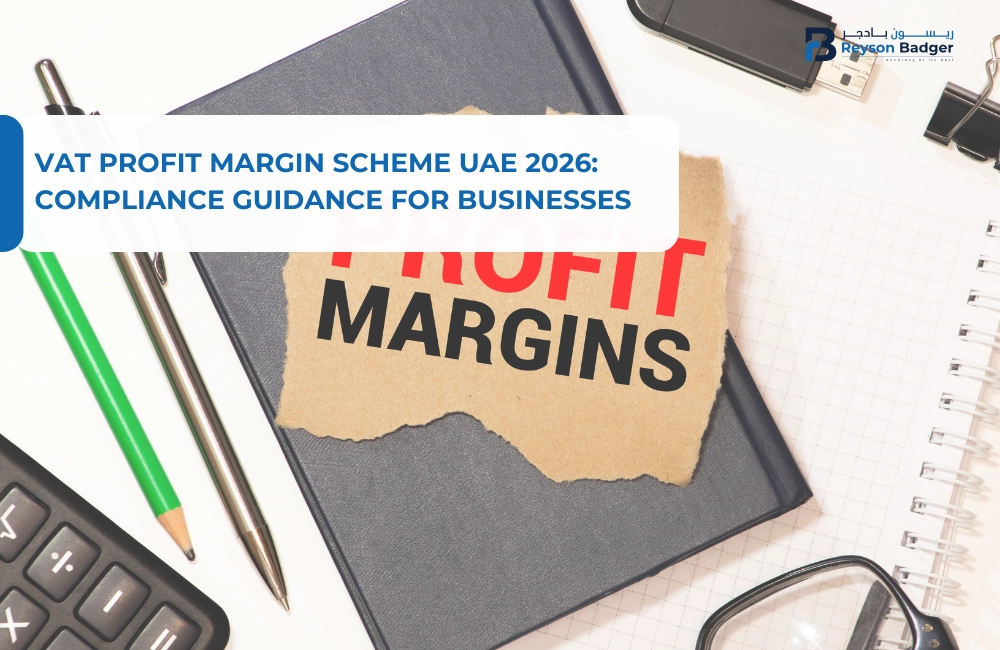


The UAE Federal Tax Authority (FTA) has issued an updated VAT guide clarifying the VAT Profit Margin Scheme UAE, providing much-needed guidance for businesses that deal in eligible goods where standard VAT treatment may result in tax cascading. This clarification is particularly important as the UAE continues to strengthen its VAT compliance framework heading into 2026.
The updated guidance explains when the Profit Margin Scheme can be applied, the conditions businesses must meet, and how VAT should be invoiced and recorded. For businesses operating under UAE VAT, incorrect application of special VAT schemes can lead to assessment errors, penalties, and disputes during audits.
This guide is especially relevant for businesses involved in the resale of second-hand goods, antiques, or collectibles, where VAT charged on the full selling price may distort the actual tax burden. Understanding how the VAT Profit Margin Scheme UAE works is therefore essential for maintaining accurate and compliant VAT treatment.
What Is the VAT Profit Margin Scheme Under UAE VAT Law?
The VAT Profit Margin Scheme is a special VAT mechanism under UAE VAT regulations that allows eligible businesses to calculate VAT only on the profit margin, rather than on the full selling price of certain goods.
Under normal UAE VAT rules, VAT is charged on the total consideration received for a supply. However, in specific cases—particularly involving used goods—this can result in VAT being applied multiple times on the same item as it passes through different sellers. The Profit Margin Scheme addresses this issue by taxing only the difference between the purchase price and the selling price.
In simple terms, VAT under this scheme is calculated as follows:
VAT = Output VAT on the profit margin, not on the total selling value
This approach supports fair taxation, avoids VAT cascading, and ensures that VAT reflects the actual value added by the reseller. The scheme plays an important role within the broader UAE VAT framework, but it can only be applied where all regulatory conditions are strictly met.
Who Can Apply the VAT Profit Margin Scheme?
Not all businesses or transactions are eligible to apply the VAT Profit Margin Scheme UAE. The scheme is specifically designed for businesses that trade in certain types of goods and meet defined eligibility conditions.
Typically, the scheme applies to businesses involved in:
- Buying and reselling second-hand goods
- Trading in antiques and collectors’ items
- Dealing in goods that were previously owned and supplied without VAT recovery
Common examples include used car dealers, antique traders, auction houses, and businesses reselling refurbished or previously owned items.
However, eligibility is not determined by business type alone. Businesses must ensure that the goods they sell meet the FTA defined criteria, including how those goods were originally acquired and whether VAT was recoverable at the time of purchase. Applying the scheme without meeting these conditions can lead to incorrect VAT reporting and compliance exposure.
Key Conditions Clarified in the FTA’s Latest Guide
The FTA’s latest guide provides clearer interpretation of the conditions that must be met before applying the Profit Margin Scheme under UAE VAT law.
One of the most important conditions relates to how the goods were acquired. The scheme can generally be applied only if:
- The goods were purchased from a non-VAT-registered person, or
- The goods were purchased from a VAT-registered person who did not charge VAT, or
- VAT was charged, but the buyer was not entitled to recover input VAT
Another critical clarification concerns input VAT recovery. Where the Profit Margin Scheme is applied, businesses cannot recover input VAT on the purchase of those goods. This restriction is fundamental to the scheme and must be reflected accurately in VAT accounting records.
The guide also clarifies situations where the scheme cannot be applied, such as:
- Supplies of new goods
- Goods purchased with recoverable input VAT
- Supplies where VAT is required to be charged under standard UAE VAT rules
Understanding these limitations is essential to avoid misapplication of the scheme and potential VAT penalties.
Invoicing and Record-Keeping Requirements
The FTA has placed strong emphasis on invoicing and documentation when applying the VAT Profit Margin Scheme UAE, as these are key focus areas during VAT audits.
When issuing invoices under this scheme:
- VAT must not be shown separately on the invoice
- The invoice should clearly indicate that the Profit Margin Scheme has been applied
- The selling price should be stated without breaking out VAT as a separate line item
This invoicing restriction is critical. Showing VAT separately on an invoice under the Profit Margin Scheme is not permitted and may result in non-compliance findings.
In addition, businesses must maintain detailed records to support their VAT treatment, including:
- Purchase and sale invoices
- Evidence of how the profit margin was calculated
- Records confirming that input VAT was not recovered
- Documentation supporting eligibility under the scheme
Strong record-keeping is essential to demonstrate compliance during FTA reviews or audits.
Compliance Impact for Businesses in the UAE
The updated FTA guide significantly improves clarity around the VAT Profit Margin Scheme, reducing uncertainty for businesses that rely on this special VAT treatment. However, it also raises the bar for compliance.
Businesses must ensure that:
- Internal VAT processes align with the clarified guidance
- Staff responsible for VAT understand when the scheme applies
- VAT returns accurately reflect margin-based calculations
Failure to apply the scheme correctly may lead to VAT reassessments, penalties, and disputes with the FTA. As a result, periodic VAT health checks and professional VAT service support are strongly recommended, especially for businesses regularly dealing in eligible goods.
Applying special VAT schemes without ongoing review increases compliance risk—particularly as regulatory scrutiny continues to increase under UAE VAT law.
Conclusion
The FTA’s latest guidance on the VAT Profit Margin Scheme UAE provides practical clarity for businesses seeking to apply the scheme correctly and confidently. By clearly defining eligibility, conditions, invoicing rules, and record-keeping requirements, the guide helps reduce ambiguity and strengthen VAT compliance.
Businesses currently using or planning to use the Profit Margin Scheme should reassess their VAT treatment, invoicing practices, and documentation to ensure full alignment with official FTA guidance. Staying compliant with evolving UAE VAT regulations is essential for managing tax risk and avoiding unnecessary penalties.
Engaging professional VAT advisory support can help businesses navigate special VAT schemes effectively and maintain long-term compliance.