E-Invoicing Coming to the UAE: What Businesses Should Know in 2026
23-Jan-2026
Switch to Smart UAE E-Invoicing Today!
E-Invoicing Services in UAE compliant implementation, ASP integration,
ERP support & expert guidance before mandatory deadlines.
E-Invoicing Services in UAE
Looking for reliable E-Invoicing Services in Dubai to prepare your business for the UAE's mandatory e-invoicing framework? Reyson Badger helps businesses implement secure, compliant, and automated e-invoicing solutions across all emirates. From system readiness assessments and ERP integration to Accredited Service Provider (ASP) onboarding and compliance support, we manage the entire implementation process.
With the UAE introducing phased e-invoicing requirements, businesses must ensure their invoicing systems meet the latest Ministry of Finance (MoF) and Federal Tax Authority (FTA) standards. Our E-Invoicing Services in UAE help businesses transition smoothly, reduce compliance risks, improve invoice accuracy, and streamline financial operations while remaining fully prepared for future regulatory changes.
Official UAE E-Invoicing Framework
The UAE e-invoicing framework is governed by Cabinet Decision No. 106 of 2025 and Ministerial Decision No. 64 of 2025, which establish the legal, technical, and operational requirements for electronic invoicing. These regulations define how businesses must issue, validate, transmit, and store electronic invoices through Accredited Service Providers (ASPs).
The framework also introduces standardised invoice formats, secure electronic transmission, digital validation, and reporting requirements that support greater tax transparency and efficient VAT administration. Businesses that fail to comply may face administrative penalties and increased scrutiny from the FTA.
What is E-Invoicing in UAE?
E-invoicing is the electronic creation, exchange, validation, and storage of invoices in a structured digital format such as XML. Unlike traditional PDF or paper invoices, structured electronic invoices allow accounting systems, ERP platforms, Accredited Service Providers (ASPs), and government platforms to exchange invoice data automatically without manual intervention.
Under the UAE's new framework, e-invoicing will become mandatory for businesses that fall within the implementation phases announced by the Ministry of Finance. The system follows the internationally recognised Peppol 5-Corner Model, allowing secure invoice exchange between suppliers, buyers, ASPs, and the Ministry of Finance.
Implementing compliant E-invoicing in Dubai helps businesses improve invoice accuracy, reduce manual processing, strengthen VAT compliance, and simplify financial reporting.
Overview of the UAE PINT AE Data Dictionary
The UAE e-invoicing framework uses the PINT AE data standard to ensure invoices are created in a consistent format that can be processed automatically by different accounting systems and Accredited Service Providers.
Every electronic invoice must include mandatory information such as:
- Supplier and buyer details
- Tax Registration Numbers (TRNs)
- Invoice number and issue date
- Description of goods or services
- Taxable value
- VAT amount and applicable tax rate
- Total invoice amount
Following the PINT AE data requirements helps ensure invoices are successfully validated, transmitted, and accepted within the UAE e-invoicing network.
Why E-Invoicing is Important for UAE Businesses?
E-invoicing plays a key role in the UAE's digital transformation by making tax reporting faster, more accurate, and more transparent. It reduces reliance on manual invoicing, improves VAT compliance, and enables businesses to automate financial processes while maintaining secure digital records.
For businesses, adopting E-Invoicing Services in Dubai offers several practical advantages:
- Faster invoice processing and payment cycles
- Improved VAT compliance
- Reduced manual errors
- Better financial visibility
- Secure digital record keeping
- Easier audit preparation
- Improved ERP and accounting system integration
Moving to e-invoicing also helps businesses prepare for future regulatory updates while improving operational efficiency.
Continuous Transaction Controls (CTC) & Digital Reporting Requirements (DRR)
The UAE e-invoicing framework incorporates Continuous Transaction Controls (CTC) and Digital Reporting Requirements (DRR) to strengthen tax compliance and improve invoice transparency.
Under this framework:
- Every B2B and B2G invoice is validated electronically before being exchanged.
- Invoice data is securely transmitted through an Accredited Service Provider (ASP).
- Transaction information is shared with the Ministry of Finance in accordance with reporting requirements.
- Digital records are maintained to support future audits and compliance reviews.
- Businesses that fail to meet these reporting obligations may face administrative penalties under the UAE's tax regulations.
Working with experienced E-invoicing Service Providers UAE helps ensure systems are correctly configured before mandatory implementation.
E-Invoicing Requirements in the UAE
To comply with the UAE e-invoicing framework, businesses must ensure their invoicing systems meet both technical and regulatory requirements.
- Structured Electronic Invoices: Invoices must be generated in approved machine-readable formats, such as XML, following the UAE's PINT AE and Peppol standards.
- Accredited Service Provider (ASP): Electronic invoices must be transmitted through an MoF-approved Accredited Service Provider that validates and securely exchanges invoice data.
- Mandatory Invoice Information: Each invoice must contain all mandatory data fields, including supplier and buyer details, TRNs, invoice number, invoice date, taxable amount, VAT information, and total payable amount.
- ERP & Accounting System Integration: Businesses should ensure their ERP, billing, or accounting software can generate compliant electronic invoices and integrate with their chosen ASP.
- Electronic Record Keeping: Issued and received electronic invoices must be stored securely in accordance with UAE tax record retention requirements and remain easily accessible for future audits.
Benefits of E-Invoicing for UAE Businesses
Implementing E-Invoicing Services in UAE is more than a compliance requirement—it helps businesses automate invoicing, improve accuracy, and strengthen financial controls. By replacing manual processes with structured digital invoices, businesses can reduce administrative work while improving tax compliance and operational efficiency.
- Faster Invoice Processing: Electronic invoices are generated, validated, and exchanged automatically, reducing manual data entry and accelerating invoice approvals, payments, and reconciliations.
- Improved VAT Compliance: Structured invoice formats and automated validation help ensure invoices contain the required information, reducing VAT reporting errors and supporting smoother FTA compliance.
- Greater Accuracy: Automation minimises manual mistakes such as duplicate invoices, incorrect VAT calculations, and missing information, improving the quality of financial records.
- Better System Integration: E-invoicing integrates with ERP, accounting, and billing systems, allowing invoice data to flow seamlessly across departments without repetitive manual work.
- Secure Digital Records: Electronic invoices are stored digitally, making them easier to retrieve during audits while improving document security and reducing paper-based storage.
- Increased Business Efficiency: Automated invoicing reduces administrative workload, shortens processing times, and allows finance teams to focus on higher-value activities instead of manual invoice handling.
How UAE E-invoicing work?
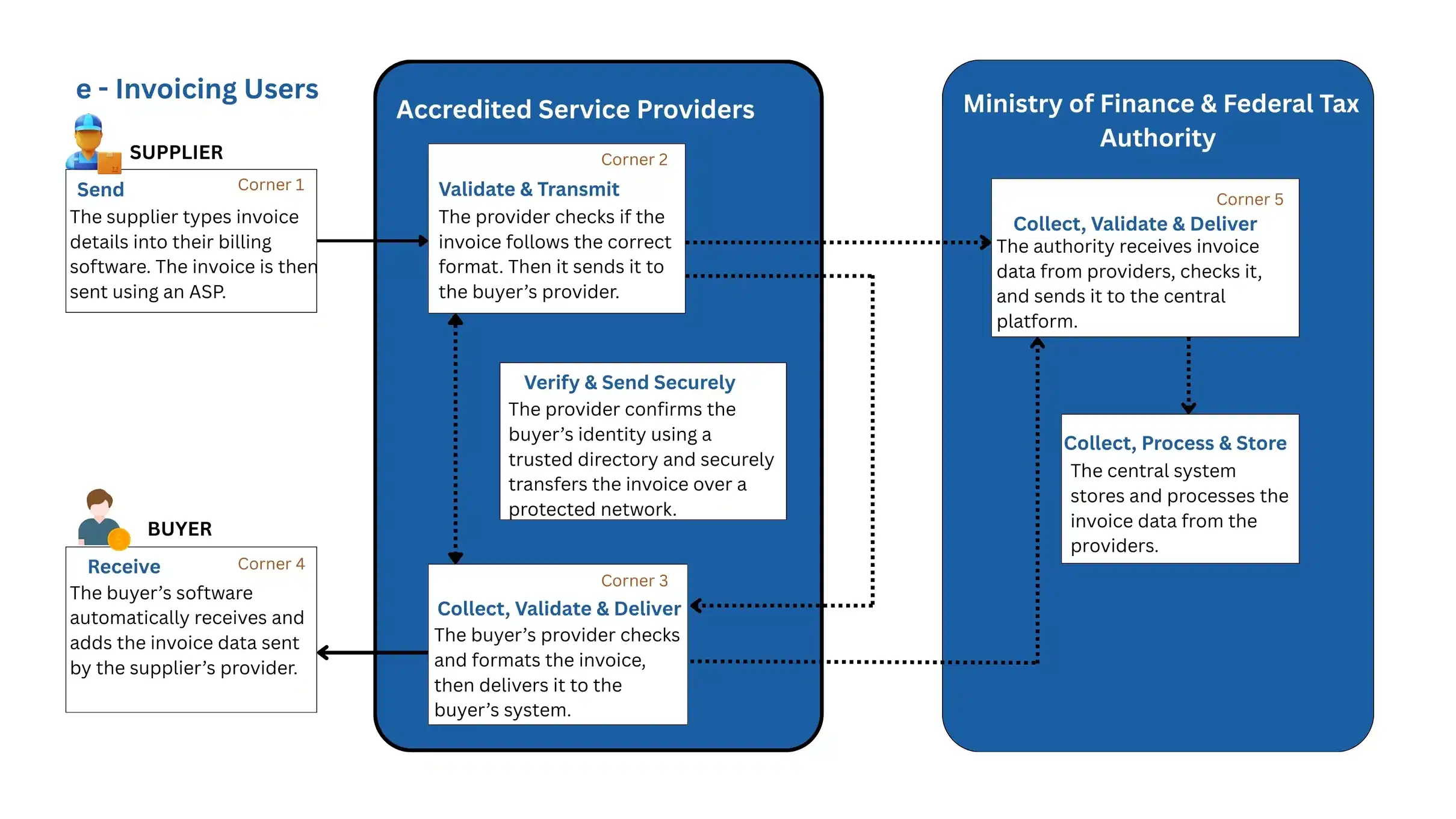
The UAE follows the internationally recognised Peppol 5-Corner Model, allowing businesses to exchange invoices securely through Accredited Service Providers (ASPs).
- Step 1: Invoice Creation
The supplier creates an invoice using its ERP, accounting, or billing system in the required structured format.
- Step 2: Invoice Validation
The supplier's Accredited Service Provider validates the invoice, ensuring it complies with UAE technical and regulatory requirements.
- Step 3: Invoice Exchange
Once validated, the supplier's ASP securely transmits the invoice to the buyer's Accredited Service Provider, which then delivers it to the buyer.
- Step 4: Reporting to the Authorities
Invoice information is transmitted through the approved framework to support Ministry of Finance and Federal Tax Authority reporting requirements.
- Step 5: Digital Storage
Both parties retain electronic records in accordance with UAE record-keeping requirements for future audits and compliance reviews.
Who Must Comply with UAE E-Invoicing?
The UAE is introducing e-invoicing through a phased implementation approach. Businesses that fall within the prescribed categories will need to comply based on the implementation timeline announced by the Ministry of Finance.
The framework primarily applies to:
- VAT-registered businesses
- Business-to-Business (B2B) transactions
- Business-to-Government (B2G) transactions
- VAT Groups
- Government entities included within the phased rollout
Businesses should begin assessing their systems early to avoid last-minute implementation challenges and ensure readiness before their mandatory compliance date.
UAE E-Invoicing Implementation Timeline
The Ministry of Finance has announced a phased rollout to allow businesses sufficient time to prepare for the new framework.
| Phase | Businesses Covered | ASP Appointment Deadline | Mandatory Go-Live |
|---|---|---|---|
| Pilot Programme | Selected participants | As notified by MoF | From 1 July 2026 |
| Voluntary Adoption | Any eligible business | Optional | From 1 July 2026 |
| Phase 1 | Businesses with annual revenue of AED 50 million or more | 30 October 2026 | 1 January 2027 |
| Phase 2 | Businesses with annual revenue below AED 50 million | 31 March 2027 | 1 July 2027 |
| Phase 3 | Government entities (B2G) | 31 March 2027 | 1 October 2027 |
Business-to-Consumer (B2C) transactions are currently outside the scope of the mandatory rollout unless future guidance from the Ministry of Finance provides otherwise.
Preparing Your Business for E-Invoicing
Early preparation helps businesses implement the new framework with minimal disruption while avoiding compliance risks.
- Assess Your Existing Systems: Review your ERP, accounting, and billing software to determine whether they can generate structured electronic invoices and support the UAE's technical requirements.
- Select an Accredited Service Provider (ASP): Choose an MoF-approved Accredited Service Provider capable of validating, transmitting, and receiving invoices under the UAE e-invoicing framework.
- Upgrade and Integrate Your Systems: Configure your accounting or ERP software to generate compliant electronic invoices and integrate with your selected ASP.
- Validate Your Invoice Data: Ensure customer information, Tax Registration Numbers (TRNs), VAT details, and mandatory invoice fields are complete and accurate before implementation.
- Train Your Finance Team: Provide practical training so employees understand the new invoicing workflow, compliance obligations, and reporting procedures.
- Test Before Going Live: Carry out system testing to confirm invoices are successfully generated, validated, transmitted, and received before mandatory implementation begins.
- Monitor Regulatory Updates: The UAE e-invoicing framework will continue to evolve. Regular reviews help ensure your systems remain compliant with future technical and regulatory updates.
Mandatory Information Required on UAE E-Invoices
Every electronic invoice must contain the mandatory information specified under the UAE e-invoicing framework. Missing or incorrect information may cause invoice validation failures.
Required fields include:
- Unique invoice number
- Invoice issue date
- Supplier details
- Buyer details
- Supplier and buyer Tax Registration Numbers (where applicable)
- Description of goods or services
- Quantity and unit price
- Taxable value
- Applicable VAT rate
- VAT amount
- Total invoice value
- Required structured digital format (PINT AE / Peppol compliant)
Ensuring these fields are completed accurately helps businesses avoid processing delays and maintain compliance with UAE e-invoicing requirements.
E-Invoicing Exemptions in the UAE
Although the UAE is introducing mandatory e-invoicing in phases, not every transaction falls within its scope. Certain transactions and sectors are currently exempt under the Ministry of Finance framework.
Common exemptions include:
- Business-to-Consumer (B2C) transactions
- Government activities carried out in a sovereign capacity
- International passenger air transport using electronic tickets
- Certain ancillary airline services using Electronic Miscellaneous Documents (EMDs)
- International air cargo transactions covered by an airway bill during the exemption period
- Eligible VAT-exempt financial services
- Other transactions specifically exempted by the Ministry of Finance
Businesses should review their transaction types carefully, as exemptions may change with future regulatory updates.
Penalties for Non-Compliance
Failure to comply with the UAE's e-invoicing requirements can result in administrative penalties and increased regulatory scrutiny. Early implementation helps businesses avoid unnecessary disruptions and compliance risks.
| Violation | Penalty |
|---|---|
| Failure to implement the e-invoicing system or appoint an Accredited Service Provider (ASP) within the prescribed timeline | AED 5,000 for each month or part thereof |
| Failure to issue or transmit an electronic invoice within the prescribed timeline | AED 100 per invoice, up to AED 5,000 per month |
| Failure to issue or transmit an electronic credit note | AED 100 per credit note, up to AED 5,000 per month |
| Failure to notify the FTA of system failures | AED 1,000 per day of delay |
| Failure to notify an ASP of changes to registered information | AED 1,000 per day of delay |
A proactive implementation strategy reduces the likelihood of penalties while ensuring business continuity throughout the transition.
Common E-Invoicing Challenges
Many businesses underestimate the preparation required for e-invoicing. Addressing common implementation challenges early helps avoid delays during rollout.
- Legacy ERP Systems: Older accounting or ERP systems may not support structured electronic invoice formats or integration with Accredited Service Providers.
- Poor Data Quality: Incorrect customer information, missing Tax Registration Numbers (TRNs), or inconsistent master data can lead to invoice validation failures.
- Integration Complexity: Connecting ERP systems, billing software, and Accredited Service Providers often requires technical planning and testing.
- Staff Readiness: Finance and accounting teams must understand new invoicing procedures, validation rules, and compliance responsibilities.
- Regulatory Changes: As the UAE e-invoicing framework evolves, businesses must regularly review their systems to remain compliant with updated technical specifications.
Accredited Service Providers (ASPs)
Accredited Service Providers (ASPs) are approved intermediaries responsible for validating, transmitting, and receiving electronic invoices within the UAE's e-invoicing framework. Every in-scope business must exchange invoices through an MoF-approved ASP rather than sending invoices directly.
An ASP performs several important functions, including:
- Validating invoice data before transmission
- Applying the required digital security standards
- Exchanging invoices securely between trading partners
- Supporting Ministry of Finance reporting requirements
- Maintaining secure electronic records and transmission logs
Choosing the right ASP is one of the most important decisions during an e-invoicing implementation project.
ASP Eligibility Requirements
Only providers approved by the Ministry of Finance can operate as Accredited Service Providers in the UAE. These providers must satisfy strict technical, operational, financial, and security requirements, including recognised information security standards, business continuity measures, regulatory compliance, and UAE licensing obligations.
Working with approved providers ensures businesses meet the UAE's technical and legal requirements while reducing implementation risks.
Industry-Specific E-Invoicing Solutions
Every industry has different invoicing processes and compliance requirements. Reyson Badger provides tailored E-Invoicing Services in Dubai designed to suit the operational needs of businesses across multiple sectors.
| Industry | Our Solution |
|---|---|
| Healthcare | Automated e-invoicing for hospitals, clinics, diagnostic centres, and healthcare providers with support for VAT-compliant medical billing. |
| Real Estate | Digital invoicing solutions for property developers, real estate agencies, and property management companies. |
| Free Zone Companies | E-invoicing solutions designed for businesses operating in UAE Free Zones while supporting cross-border transactions and VAT compliance. |
| Construction & Contracting | Structured invoicing for milestone billing, retention payments, and project-based invoicing. |
| FMCG & Distribution | Scalable e-invoicing solutions for high-volume invoice processing and distributor networks. |
| Retail & Trading | Automated invoice processing integrated with ERP and inventory systems for faster reconciliation. |
Whether you operate a growing SME or a multinational enterprise, our consultants design solutions that align with your business processes while ensuring regulatory compliance.
Why Choose Reyson Badger for E-Invoicing Services in UAE?
Implementing e-invoicing requires more than software installation—it demands technical expertise, regulatory knowledge, and careful project management. Reyson Badger delivers complete implementation support to help businesses transition confidently.
- Regulatory Expertise: Our consultants stay updated with the latest Ministry of Finance and Federal Tax Authority requirements, ensuring your implementation remains compliant.
- End-to-End Implementation: From readiness assessments to system integration and post-implementation support, we manage every stage of your e-invoicing journey.
- ERP & Software Integration: We work with leading accounting, ERP, and billing platforms to ensure smooth integration with Accredited Service Providers.
- Industry-Specific Solutions: Our implementation approach is tailored to your industry, business structure, transaction volumes, and reporting requirements.
- Ongoing Compliance Support: We continue supporting your business after implementation through system reviews, regulatory updates, and compliance guidance as the UAE framework evolves.
Our E-Invoicing Services in Dubai & UAE
Reyson Badger offers comprehensive E-Invoicing Services in UAE, helping businesses implement compliant digital invoicing systems while minimissing disruption to daily operations.
Our services include:
- E-Invoicing Readiness Assessment: We evaluate your existing accounting systems, ERP platforms, billing processes, and data quality to identify any compliance or technical gaps before implementation.
- ERP & Accounting System Integration: Our specialists configure your ERP and accounting software to generate structured electronic invoices that meet UAE technical standards.
- Accredited Service Provider (ASP) Selection & Onboarding: We help you choose a suitable MoF-approved ASP and manage the onboarding process to ensure seamless invoice exchange.
- Invoice Data Mapping: We align your invoice data with the UAE PINT AE Data Dictionary, ensuring mandatory fields are correctly configured for successful validation.
- Compliance Review & Testing: Before going live, we conduct comprehensive testing to verify invoice generation, transmission, validation, and reporting processes.
- Staff Training: We train finance and operational teams on new workflows, compliance obligations, and best practices for managing electronic invoices.
- Ongoing Support: Our consultants provide continuous support, helping businesses remain compliant as UAE e-invoicing regulations continue to evolve.
With Reyson Badger as your implementation partner, you gain a practical, scalable, and compliant e-invoicing solution that supports long-term business growth while reducing compliance risk.
FAQ
1. What is e‑Invoicing in the UAE?
E‑Invoicing is the electronic creation, exchange, and storage of tax invoices in a standardized digital format. It automates invoicing and enhances compliance with UAE tax regulations.
2. Is e‑Invoicing mandatory in the UAE?
Not yet, but it will be phased in soon. The voluntary phase starts 1 July 2026. Mandatory e‑invoicing applies from 1 January 2027 for large taxpayers (≥ AED 50 million) and 1 July 2027 for smaller taxpayers. Early adoption ensures smooth compliance.
3. Who must comply with e‑Invoicing?
All VAT‑registered businesses must comply based on size:
- Large taxpayers (≥ AED 50 million): mandatory from 1 Jan 2027; ASP registration by 31 Jul 2026.
- Other taxpayers (< AED 50 million): mandatory from 1 Jul 2027; ASP registration by 31 Mar 2027.
- Government entities (B2G): mandatory from 1 Oct 2027; ASP registration by 31 Mar 2027. Applies to taxable B2B and B2G transactions.
4. What is an Accredited Service Provider (ASP)?
An ASP is an approved intermediary that validates and transmits e‑invoices to the Federal Tax Authority (FTA). Partnering with a certified provider ensures secure integration and compliance.
5. What are the benefits of e‑Invoicing?
- Ensures FTA compliance
- Reduces fraud and human error
- Speeds up processing and reconciliation
- Simplifies VAT reporting
6. How can a business prepare for e‑Invoicing?
- Select a certified e‑Invoicing provider
- Map invoice data to the UAE data dictionary
- Integrate e‑Invoicing with ERP or accounting software
7. Who creates the e‑Invoice in self‑billing?
In self‑billing, the buyer generates the e‑Invoice, exchanges it with the seller, and reports it to the FTA through an ASP.
8. What steps should businesses take for implementation?
Review transaction processes, align invoice data with the UAE e‑Invoicing dictionary, and partner with an ASP once the Ministry of Finance (MoF) releases the approved list.
9. Does e‑Invoicing apply to non‑VAT‑registered entities?
No. The framework applies only to VAT‑registered businesses conducting B2B or B2G transactions, unless otherwise specified by the MoF.
10. What is PEPPOL in the UAE?
PEPPOL (Pan‑European Public Procurement Online) is the international framework adopted by the UAE for standardized, secure, and automated exchange of electronic invoices and related documents.
11. How to adopt PEPPOL e‑Invoicing in the UAE?
- Choose an Accredited Service Provider (ASP)
- Integrate internal invoicing systems with the PEPPOL network
- Generate invoices in standardized formats (XML or JSON)
- Test and confirm compliance with UAE e‑Invoicing requirements
Power Up Your Business with UAE E Invoicing in 2026
Simplify E invoicing UAE compliance with smart automation tools. Secure, fast, and fully aligned with UAE regulations for 2026 and beyond.

E-Invoice
Related Blogs
UAE E-Invoicing Timeline & Deadline
28-Jan-2026
E-Invoicing Solutions For Financial Institutions
28-Jan-2026Request a Quote
We’ll get back to you shortlyFAQs
No, businesses do not need to engage directly with the UAE PEPPOL Authority. All communication and coordination are handled by the Accredited Service Provider (ASP) on behalf of the business.
In the UAE, a business is identified using its Tax Identification Number (TIN), which corresponds to the first 10 digits of its Tax Registration Number (TRN). If a business is not yet registered with the Federal Tax Authority (FTA) and does not have a TRN, it must first register to obtain one and receive its TIN.
Yes. Under the UAE’s e-Invoicing system, both the seller and buyer must be connected through Accredited Service Providers (ASPs).
This ensures that invoices are exchanged securely and in a standardized electronic format within the 5-corner model - where each party’s ASP validates, transmits, and reports invoices to the FTA in compliance with e-Invoicing regulations.
Currently, business-to-consumer (B2C) transactions are excluded from the UAE’s e-invoicing requirements, so retail businesses are not mandated to adopt e-invoicing for such transactions
No. UAE e‑invoices must be in a structured digital format (XML/JSON) via an ASP. QR codes are optional.
E-invoices in the UAE must:
Be in digital format such as XML or JSON.
Follow structured standards like UBL or PINT for compliance and interoperability
Latest Blogs
16
Sep
How to Calculate VAT in UAE 2026: Complete Guide
Learn how to calculate VAT in the UAE in 2026, including VAT formulas, taxable amounts, input VAT, output VAT, and practical calculation examples.
READ MORE →
15
Sep
How to Choose an Accredited Service Provider for UAE E-Invoicing?
An e-invoicing service provider helps businesses create, process, transmit and manage electronic invoices through systems designed to support the applicable e-invoicing framework.
READ MORE →
16
Sep
How to Get a UAE Residence Visa: Step-by-Step Guide
Learn how to apply for a UAE residence visa, including visa types, eligibility, required documents, application steps, costs, and common mistakes to avoid
READ MORE →
11
Sep
Accounting Software in UAE: How to Choose the Right Accounting Software for Your Business
Professional Accounting Software Consultant in Dubai or Accounting Software Consultant in UAE services can help you compare suitable options and make a more informed decision.
READ MORE →
10
Sep
How to Register Copyright in the UAE: Requirements, Fees, and Timeline
A practical guide explaining how to register copyright in the UAE, covering requirements, fees, process, timeline, and key benefits for individuals and businesses.
READ MORE →
09
Sep
What Does an Audit Service in Dubai Actually Include? A Full Breakdown
Not sure what an audit actually covers? This guide breaks down the full audit process step by step, from financial checks to reporting and explains what to expect from professional Audit Services in Dubai.
READ MORE →
03
Sep
How Businesses Can Stay VAT Compliant in 2026
Learn how businesses can stay VAT compliant in 2026 through proper registration, accurate filing, record keeping, invoicing, and regular compliance checks.
READ MORE →
04
Sep
UAE E-Invoicing: Latest Rules, Deadlines, Penalties and What Businesses Need to Know in 2026
Reyson Badger, businesses can get support in reviewing their current invoicing processes, understanding applicable requirements and preparing their accounting operations for the transition.
READ MORE →
03
Sep
How Government and Legal Services in UAE Support Business Setup and Operations
Explore how government and legal services help UAE businesses manage setup, licensing, immigration, documentation, compliance, and ongoing administrative requirements.
READ MORE →
02
Sep
Accounting Mistakes That Triggers Tax Issues in the UAE
Our Accounting services in UAE can include ongoing bookkeeping, financial record maintenance, reconciliations, financial reviews, and accounting support tailored to the needs of the business.
READ MORE →