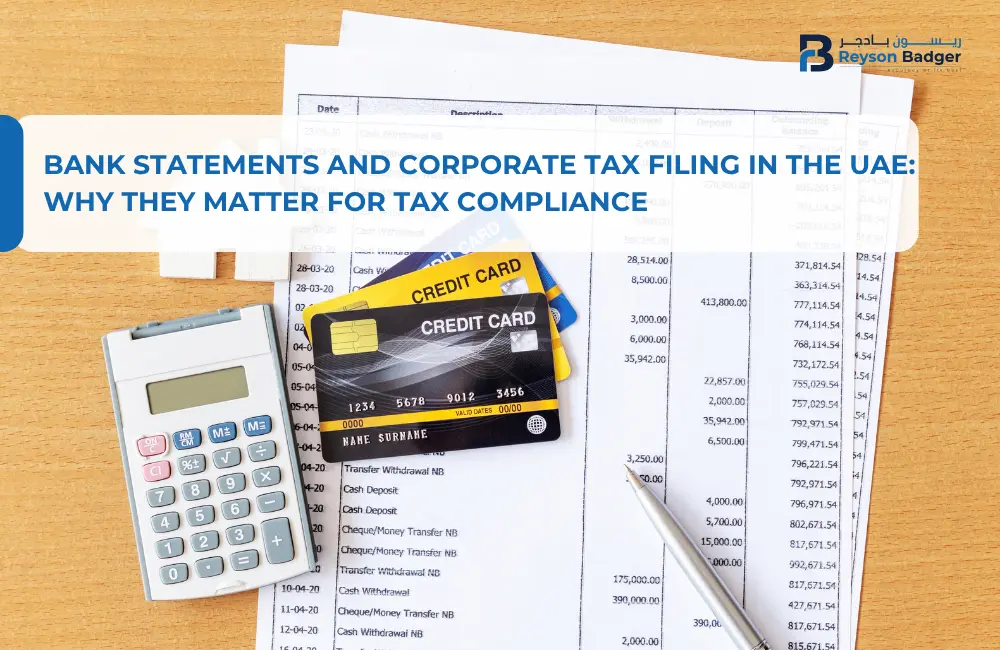


Bank statements are more than records of money entering and leaving a business bank account. For UAE businesses, they can be an important part of the financial records used to verify revenue, expenses, cash movements, and other transactions before preparing a Corporate Tax return. When bank statements do not match the accounting records, businesses may end up with inaccurate financial statements and incorrect tax calculations.
For businesses preparing for Corporate Tax filing in the UAE, regular bank reconciliation is therefore an important accounting control. It helps identify missing transactions, duplicate entries, unexplained deposits, incorrectly classified expenses, and transfers that may have been recorded incorrectly.
Bank statements should not, however, be treated as standalone evidence that an expense is deductible or that a transaction has a particular tax treatment. They should be reviewed together with invoices, receipts, contracts, accounting records, and other supporting documentation.
This article explains how business bank statements support Corporate Tax preparation, what businesses should review before filing, common reconciliation errors, record-keeping considerations, and how professional accounting support can help maintain accurate tax records.
What are Bank Statements?
Definition of a Bank Statement
A bank statement is an official record provided by a bank showing the transactions carried out through a particular account over a specified period. For a business, it provides a chronological record of receipts, payments, transfers, charges, and other account movements.
Business bank statements can be used alongside accounting records to help establish whether transactions recorded in the books correspond with actual movements in the company's bank account.
For Corporate Tax purposes, this makes bank statements a useful supporting record when reviewing the financial information used to prepare the tax return.
What Information Does a Bank Statement Include?
A typical business bank statement may include:
- Business or account holder name
- Bank account details
- Statement period
- Transaction dates
- Customer receipts and other deposits
- Supplier and other payments
- Bank transfers
- Bank charges
- Interest received or paid
- Opening balance
- Closing balance
The exact information and format depend on the bank and account type.
Why Should UAE Businesses Review Bank Statements Regularly?
Waiting until the end of the Tax Period to review bank statements can make reconciliation more difficult. Monthly or regular reviews allow businesses to identify discrepancies while the transactions are still easy to trace.
Regular reviews can help businesses:
- Identify transactions missing from the accounting system
- Detect duplicate entries
- Investigate unusual receipts or payments
- Match transactions with invoices and supporting documents
- Keep bookkeeping records up to date
- Improve the accuracy of financial statements
- Prepare more reliable information for Corporate Tax calculations
Why Bank Statements are Important for Corporate Tax Filing in the UAE?
Bank statements can provide an additional layer of verification when a business reviews its accounting records before filing its Corporate Tax return.
Verify Business Income
Business receipts appearing in bank statements should generally be compared with the revenue recorded in the accounting system.
For example, if a customer pays AED 25,000 into the company's bank account, the accounting records should contain the corresponding sales transaction, subject to the nature and accounting treatment of that transaction.
A reconciliation can reveal situations where:
- Sales have been recorded but payment has not been identified
- Customer receipts have entered the bank but were not recorded in the books
- A receipt has been recorded twice
- A deposit has been incorrectly classified as revenue
Investigating these differences before filing helps ensure that the financial information used for Corporate Tax purposes is complete and accurate.
Support Business Expense Claims
Bank statements can help businesses identify payments made to suppliers, employees, service providers, landlords, and other parties.
However, a bank payment by itself does not automatically establish that an expense is deductible for Corporate Tax purposes.
The payment should normally be considered together with supporting evidence such as an invoice, contract, receipt, or other relevant documentation and the applicable Corporate Tax rules.
For example, a payment of AED 10,000 to a supplier may appear clearly on the bank statement, but the business should still be able to establish what the payment relates to and whether the related expense is treated appropriately for tax purposes.
Reconcile Accounting Records
Bank reconciliation involves comparing the transactions and balance shown by the bank with the corresponding accounting records.
This process can identify:
- Unrecorded bank charges
- Outstanding transactions
- Timing differences
- Missing receipts
- Duplicate entries
- Incorrect balances
- Unidentified payments
Resolving these issues before preparing the Corporate Tax return can improve the reliability of the underlying financial information.
Detect Missing or Duplicate Transactions
Even a small accounting error can affect reported income or expenses.
Suppose a business receives three customer payments but only two are entered into the accounting system. The bank statement can help identify the missing receipt.
Similarly, if the same supplier payment has been entered twice in the accounting system, reconciliation can help detect the duplicate.
Strengthen Audit Readiness
If the Federal Tax Authority (FTA) reviews a business's tax affairs, the business may need to substantiate information contained in its accounting and tax records.
Well-organized bank statements, reconciliations, invoices, contracts, receipts, and financial statements can make it easier to trace transactions and explain the figures reported.
Bank statements are therefore best maintained as part of a broader financial documentation system rather than stored separately from the accounting records.
How Bank Statements Support UAE Corporate Tax Compliance?
Matching Income With Financial Records
One useful control is to compare bank deposits against:
- Sales invoices
- Customer accounts
- Revenue ledgers
- Receivables records
- Other relevant accounting entries
Where a bank deposit cannot be matched to an accounting entry, the business should investigate it rather than automatically treating it as taxable sales or ignoring it.
The transaction could represent a customer payment, shareholder funding, a loan, an internal transfer, or another type of receipt.
Confirming Deductible Expenses
Businesses should review payments against their supporting documents before finalizing their tax calculations.
This means asking:
What was paid? Who was paid? Why was it paid? Is there supporting documentation? How should it be treated under the UAE Corporate Tax rules?
This approach is more reliable than simply classifying every bank payment as a deductible business expense.
Identifying Taxable Transactions
Bank reconciliation can help businesses identify transactions that require further accounting or tax review.
This is particularly important where a company has multiple types of transactions, such as:
- Trading revenue
- Service income
- Loans
- Shareholder contributions
- Intercompany transfers
- Asset purchases
- Refunds
- Deposits
- Investment-related transactions
Not every bank movement represents income or an expense. Proper classification is therefore essential.
Supporting Tax Return Documentation
The figures reported in a Corporate Tax return should be supported by appropriate accounting and financial records.
Bank statements can form part of this supporting documentation, particularly where they help establish the movement and nature of business transactions.
What to Check in Bank Statements Before Filing Corporate Tax in the UAE?
A detailed bank statement review before Corporate Tax filing can prevent many avoidable accounting problems.
Deposit Accuracy
Review all significant deposits and confirm that they have been appropriately recorded.
Unexplained deposits should be investigated before the tax return is finalized.
Payment Verification
Large or unusual payments should be matched with relevant invoices, contracts, receipts, or other supporting records.
This is especially important for expenses that materially affect taxable income.
Bank Charges and Interest
Bank charges and interest transactions should be separately reviewed and appropriately recorded.
Businesses should avoid grouping all bank-related transactions into a single generic account because different transactions may have different accounting or tax treatments.
Loan Transactions
Loan proceeds should not normally be confused with business revenue.
Similarly, repayment of loan principal should not automatically be treated as an ordinary business expense.
Businesses should reconcile loan-related bank transactions with:
- Loan agreements
- Repayment schedules
- Accounting records
- Interest calculations
Transfers Between Business Accounts
A company operating multiple bank accounts may regularly transfer funds between them.
These transfers should be identified correctly so that the same money is not accidentally recorded as additional income or expense.
For example, transferring AED 50,000 from a company's operating account to its savings account does not create AED 50,000 of new business revenue.
Outstanding or Unusual Transactions
Before filing, businesses should investigate:
- Large unexplained deposits
- Unusual supplier payments
- Old outstanding transactions
- Unidentified transfers
- Suspicious duplicate entries
Significant differences between bank and ledger balances
Common Bank Statement Errors that can Affect UAE Corporate Tax Filing
Missing Business Transactions
If a receipt or payment is not recorded in the books, the financial statements may not reflect the company's actual financial position.
Missing transactions can consequently affect the information used in Corporate Tax calculations.
Personal Expenses Paid From Business Accounts
Mixing personal and business spending makes accounting and tax review more difficult.
Business owners should maintain a clear distinction between company transactions and personal expenses. Where a personal transaction has been paid from a business account, it should be correctly identified and recorded rather than incorrectly treated as a deductible business expense.
Duplicate Entries
Duplicate transactions can overstate revenue or expenses.
For example, if one supplier payment appears twice in the accounting system while it appears only once on the bank statement, the reconciliation process can help identify the duplication.
Unreconciled Bank Balances
An unreconciled difference between the bank statement and accounting ledger means the financial records may not yet be complete.
Businesses should investigate and resolve material differences before finalizing their financial statements and Corporate Tax calculations.
Incorrect Transaction Categorization
A transaction can be recorded in the books but still be classified incorrectly.
For example, a loan receipt, capital contribution, asset purchase, or internal transfer may be incorrectly classified as ordinary business income or an operating expense.
Correct classification is therefore as important as recording the transaction itself.
Best Practices for Managing Bank Statements in the UAE
Download Statements Every Month
Maintain statements for each business bank account on a regular basis.
Monthly records make it easier to track transactions and investigate discrepancies.
Reconcile Bank Accounts Regularly
Monthly bank reconciliation is a practical accounting control for businesses of all sizes.
Instead of waiting for Corporate Tax filing, businesses can identify and correct discrepancies throughout the year.
Keep Digital Copies Securely
Electronic copies should be stored in an organized system with appropriate access controls and backup procedures.
Businesses should be able to retrieve records when required.
Maintain Supporting Documents for Transactions
Bank statements should be maintained together with relevant:
- Invoices
- Receipts
- Contracts
- Purchase documents
- Sales records
- Payment confirmations
- Loan agreements
- Financial statements
Separate Business and Personal Banking
Using dedicated business bank accounts helps create a clearer audit trail and makes reconciliation easier.
It also reduces the risk of personal transactions being incorrectly included in business accounting records.
UAE Corporate Tax Record-Keeping Requirements
What Financial Records Should UAE Businesses Maintain?
Businesses should maintain accounting records and supporting documents that allow their financial position and transactions to be properly established.
Depending on the business, records may include:
- Bank statements
- Sales invoices
- Purchase invoices
- Receipts
- Contracts
- General ledger
- Trial balance
- Financial statements
- Payroll records
- Asset registers
- Tax records
Relevant correspondence and supporting documentation
The exact records required can vary according to the business's activities and circumstances.
How Long Should UAE Businesses Keep Tax Records?
UAE businesses should pay close attention to the applicable Corporate Tax record-keeping requirements and retain records supporting their tax returns and financial information for the required period.
Records should not simply be kept until the Corporate Tax return has been submitted. They should remain accessible for the applicable statutory retention period.
Why Proper Record Keeping Matters During an FTA Review?
Good record keeping allows a business to explain how reported figures were calculated and provide supporting evidence when required.
A properly maintained trail from bank transaction → accounting entry → supporting document → financial statement → Corporate Tax return creates a much stronger compliance framework.
Using Accounting Software With Bank Statements
Modern accounting systems can make bank reconciliation more efficient, particularly when bank feeds are available.
Automatic Bank Feeds
Where supported, bank feeds can import transactions directly into accounting software.
This can reduce manual data entry and provide accounting teams with more timely transaction information.
Faster Bank Reconciliation
Accounting software can help match bank transactions with existing accounting entries and identify unmatched items for review.
Real-Time Financial Reporting
Once transactions are correctly recorded and reconciled, businesses can obtain better visibility into:
- Revenue
- Expenses
- Cash balances
- Receivables
- Payables
- Cash flow
Reduced Manual Errors
Automation can reduce repetitive data entry, but it does not remove the need for professional review.
Transactions still need to be correctly classified and unusual items investigated.
How Reyson Badger Helps With Corporate Tax Filing in the UAE
Preparing a Corporate Tax return is not simply about entering numbers into the FTA system. The quality of the underlying accounting records can significantly affect the reliability of the tax return. Reyson Badger can support UAE businesses with the accounting and financial review required before Corporate Tax filing.
Bank Statement Review and Reconciliation:
Our team can review business bank statements against accounting records to identify missing, duplicate, or incorrectly recorded transactions.
Accurate Corporate Tax Preparation
We help businesses organize their financial information and prepare the records needed to support Corporate Tax calculations and return filing.
Bookkeeping and Accounting Support
Regular bookkeeping helps ensure that bank transactions, invoices, expenses, and other financial activity are recorded throughout the year rather than reconstructed shortly before the tax deadline.
UAE Corporate Tax Compliance Guidance
Businesses can receive support in understanding applicable Corporate Tax filing and documentation requirements and maintaining appropriate financial records.
Audit-Ready Financial Documentation
Organized financial records can make it easier to respond to questions or documentation requests during an FTA review.
Conclusion
Bank statements play an important supporting role in UAE Corporate Tax filing because they provide a reliable record against which businesses can compare their accounting transactions. Regular reconciliation can help identify missing income, duplicate entries, incorrectly classified transactions, unexplained payments, and other discrepancies before they affect financial statements or tax calculations.
However, bank statements should not be viewed in isolation. Accurate Corporate Tax compliance requires a complete financial trail supported by invoices, contracts, receipts, accounting records, financial statements, and other relevant documentation.
For UAE businesses, maintaining these records throughout the year is generally more effective than trying to reconstruct financial information when the Corporate Tax filing deadline approaches. Professional bookkeeping, bank reconciliation, and tax support can make this process more structured and efficient.
Reyson Badger can assist businesses with bookkeeping, bank reconciliation, accounting records, Corporate Tax preparation, and ongoing UAE tax compliance. Contact our team to discuss your business's accounting and Corporate Tax requirements.