Top 20 Corporate Tax Consultants in UAE
19-Jan-2026
Corporate Tax in UAE: Complete Compliance Guide
Understand corporate tax rates, registration requirements, filing deadlines, exemptions, and Free Zone benefits under UAE tax law.
Corporate Tax in UAE 2026 Guide: Rates, Registration & Compliance
The United Arab Emirates (UAE) implemented a federal Corporate Tax (CT) system in June 2023. This new regime aims to diversify the country's revenue streams and position it as a more competitive global business hub. This guide will provide you with a comprehensive overview of the key aspects of UAE Corporate Tax.
Objectives of Corporate Tax
The UAE introduced corporate tax to:
- Strengthen its position as a global business hub.
- Support economic growth and strategic transformation.
- Ensure compliance with international tax transparency standards.
- Prevent harmful tax practices and promote fair competition.
Who is Subject to UAE Corporate Tax?
The Corporate Tax applies to most businesses and commercial activities conducted within the UAE, with a few exceptions. Here's a breakdown of who is subject to the tax:
Individuals do not pay corporate tax on their salary or employment income. The corporate tax regime applies to individuals only when they carry on a business activity (e.g. sole proprietorship, freelancing) and are classified as taxable persons. In such cases, business profits are taxed under the same brackets: 0% up to AED 375,000, 9% above that (unless otherwise exempt).
1. Companies & Legal Entities Required to Pay Corporate Tax in Dubai, UAE
a) UAE-Based Companies
Mainland Companies: All businesses registered in the UAE (except exempt entities).
Free Zone Companies:
- Subject to 0% CT if they qualify as a Qualifying Free Zone Person (QFZP).
- Taxed at 9% if they do not meet QFZP conditions or earn mainland-sourced income.
b) Foreign Companies with UAE Presence
Businesses with a Permanent Establishment (PE) in the UAE (e.g., branch offices, physical offices).
Companies earning UAE-sourced income (e.g., from real estate, services, or contracts performed in the UAE).
c) Tax Groups
Companies under 75% common ownership can form a tax group and file a consolidated return.
2. Individuals Subject to Corporate Tax in UAE
Self-employed professionals & freelancers (if annual business income exceeds AED 375,000).
Sole proprietorships & individual business owners engaged in commercial activities.
3. Exempt Entities (Do Not Pay Corporate Tax)
The following are generally exempt from UAE corporate tax:
- Government & semi-government entities
- Public benefit organizations & charities (approved by the FTA)
- Pension & social security funds
- Qualifying investment funds
- Extractive businesses (oil & gas, subject to emirate-level taxes)
- Non-resident businesses with no UAE-sourced income or PE
4. Special Cases & Conditions
a) Free Zone Businesses (0% Tax Under Conditions)
To benefit from 0% CT, a free zone company must:
- Conduct qualifying activities (e.g., manufacturing, trading, logistics).
- Maintain adequate substance in the UAE (office, employees, operations).
- Not earn mainland UAE-sourced income (unless permitted).
- Comply with transfer pricing and anti-abuse rules.
b) Non-Resident Businesses (Only Taxed on UAE Income)
Foreign companies without a UAE presence are only taxed on:
- Income from a UAE Permanent Establishment (PE).
- UAE-sourced income (e.g., real estate, service contracts).
UAE Corporate Tax Rates
1. Resident Taxable Person
0% Tax
- If taxable income is up to AED 375,000
- Encourages small and growing businesses
9% Tax
- If taxable income is above AED 375,000
- Applies only to the amount exceeding the threshold
- Applies per tax period, even if you operate multiple business activities.
2. Free Zone Companies
Qualifying Free Zone Businesses
- 0% Corporate Tax
- Conditions:
- Earn qualifying income
- Maintain economic substance in UAE
- Follow transfer pricing rules
- Do not opt for standard taxation
Non-Qualifying Free Zone Income
- 9% Corporate Tax
- Applies when income does not meet qualifying criteria
3. Large Multinational Companies (MNEs)
- 15% Minimum Tax (DMTT)
- Applies if:
- Global revenue exceeds €750 million
- Threshold met in at least 2 of the last 4 years
- Effective from 1 January 2025 under global tax rules.
4. Small Business Relief
- 0% Tax (Temporary Relief)
- Eligibility:
- Revenue ≤ AED 3 million
- Valid until:
- End of 2026
Eligible businesses can treat taxable income as zero.
Small Business Relief in UAE
For many small businesses, the biggest concern is whether corporate tax will impact their cash flow. This is where Small Business Relief becomes important.
Businesses with revenue up to AED 3 million can opt for this relief, which is currently available until 2026. Instead of calculating taxable income in detail, eligible businesses are treated as having no taxable income. That essentially means no corporate tax liability during the relief period.
However, this doesn’t mean businesses can ignore compliance. You still need to maintain proper records, file returns, and ensure that revenue is not artificially split to stay within the threshold.
For example, if a small consultancy firm earns AED 900,000 annually, it can benefit from this relief and avoid corporate tax while still staying compliant with filing requirements.
Free Zone Corporate Tax Explained
One of the most talked-about areas in UAE corporate tax is how free zone businesses are treated.
Many assume that free zone companies automatically enjoy 0% tax, but that’s only true if they qualify under specific conditions.
To be considered a qualifying free zone person, a business must maintain real economic substance in the UAE, earn qualifying income (such as international trade), and comply with all regulatory and documentation requirements.
If a free zone company earns income from mainland UAE, that portion becomes taxable at 9%.
For instance, a free zone company exporting goods internationally may enjoy 0% tax, but if it starts selling directly within the UAE market, that local income will be taxed.
The key takeaway here is that free zone benefits depend on compliance not just location.
What Income is Taxable in UAE?
Corporate tax applies to different types of income, and understanding this helps avoid confusion during filing.
Income generated within the UAE such as sales, services, or operations is taxable. Additionally, UAE-resident businesses are taxed on their global income, meaning foreign earnings are also considered.
Passive income, such as interest or royalties, may also fall under taxable income depending on the context.
For example, a UAE-based company providing services to international clients must include that income when calculating taxable profit.
What Income is Exempt from Corporate Tax?
Not all income is taxed, and this is where the UAE system provides relief.
Dividends received from qualifying shareholdings are generally exempt. Similarly, capital gains from selling shares may also be exempt if conditions are met.
Transactions within the same corporate group can qualify for tax neutrality, and certain free zone income remains tax-free if eligibility criteria are satisfied.
These exemptions are designed to avoid double taxation and support business growth.
Corporate Tax Calculation in UAE
At its core, corporate tax calculation is based on accounting profit, adjusted for specific items.
The formula is simple:
Taxable income = Accounting profit plus or minus adjustments
Businesses can deduct legitimate expenses such as salaries, rent, and operational costs. However, certain expenses like fines or penalties are not deductible.
For example, if a company reports an accounting profit of AED 500,000 and has AED 20,000 in non-deductible expenses, the taxable income becomes AED 520,000. The 9% tax is then applied to this amount.
Understanding these adjustments is crucial to avoid overpaying or underreporting tax.
Tax Loss Carry Forward Rules
If your business incurs losses, the UAE allows you to carry them forward to reduce future tax liability.
However, only up to 75% of taxable income can be offset using previous losses, and losses cannot be carried backward.
For instance, if a company makes a loss in one year and a profit the next, it can use that loss to reduce taxable income but only within the allowed limit.
This helps businesses manage financial fluctuations without being penalized during recovery periods.
Transfer Pricing Rules in UAE
Transfer pricing ensures that transactions between related parties are conducted fairly.
The UAE follows the arm’s length principle, meaning transactions must be priced as if they were between unrelated entities.
Businesses involved in related-party transactions must maintain proper documentation to justify pricing. This includes agreements, benchmarking studies, and financial records.
Failure to comply can lead to adjustments and penalties, so proper documentation is essential.
Withholding Tax in UAE
One of the advantages of the UAE tax system is the 0% withholding tax on most cross-border payments.
This means payments like dividends, interest, and royalties sent abroad are generally not subject to withholding tax, making the UAE an attractive location for international business operations.
Tax Grouping & Group Relief
Businesses operating under a group structure can benefit from tax grouping.
If a parent company owns at least 95% of its subsidiaries, they can form a tax group and file a single corporate tax return.
This simplifies compliance and allows losses in one entity to offset profits in another, improving overall tax efficiency.
Register For Corporate Tax in UAE
According to Decision No. 3 of 2024 from the Federal Tax Authority, starting from March 1, 2024, the FTA has set forth deadlines for all businesses and taxable individuals to enrol. This enrolment pertains to all businesses (legal entities) possessing a trade license. The deadlines are staggered to allow the Federal Tax Authority (FTA) enough time to properly evaluate applicants.
Under FTA Decision No. 3 of 2024 (effective 1 March 2024), registration deadlines vary by the month of licence issuance.
- For licences issued before 1 March 2024, deadlines are set according to the month of issuance — for example, licences issued in January–February → register by 31 May 2024; March–April → register by 30 June 2024, and so on.
- For businesses licensed on or after 1 March 2024, registration must be completed within 3 months of licence issuance.
- Entities that fail to register by their deadline are subject to an administrative penalty of AED 10,000.
Regardless of the year of issuance of the license, the date of license issuance is taken into consideration.
Here are the deadlines for submitting a Corporate Tax registration application:
| License Issuance Period | Deadline for Tax Registration Application |
|---|---|
| Before 1 March 2024 | 31 May 2024 (for May/June 2024 deadlines) |
| Between 1 March 2024 and 31 December 2024 | Within 3 months of licence issuance |
| On or after 1 January 2025 | Within 3 months of licence issuance |
Notes:
- Businesses operating before 1 March 2024 had to register by 31 May 2024 (if their turnover exceeded AED 1 million in 2023).
- New businesses (licences issued after 1 March 2024) must register within 3 months of incorporation or licence issuance.
- The Federal Tax Authority (FTA) may adjust deadlines, so it's best to check the latest updates on the FTA website.
Businesses failing to submit their Corporate Tax registration applications within the specified timelines will face an administrative penalty of AED 10,000 for late registration.
Steps to Corporate Tax Filing in UAE
Filing Corporate Tax in Dubai, UAE, is a structured and straightforward process designed to ensure compliance with Federal Decree-Law No. 47 of 2022. Here’s how businesses can file their Corporate Tax returns:
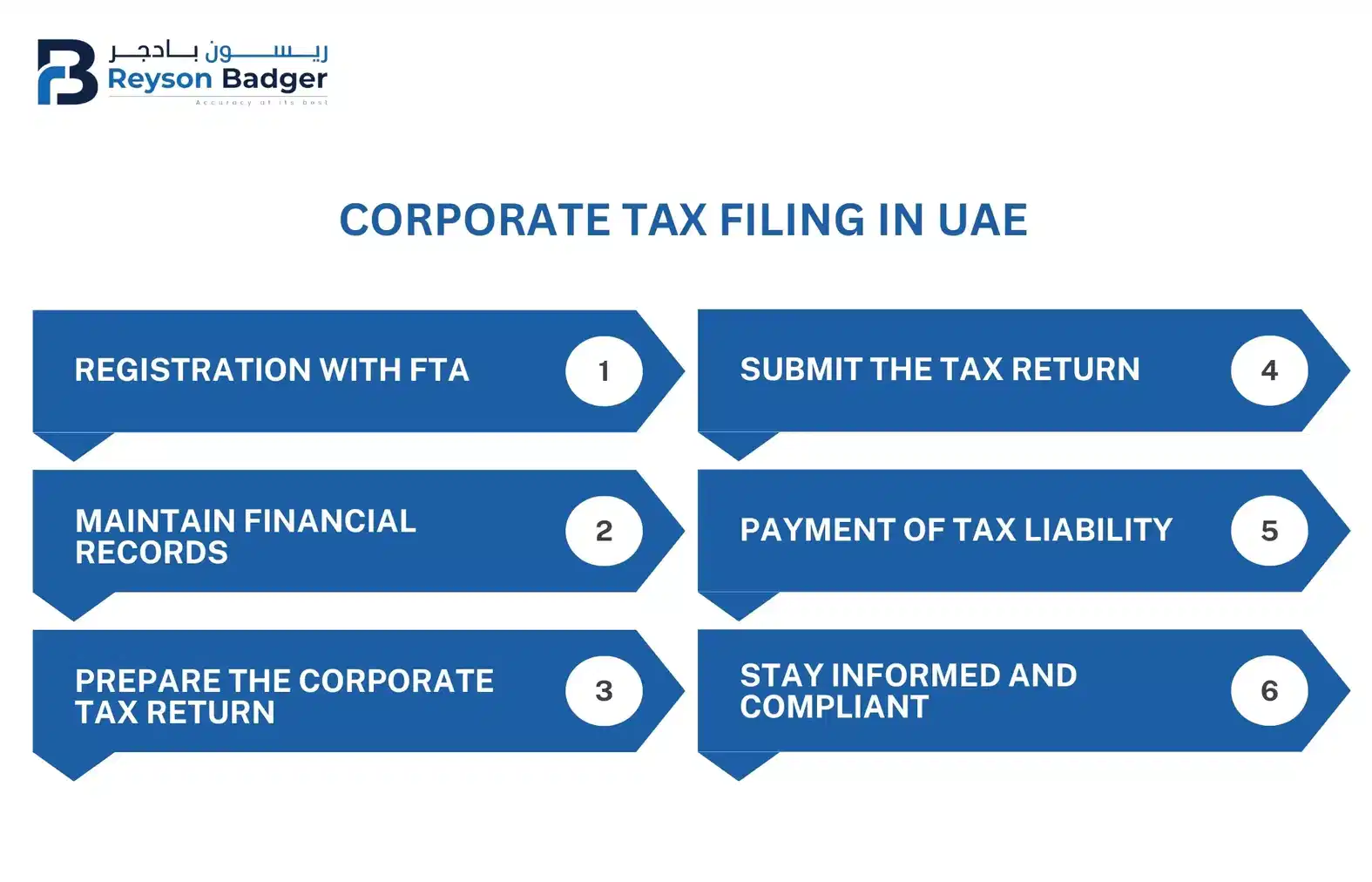
Step 1: Registration with FTA
- All taxable persons must register on the Federal Tax Authority’s (FTA) EmaraTax platform.
- Obtain a unique Tax Registration Number (TRN).
Step 2: Maintain Financial Records
- Maintain accurate financial records and compute taxable income.
- Identify eligible deductions, exemptions, and reliefs (e.g., small business relief, group transfers).
Step 3: Prepare the Corporate Tax Return
- Calculate your taxable income by adjusting your accounting profit for any exemptions, reliefs, or deductions as specified by the UAE Corporate Tax Law.
- The UAE imposes a 0% tax rate on taxable income up to AED 375,000 and a 9% rate on taxable income exceeding this threshold.
Step 4: Submit the Tax Return
- Submit your corporate tax return electronically through the EmaraTax portal within 9 months of the financial year’s end.
- The UAE requires that all corporate tax returns be filed online via the EmaraTax portal. The system is dynamic, presenting tailored questions and schedules based on the taxpayer's specific circumstances related to Corporate Tax in Dubai.
Step 5: Payment of Tax Liability
- Determine your tax liability based on the applicable rates and ensure payment is made by the specified deadline to avoid penalties.
Step 6: Stay Informed and Compliant
- Regularly consult the FTA's official communications and guidelines to stay updated on any changes in tax laws or filing procedures.
- Consider seeking advice from tax professionals to ensure full compliance and to address any complexities specific to your business operations.
Corporate Tax in Dubai, UAE
The UAE's corporate tax rules are new and evolving, so it's smart to have a well-thought-out plan from the start. This will make it easier to adjust to any future changes. Since the tax landscape is constantly shifting, it's important to regularly review your strategy and get advice from UAE tax experts. By being proactive and staying informed, your business can handle the complexities of UAE corporate taxes. Reyson Badger is here to expertly guide your organization through all aspects of UAE corporate tax compliance and optimization – both now and in the years ahead.
Corporate Tax



Request a Quote
We’ll get back to you shortlyFAQs
The UAE introduced a federal corporate tax starting 1 June 2023. Businesses pay 0% tax on profits up to AED 375,000 and 9% on profits above that amount. The law applies to mainland companies and eligible free zone businesses, with certain exemptions
Some entities do not pay UAE corporate tax. These include government and government-controlled entities, natural resource businesses, qualifying public benefit organizations, and approved investment funds, as long as they meet conditions set by the Federal Tax Authority
If a business fails to register, file returns, or pay UAE corporate tax on time, penalties may apply. These include administrative fines, late filing penalties, and charges on unpaid tax. The FTA may offer relief initiatives, but timely compliance is still required
Free zone companies can benefit from 0% corporate tax on qualifying income if they meet the conditions of a Qualifying Free Zone Person. Any non-qualifying income is taxed at 9%, and businesses must follow substance and reporting rules
To calculate UAE corporate tax, start with your business profits from financial statements. Apply allowable deductions and exemptions. Profits up to AED 375,000 are taxed at 0%, while profits above that are taxed at 9%, unless free zone benefits apply
Qualifying Free Zone Income is income earned by an eligible free zone company from approved activities. This income is taxed at 0%, provided the business meets substance requirements, follows transfer pricing rules, and qualifies as a Qualifying Free Zone Person
The standard rate is 9%, with certain income qualifying for 0% tax.
Yes, if they conduct business activities and exceed the threshold, though they may qualify for Small Business Relief.
It allows eligible businesses with revenue up to AED 3 million to avoid paying corporate tax.
Not entirely. Corporate tax now applies, but the UAE remains highly tax-efficient.
You may face penalties and compliance issues with the tax authority.
Latest Blogs
12
Jun
How UAE Accounting Services Help Businesses Stay 100% FTA Compliant
Discover how expert accounting services in UAE reduce filing errors, prevent FTA penalties, and keep your business audit-ready and compliant.
READ MORE →
11
Jun
Do UAE E-Invoicing Need QR Codes? Explained Simply
The right E-invoicing Services in UAE, businesses can ensure smooth compliance, improve efficiency, and stay ready for the future of digital taxation in the UAE.
READ MORE →
10
Jun
The Importance of Audit Services in UAE for Manufacturing Businesses
READ MORE →
10
Jun
How to Close a Business in Dubai: Complete Guide to Company Liquidation
Learn how to close a business in Dubai with this complete guide to company liquidation. Understand the legal requirements, liquidation process, document preparation, license cancellation procedures, and compliance obligations to ensure a smooth and hassle-free business closure in the UAE.
READ MORE →
16
Jun
Anti-Money Laundering Regulations in UAE: How AML Compliance Services Keep You Protected
AML Compliance Services in the UAE help businesses meet anti-money laundering rules, reduce financial crime risk, and avoid regulatory penalties.
READ MORE →
04
Jun
In-House Accountant vs Outsourced Accounting in Dubai: Real Cost Comparison for 2026
Our outsourced accounting services Dubai are structured around each client's business size, transaction volume, and compliance requirements, not a generic package.
READ MORE →
29
May
Mandatory vs Voluntary VAT Registration in the UAE: Which One is Right for Your Business?
Understand mandatory vs voluntary VAT registration in the UAE, including turnover thresholds, compliance requirements, benefits, and how to choose the right VAT registration option for your business.
READ MORE →
29
May
Difference Between Regular and Golden Visa in UAE
Learn the differences between Regular and Golden Visas in the UAE, including eligibility, duration, and benefits.
READ MORE →
26
May
Corporate Tax Year-End Accounting Checklist for Dubai Businesses: What to Prepare Before the Deadline
Professional support through accounting services in Dubai and corporate tax services in UAE makes the difference between a smooth, compliant year-end and a stressful.
READ MORE →
25
May
Understanding Your Rights: Legal Services for Individuals in UAE
A guide to legal services for individuals in the UAE and the importance of understanding your legal right.
READ MORE →