Company Formation in Saudi Arabia vs UAE: Which is Better for Your Business?
03-Mar-2026
Start Your Company Formation in UAE Today
Set up your UAE company smoothly with expert guidance on mainland, free zone, or offshore formation.
Company Formation in UAE

Company Formation in UAE is one of the most strategic business moves for entrepreneurs, investors, and business owners exploring international expansion, and choosing the right company formation services in UAE is critical to getting it right. The United Arab Emirates has established itself as a leading global business hub, strategically located between Europe, Asia, and Africa, which makes it a natural gateway to international markets. Its pro-business environment continues to attract global interest, offering 100% foreign ownership for most activities, zero personal income tax, a competitive 9% corporate tax, and a standard 5% VAT regime. With full repatriation of profits and capital, political stability, and world-class infrastructure, the UAE provides an ideal foundation for startups, SMEs, foreign investors, and multinational companies seeking long-term growth and security.
Business setup in UAE is further strengthened by a fast and transparent company registration process. Licensing and visa procedures are simplified, allowing businesses to get started with minimal delays. The UAE also offers flexible structuring options to suit different commercial needs. Entrepreneurs can choose between mainland, free zone, and offshore company setup based on market access, operational scope, and compliance requirements. Mainland companies allow direct access to the UAE market and eligibility for government contracts. Free zone entities support sector-focused growth and offer ownership and customs advantages. Offshore structures are commonly used for international trading and asset holding.
As a trusted advisor for Company Formation in UAE, Reyson Badger provides end-to-end business setup support across Dubai, Abu Dhabi, and other emirates. The firm covers licensing, visa assistance , and bank account opening . With a strong focus on regulatory compliance and strategic alignment, Reyson Badger supports businesses in building a solid foundation for sustainable growth.
Which Jurisdiction is Right for Your UAE Business Setup?
Here's an overview of the key differences between Free Zones, Mainland, and Offshore jurisdictions in the UAE:
Free Zones
- Autonomous regions with special economic status: Free zones are designated areas within the country that enjoy special economic status, allowing them to operate in an exclusive regulatory framework as compared to the mainland. This enables companies to acquire more favorably phrased economic policies within the UAE.
- Tax Benefits: A Qualifying Free Zone Person (QFZP) can enjoy a 0% corporate tax rate on qualifying income only if it meets FTA’s conditions — including maintaining adequate economic substance, deriving qualifying income from permitted activities, complying with transfer pricing rules, submitting audited financial statements, and staying within the de-minimis threshold.
- Free zones allow 100% foreign ownership: Free zone companies allow 100% foreign ownership. However, to enjoy 0% corporate tax, they must qualify as a ‘Qualifying Free Zone Person (QFZP)’ by meeting FTA conditions such as maintaining adequate substance, earning qualifying income, having audited financials, and staying within the de-minimis limit
- No customs duty on imports/exports: Goods imported into a free zone are typically exempt from customs duty while they remain in that zone. However, if goods are moved into the UAE mainland or sold locally, applicable customs duties will apply.
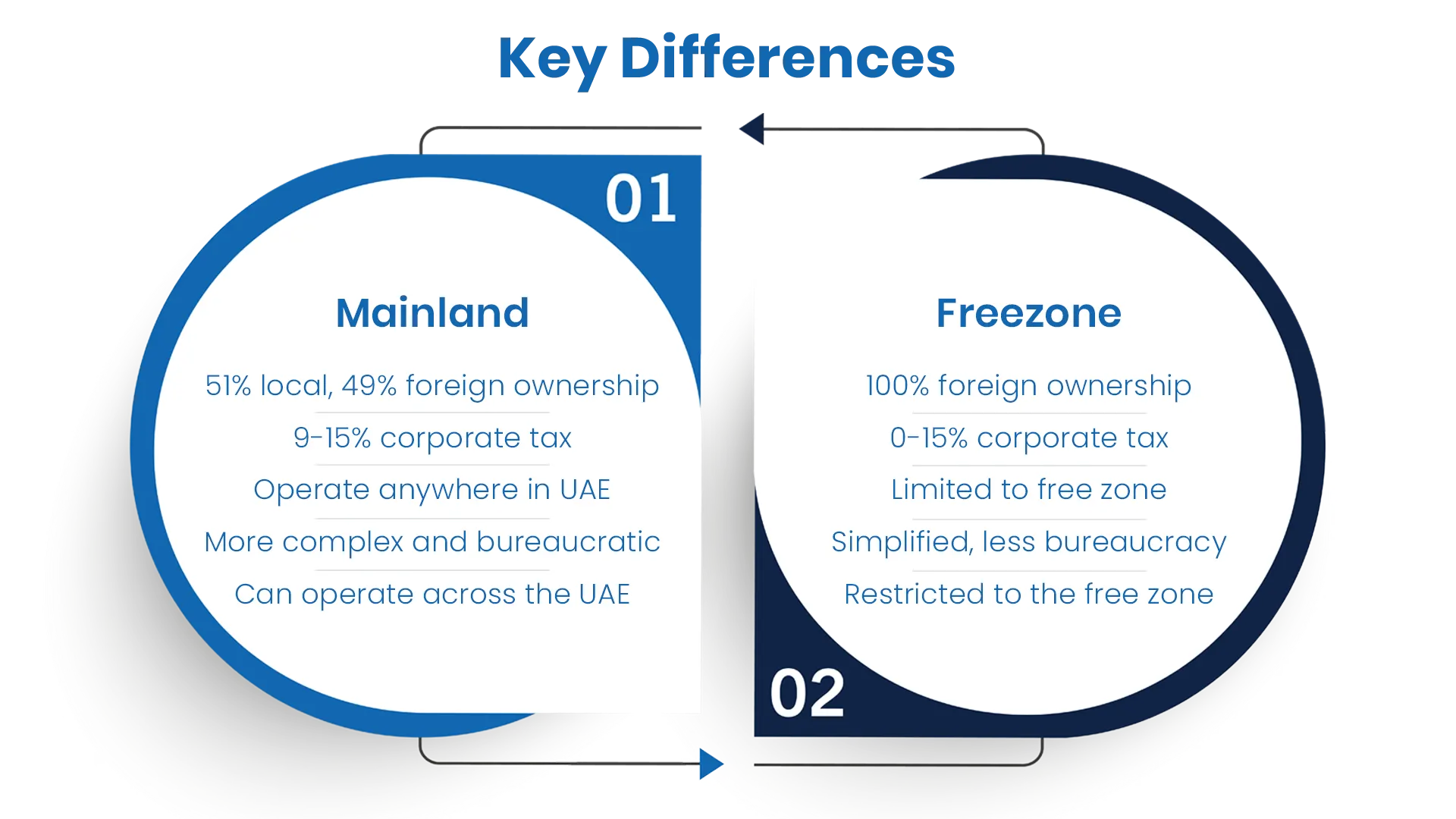
- Simplified licensing and regulation: The free zones ensure streamlined processes in the setting up of business. Recent reforms to the UAE Commercial Companies Law have allowed 100% foreign ownership for most mainland activities. However, certain strategic or regulated sectors (like defense, telecom, banking, or insurance) still require local shareholding or additional regulatory approvals.es by having fewer bureaucratic hurdles and faster licensing compared to mainland companies.
- Limited scope of activities: Although the advantages abound for free zones, business ventures get restricted to performing activities within their areas of operation and are more or less limited while seeking to carry out business elsewhere outside the free zone, especially when it comes to the UAE mainland market.
Major Free Zones
Mainland
- Onshore jurisdiction: Businesses on the mainland are subject to the federal laws of the UAE, hence giving them geographical freedom to operate a business in any part of the country.
- Key Update: Foreign investors can now own 100% of their mainland company for most business activities. However, certain regulated or strategic sectors—such as banking, telecom, or defense—may still require a local partner or specific government approval.
- Corporate Tax Overview: Mainland companies are taxed at 0% on taxable income up to AED 375,000, and 9% on income above that threshold. From 1 January 2025, a 15% Domestic Minimum Top-Up Tax (DMTT) will apply to large multinational enterprises (MNEs) with global revenues of €750 million or more, ensuring alignment with global minimum tax standards. This ensures the UAE's tax regime aligns with international standards.
- Import/export customs duty: Firms operating in the mainland UAE have to pay customs duties on goods imported to or exported out of the UAE, hence the cost of operations goes higher.
- More complex licensing and regulations: the regulatory environment. Licensing and compliance procedures for mainland companies are generally more detailed and may require additional approvals compared to free zone setups.
- Broader scope of activities: Whereas a free-zone company is limited in its scope of activities, mainland businesses are not restricted to any specific type of activities to be undertaken, and they are free to trade within the local UAE market as well as internationally.
UAE Mainland
The United Arab Emirates (UAE) consists of seven mainland jurisdictions across the country.
Offshore
- Special financial and legal framework: Offshore companies have a separate financial and legal framework that is established; there are some regulations that back international business or investment, making it easy and with low bureaucracy.
- 100% foreign ownership: Offshore structures offer 100% foreign ownership without the requirement for local partners or shareholders since, with offshore structures, full control is allowed to international investors.
- Confidentiality and anonymity: Those offshore companies supply the most confidentiality and anonymity; in such places, the amount of information in the public domain regarding company ownership or finances is minimal, offering protection of the identity of owners/shareholders.
- Activity scope: Offshore companies are designed for international operations or asset holding. They are not permitted to conduct business within the UAE domestic market.
- No physical presence is necessary: offshore firms can be established without requiring any office or staff in the UAE which thereby enables flexible and cost-effective operations.
UAE OFFSHORE
The most popular jurisdictions for offshore company setup
- DIFC OFFSHORE
- ADGM OFFSHORE
- Jebel Ali Free Zone Authority
- Offshore (JAFZA Offshore)
- Ajman Offshore
- Ras Al Khaimah International
- Corporate Centre (RAK ICC)
- Dubai Offshore
Differences Between Setting Up a Mainland Business v/s a Free Zone Business
Criteria | Mainland Business | Free Zone Business |
|---|---|---|
Ownership Structure |
|
|
Taxation |
|
|
Business Activities |
|
|
Location |
|
|
Number of Employees |
|
|
Dealing with Local Entities |
|
|
Office Space |
|
|
Customs Duty |
|
|
Licensing and Regulations |
|
|
Bureaucracy |
|
|
Key Business Setup Differences
Choosing Between the Mainland and the Free Zone
- Assess your business needs and long-term goals
- Evaluate regulatory and ownership requirements
- Consider tax implications and compliance
- Weigh the advantages of ownership and operational control
- Research the location’s accessibility and strategic fit
- Consult with experts for tailored advice
Legal Requirements for Business Setup in the UAE
Business Structure: While setting up a business in the UAE, entrepreneurs can opt for registration of a company through one of the five structures: Sole Establishment, Limited Liability Company, Free Zone Company , Branch Office, or Representative Office. Each structure has its merits and demerits, and the form of structure chosen by an entrepreneur will also have an impact on the process of registration and regulatory requirements of a UAE company.
Registration Documents: The formal documents to officially register the company in the UAE are
- Passport and proof of address
- Memorandum & Articles of Association (MOA/AOA)
- shareholder and director resolutions
- lease or tenancy agreement (Ejari or equivalent)
- bank reference or financial documents
- any sectoral approvals.
All documents must be notarized, attested, and legalized where required.
- Regulatory Approvals: Before setting up a business, many UAE companies must have regulatory approvals from various departments. If the company falls in the healthcare or finance sectors, it requires additional approvals. However, if it does not, it would still need to have a few more categories of approval, such as the Ministry of Economy, the Department of Economic Development (DED), and Free Zone Authorities.
- Tax Registrations: In the UAE, businesses must register for VAT and, if applicable, Corporate Tax. The UAE currently does not impose any general withholding tax on domestic or most cross-border payments. The Federal Tax Authority (FTA) administers the tax registration and compliance.
- Business Licenses: There are some business licenses that firms in the UAE must obtain. These include trade licenses , commercial licenses, industrial licenses, professional licenses, and some specific licenses. DED or Free Zone Authoritie s issue these licenses.
- Local Compliance Laws: Local compliance includes adherence to the UAE Companies Law, Labour and Immigration Laws, Corporate Tax Law, VAT Law, and the UAE Personal Data Protection Law (PDPL – Federal Decree-Law No. 45 of 2021), alongside environmental and health regulations.
How to form a Company in the UAE?
Step by Step Company Formation Process in the UAE
Starting a company in the UAE is simple when you follow the right process. Reyson Badger provides complete support to help you set up your business smoothly and legally in the UAE.
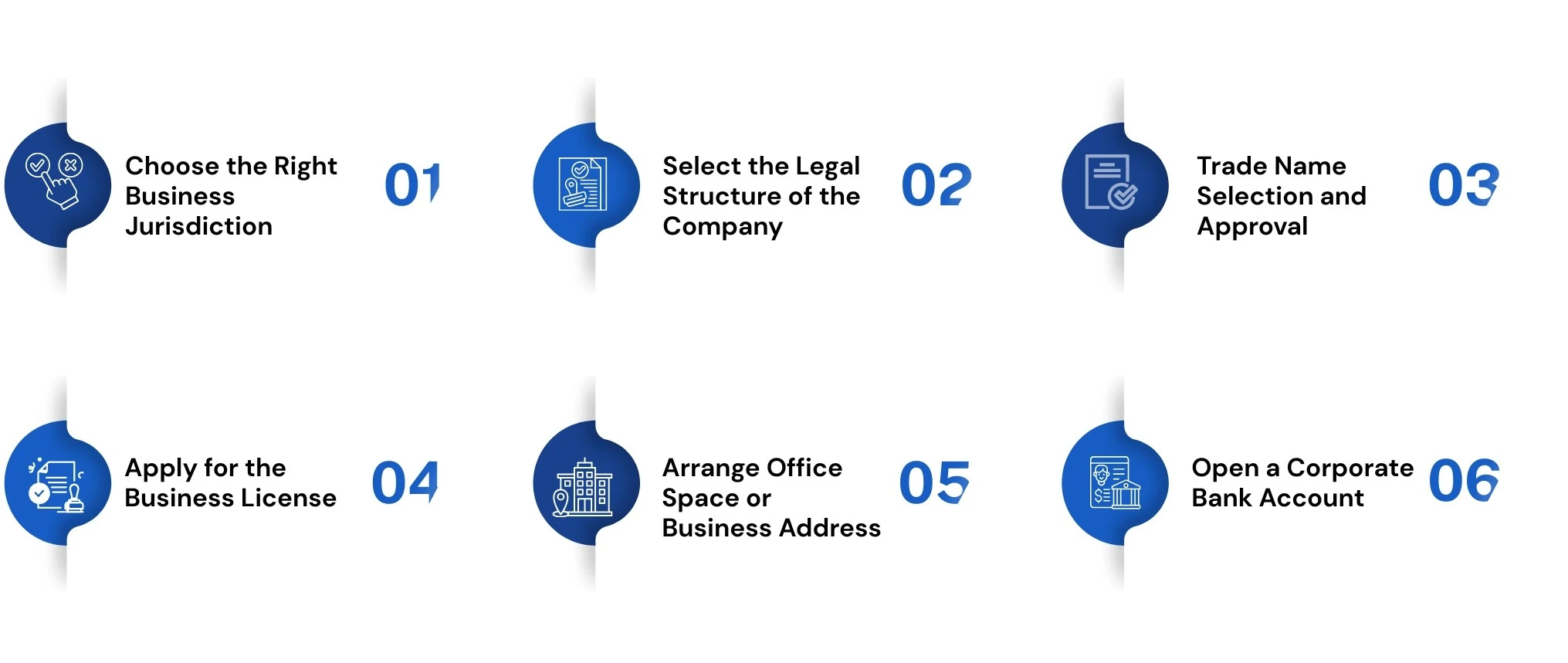
Step 1: Choose the Right Business Jurisdiction
The first step is selecting the correct location for your business. You can choose between mainland, free zone, or offshore company formation.
- Mainland companies can conduct business freely across the UAE market.
- Free zone companies provide 100% foreign ownership along with various tax advantages.
- Offshore companies are suitable for international operations and do not require a physical office.
Our specialists analyse your business goals and advise the most suitable option.
Step 2: Select the Legal Structure of the Company
After choosing the jurisdiction, you must decide on the legal structure of your business. Common structures include limited liability company, sole establishment, free zone company, and branch office.
Each structure has different ownership rules and compliance requirements. Reyson Badger helps you choose the structure that fits your business activities and future plans.
Step 3: Trade Name Selection and Approval
Choosing a trade name is an important step in company formation. The UAE has clear guidelines for business names. The name should not include offensive words, religious references, or well-known organisation names.
We assist in checking name availability and obtaining trade name approval from the relevant authority.
Step 4: Apply for the Business License
Once the trade name is approved, the next step is applying for the business license.
- For mainland companies, applications are submitted to the Department of Economy.
- For free zone companies, applications are submitted to the respective free zone authority.
Our team handles documentation, approvals, and license issuance without delays.
Step 5: Arrange Office Space or Business Address
Most businesses in the UAE require a registered office address. This can be a physical office, shared workspace, or flexi desk, depending on the business activity.
Reyson Badger assists in arranging office solutions that meet legal requirements. Offshore companies are not required to maintain a physical office presence.
Step 6: Open a Corporate Bank Account
Opening a corporate bank account is the final step in the process. UAE banks follow strict compliance procedures. Proper documentation is required for approval.
We support you in selecting the right bank and completing the account opening process smoothly.
Ensure a smooth setup process by avoiding these common mistakes: Business Setup Mistakes in the UAE & How to Avoid Them in 2025?
Form Your Company in the UAE with Reyson Badger
To make a truly informed decision, a comprehensive understanding of the regulatory landscape and legal requirements is crucial. This is where professional guidance becomes indispensable.
With years of experience in providing company formation and advisory services, Reyson Badger offers the perfect solution for your business setup in the UAE. Whether you're looking at a mainland or free zone company, we'll ensure the process is smooth and fully compliant.
Ready to start your journey? Contact Reyson Badger today to find out more about how we can help with your business registration and licensing in the UAE.
FAQs
1. What is the easiest and cheapest way to set up a company in the UAE?
Usually through a free zone: fast setup, 100% foreign ownership, and packaged costs. The mainland gives more flexibility to trade across the UAE but may have more requirements.
2. How long does UAE company formation take?
In many free zones, a few days to 2 weeks if documents are ready. Mainland can take a bit longer due to extra approvals and tenancy contracts.
3. What documents do foreign investors need to form a company in the UAE?
Typically: passport copies, photos, proposed trade name and activities, proof of address, MOA/AOA, and an office/desk lease. Some activities need extra government approvals.
Company Formation in UAE
Business Setup in Saudi Arabia
- Iqama Services in Saudi Arabia
- Bank Account Opening in Saudi Arabia
- Dedicated GRO Services in Saudi Arabia
- Premium Residency in Saudi Arabia
- ZATCA Registration in Saudi Arabia
- MLSD Registration in Saudi Arabia
- GOSI Registration in Saudi Arabia
- Baladiyah approval in Saudi Arabia
- Company Formation in Dammam
- Company Formation in Riyadh
- Company Formation in Jeddah
- Saudisation Consultancy & Employee Transfer Services in Saudi Arabia
- Commercial Registration in Saudi Arabia
- MISA License in Saudi Arabia
Company Formation in UAE
- Company Formation in UAE Offshore
- Company Formation in UAE Mainland
- Free Zone Company Formation
- Company Formation in Dubai International Academic City (DIAC)
- Company Formation in Gold and Diamond Park (DGDP)
- Company Formation in Dubai Design District
- Company Formation in Dubai Industrial City (DIC)
- Company Formation in Dubai Healthcare City (DHCC)
- Company Formation in Dubai International Financial Centre (DIFC)
- Company Formation in Dubai Internet City (DIC)
- Company Formation in Dubai Logistics City
- Company Formation In Dubai Media City(DMC)
- Company Formation in Dubai Multi Commodities Center (DMCC)
- Company Formation in Dubai Silicon Oasis Authority (DSOA)
- Company Formation in Dubai Outsource City (DOC)
- Company Formation in Dubai Studio City
- Company Formation in Dubai Techno Park (DTP)
- Company Formation in Dubai South Free Zone
- Company Formation in Dubai Science Park (DSP)
- Company Formation in Jebel Ali Free Zone Authority (JAFZA)
- Company Formation in Rakez Freezone
- Company Formation Services in Jebel Ali Free zone
- Company Formation in Dubai Wholesale City
- Company Formation in Dubai Freezone
- Company Formation in Dubai Production City (DPC)
- Company Formation in Dubai Humanitarian
- Company Formation in Energy and Environmental Park
- Ras Al Khaimah Mainland Company Formation
- Company Formation in Dubai Flower Centre (DFC)
- Umm Al Quwain Mainland Company Formation
- Company Formation in Dubai Auto Zone (DAZ)
- Company Formation in Creative City Free Zone Authority
- Company Formation in Dubai Textile City(DTC)
- Company Formation in Fujairah Mainland
- E-Commerce Company Formation UAE

Request a Quote
We’ll get back to you shortlyLatest Blogs
12
Jun
How UAE Accounting Services Help Businesses Stay 100% FTA Compliant
Discover how expert accounting services in UAE reduce filing errors, prevent FTA penalties, and keep your business audit-ready and compliant.
READ MORE →
11
Jun
Do UAE E-Invoicing Need QR Codes? Explained Simply
The right E-invoicing Services in UAE, businesses can ensure smooth compliance, improve efficiency, and stay ready for the future of digital taxation in the UAE.
READ MORE →
10
Jun
The Importance of Audit Services in UAE for Manufacturing Businesses
READ MORE →
10
Jun
How to Close a Business in Dubai: Complete Guide to Company Liquidation
Learn how to close a business in Dubai with this complete guide to company liquidation. Understand the legal requirements, liquidation process, document preparation, license cancellation procedures, and compliance obligations to ensure a smooth and hassle-free business closure in the UAE.
READ MORE →
16
Jun
Anti-Money Laundering Regulations in UAE: How AML Compliance Services Keep You Protected
AML Compliance Services in the UAE help businesses meet anti-money laundering rules, reduce financial crime risk, and avoid regulatory penalties.
READ MORE →
04
Jun
In-House Accountant vs Outsourced Accounting in Dubai: Real Cost Comparison for 2026
Our outsourced accounting services Dubai are structured around each client's business size, transaction volume, and compliance requirements, not a generic package.
READ MORE →
29
May
Mandatory vs Voluntary VAT Registration in the UAE: Which One is Right for Your Business?
Understand mandatory vs voluntary VAT registration in the UAE, including turnover thresholds, compliance requirements, benefits, and how to choose the right VAT registration option for your business.
READ MORE →
29
May
Difference Between Regular and Golden Visa in UAE
Learn the differences between Regular and Golden Visas in the UAE, including eligibility, duration, and benefits.
READ MORE →
26
May
Corporate Tax Year-End Accounting Checklist for Dubai Businesses: What to Prepare Before the Deadline
Professional support through accounting services in Dubai and corporate tax services in UAE makes the difference between a smooth, compliant year-end and a stressful.
READ MORE →
25
May
Understanding Your Rights: Legal Services for Individuals in UAE
A guide to legal services for individuals in the UAE and the importance of understanding your legal right.
READ MORE →