E-Invoicing Coming to the UAE: What Businesses Should Know in 2026
23-Jan-2026
E-Invoicing Services for UAE Construction Firms
Streamline construction billing with Reyson Badger’s
E-invoicing services in UAE. Ensure
VAT compliance, ERP integration, and faster payments.
E-Invoicing for Construction & Contracting Firms in UAE
The UAE construction and contracting sector plays a vital role in the country’s economic development. With large-scale infrastructure projects, real estate developments, and government contracts, the industry handles high-value and high-volume financial transactions daily.
As the UAE moves toward mandatory structured e-invoicing, construction firms must prepare for a shift from traditional billing methods to digital, compliant invoicing systems by adopting E-invoicing Services in UAE that are tailored to the construction sector.
E-invoicing in UAE is particularly relevant for construction businesses because of their complex billing structures, multi-party transactions, and strict VAT reporting requirements. From progress billing to subcontractor payments, every invoice must now align with digital compliance standards.
Adopting digital invoicing for contractors is not only about regulatory compliance it also improves efficiency, transparency, and financial control.
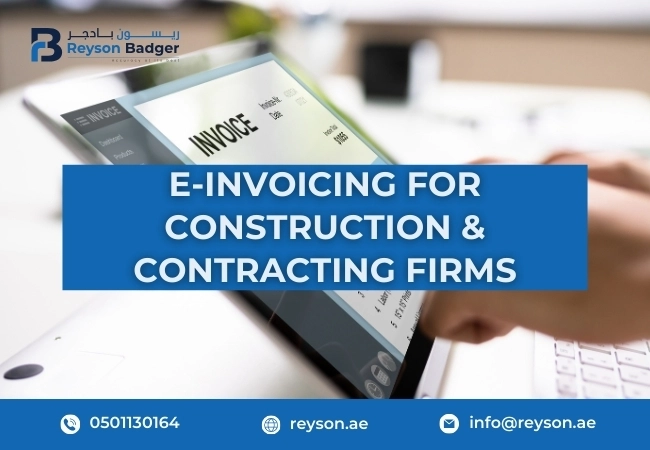
Mandatory E-Invoicing Requirements for Construction Firms
The UAE’s evolving e-invoicing framework requires businesses to issue invoices in structured digital formats that can be validated and, where applicable, reported to authorities.
For construction companies, this means adapting contract-based billing processes to meet compliance standards.
Key regulatory expectations include:
- Structured invoice formats
Invoices must include standardized data fields such as supplier details, VAT registration numbers, contract references, tax breakdowns, and project information. - Accurate VAT calculation and reporting
Construction projects often involve staged payments, retention amounts, and subcontractor billing all of which must reflect correct VAT treatment. - Secure digital storage and audit trails
Invoices must be stored electronically and be easily retrievable for tax audits and compliance reviews.
Meeting E-invoice compliance UAE standards is essential to avoid penalties, project payment delays, or disputes with clients. For projects based in Dubai, aligning with E-invoicing in Dubai requirements ensures smoother collaboration with government entities, developers, and major contractors.
Strategic Benefits for Construction & Contracting Firms
While compliance is a key driver, e-invoicing offers several strategic advantages for construction businesses.
Faster Invoice Processing
Construction projects often involve multiple approval levels. E-invoicing automates invoice submission, validation, and approval workflows, reducing processing time and speeding up payments.
Reduced Administrative Workload
Manual invoice preparation, printing, and reconciliation consume significant administrative resources. Automated systems eliminate repetitive tasks and reduce paperwork.
Greater Transparency & Fewer Disputes
Structured digital invoices provide clear documentation of:
- Project milestones
- Retention amounts
- Variations and change orders
- Subcontractor charges
This clarity reduces disputes between contractors, consultants, and project owners.
Enhanced VAT Compliance
Accurate tax calculation and structured invoice reporting help firms meet VAT obligations efficiently, lowering compliance risks.
Improved Financial Control
Real-time tracking of receivables and payables supports better cash flow management — a critical factor in the construction industry.
Implementation Considerations for Contracting Firms
Construction billing is more complex than standard product invoicing. Therefore, choosing the right e-invoicing solution is crucial.
Selecting the Right Solution
Firms must consider:
- Transaction volume
- Number of subcontractors
- Project-based billing requirements
- Multi-site operations
A scalable system ensures smooth processing even for large infrastructure projects and supports future regulatory changes related to E invoicing UAE.
ERP Integration E-Invoicing UAE
Integration is essential for seamless operations.
E-invoicing solutions should connect directly with:
- Accounting systems
- Project management platforms
- ERP software
- Procurement systems
This ensures automated data flow from project billing to financial reporting.
Managing Complex Billing Structures
Construction contracts typically involve:
- Milestone-based invoicing
- Progress payments
- Retention deductions
- Advance payments
- Change order adjustments
An effective e-invoicing system must handle these complexities without manual intervention.
Supporting Digital Transformation
Beyond compliance, implementing e-invoicing positions construction firms for long-term digital transformation. It enhances operational visibility, improves reporting accuracy, and supports modern financial management practices.
Why Choose Professional E-Invoicing Services for Construction & Contracting Firms?
Construction and contracting firms deal with complex billing structures, including milestone payments, retention amounts, variations, and subcontractor charges. Even small mistakes in invoice formatting, VAT treatment, or reporting can cause payment delays and compliance risks.
Professional e-invoicing services ensure full compliance with UAE VAT and upcoming e-invoicing regulations while accurately managing staged and project-based billing. Integrated solutions connect seamlessly with accounting and ERP systems, reducing manual work, minimizing errors, and improving efficiency. Secure digital record-keeping also strengthens audit readiness and financial transparency.
Expert implementation reduces technical challenges and workflow disruptions. Partnering with Reyson Badger ensures smooth adoption through compliance assessment, ERP integration, structured invoice configuration, and ongoing regulatory support. With the right e-invoicing solution, construction firms can streamline operations, protect cash flow, and maintain strong regulatory compliance with confidence.
E-Invoice
Related Blogs
UAE E-Invoicing Timeline & Deadline
28-Jan-2026
E-Invoicing Solutions For Financial Institutions
28-Jan-2026Request a Quote
We’ll get back to you shortlyFAQs
E-invoicing for construction companies is based on project-driven billing rather than simple transactions. Invoices are generated against milestones, progress percentages, or completed work stages, all in a structured digital format compliant with UAE regulations.
Construction invoicing involves long-term contracts, retention amounts, advance payments, and subcontractor billing. These elements must be accurately reflected in structured e-invoices, making compliance more detailed compared to standard invoicing models.
Yes, all parties involved in B2B or B2G transactions—including contractors, subcontractors, and suppliers—must comply with UAE e-invoicing regulations once implemented.
Latest Blogs
12
Jun
How UAE Accounting Services Help Businesses Stay 100% FTA Compliant
Discover how expert accounting services in UAE reduce filing errors, prevent FTA penalties, and keep your business audit-ready and compliant.
READ MORE →
11
Jun
Do UAE E-Invoicing Need QR Codes? Explained Simply
The right E-invoicing Services in UAE, businesses can ensure smooth compliance, improve efficiency, and stay ready for the future of digital taxation in the UAE.
READ MORE →
10
Jun
The Importance of Audit Services in UAE for Manufacturing Businesses
READ MORE →
10
Jun
How to Close a Business in Dubai: Complete Guide to Company Liquidation
Learn how to close a business in Dubai with this complete guide to company liquidation. Understand the legal requirements, liquidation process, document preparation, license cancellation procedures, and compliance obligations to ensure a smooth and hassle-free business closure in the UAE.
READ MORE →
16
Jun
Anti-Money Laundering Regulations in UAE: How AML Compliance Services Keep You Protected
AML Compliance Services in the UAE help businesses meet anti-money laundering rules, reduce financial crime risk, and avoid regulatory penalties.
READ MORE →
04
Jun
In-House Accountant vs Outsourced Accounting in Dubai: Real Cost Comparison for 2026
Our outsourced accounting services Dubai are structured around each client's business size, transaction volume, and compliance requirements, not a generic package.
READ MORE →
29
May
Mandatory vs Voluntary VAT Registration in the UAE: Which One is Right for Your Business?
Understand mandatory vs voluntary VAT registration in the UAE, including turnover thresholds, compliance requirements, benefits, and how to choose the right VAT registration option for your business.
READ MORE →
29
May
Difference Between Regular and Golden Visa in UAE
Learn the differences between Regular and Golden Visas in the UAE, including eligibility, duration, and benefits.
READ MORE →
26
May
Corporate Tax Year-End Accounting Checklist for Dubai Businesses: What to Prepare Before the Deadline
Professional support through accounting services in Dubai and corporate tax services in UAE makes the difference between a smooth, compliant year-end and a stressful.
READ MORE →
25
May
Understanding Your Rights: Legal Services for Individuals in UAE
A guide to legal services for individuals in the UAE and the importance of understanding your legal right.
READ MORE →