
Start Your UAE Offshore Company Today
Form your UAE offshore company with expert guidance. Enjoy tax benefits, privacy, and fast registration support.
Company Formation in UAE Offshore
Offshore companies have become an attractive option for international investors looking to establish a business presence in the UAE by forming a company. These entities provide unique benefits such as asset protection and tax optimisation, making them appealing to those seeking global business opportunities.
What is an Offshore Company in the UAE?
An Offshore Company in the UAE is essentially a business registered in a specific UAE jurisdiction (like JAFZA Offshore or RAKICC) but designed to operate outside the UAE itself. It's a popular choice for global entrepreneurs seeking a secure and private base for their worldwide operations without needing a physical presence or engaging in local UAE trade.
What to understand about UAE Offshore Company Formation?
* No Physical Office Needed: Typically, no physical office space is required in the UAE.
* No UAE Residence Visa: Offshore companies do not grant eligibility for a UAE residence visa.
* Mandatory Registered Agent: You must appoint a local registered agent to manage official communications and filings.
* Confidentiality & Compliance: While private, they still adhere to international AML/KYC regulations for banking and operations.
What are the Common Jurisdictions for Offshore Companies in the UAE?
In the United Arab Emirates (UAE), offshore companies are created in the country's specified jurisdictions for international business purposes. It is a host to several perks like tax-free status, complete foreign ownership, and confidential status. Some of the popular offshore jurisdictions of the UAE include:
Ras Al Khaimah International Corporate Centre (RAK ICC)
RAK ICC is an offshore jurisdiction found in the Emirate of Ras Al Khaimah. Its main specialty is in IBC registration and incorporation. RAK ICC is known to be cost-efficient and fast in forming companies. It provides flexibility in its regulatory environment, enabling companies to engage in nearly all types of international business activities.
Jebel Ali Free Zone Authority (JAFZA)
The oldest and most well-known free zone is the Jebel Ali Free Zone (JAFZA) in Dubai, United Arab Emirates. It enables one to form offshore companies that can own in specific areas and operate internationally. This provides the advantage of Dubai's location and infrastructure to offshore companies by JAFZA, making it the favorite for businesses
Ajman Free Zone
Ajman Free Zone offers company formation services in the UAE Offshore with competitive pricing and straightforward procedures. Companies established here can conduct international business, enjoy full foreign ownership, and benefit from the free zone's strategic location near major shipping routes.
What are the advantages of starting a business in the UAE Offshore?
* Tax Advantages: Offshore companies benefit from no corporate taxes on profits and income.
* Privacy and Confidentiality: Owners enjoy strong privacy protections, with minimal disclosure requirements.
* Adaptable Regulatory Environment: The UAE's regulatory framework supports business growth and adaptation to changes in the market.
* Tax Impartiality: The UAE ensures fairness in its tax policies, fostering a competitive business environment.
* Segregation and Safeguarding of Assets: Offshore companies provide a means to protect personal and business assets from local liabilities.
* Accessibility to International Funding Sources: Offshore entities have easier access to global investment opportunities.
Registering an Offshore Company in the UAE: What's the Process?
A company formation in the UAE offshore jurisdiction includes the following steps.
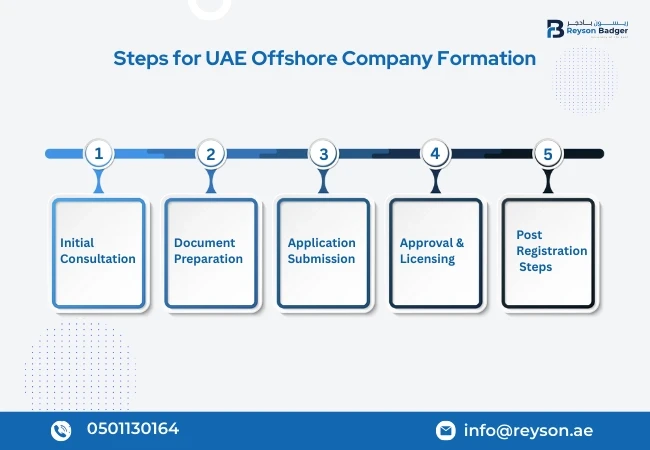
1. Initial Consultation
The registration process starts with a preliminary meeting with a business expert or legal advisor to identify the best offshore jurisdiction in the United Arab Emirates that suits your needs. The major jurisdictions include Ajman Offshore, Ras Al Khaimah International Corporate Centre (RAK ICC), and Jebel Ali Free Zone (JAFZA).
2. Documentation Preparation
Once the jurisdiction selection is completed, the next step is collecting and preparing the necessary documentation. The following are the major documents required for offshore company registration in the UAE.
→ Passport copies of shareholders and directors for identity verification
→ A detailed business plan or company activities
→ Proof of address (like a bank statement or utility bill)
→ A bank reference letter to confirm your banking relationships
→ Legal agreements, including Memorandum and Articles of Association (MOA/AOA)
→ Application forms from the relevant offshore authority
3. Application Submission
The prepared documents are sent to the authority of the appropriate offshore jurisdiction. This can be done by using the respective online portal or by physical submission. In this phase, the offshore company name is reserved, and the fee payment is completed. Before processing the application, authorities could ask for more information or explanations.
4. Approval and Licensing
Once the review process is completed, the offshore authority approves the application, and the company receives its Certificate of Incorporation. Offshore firms in the UAE do not need physical office space, but they must have a registered agent or registered office in the chosen jurisdiction. There is no trade license issued because offshore firms are not permitted to conduct business in the UAE, although they can engage in international trade, asset holding, and other offshore operations.
5. Post-Registration Steps
→ Opening a Corporate Bank Account: Most offshore companies require a UAE or international bank account to conduct transactions.
→ Annual Compliance and Renewals: Offshore firms must meet annual renewal requirements, which include retaining a registered agent and paying renewal fees to the offshore authorities.
→Tax and reporting compliance: While offshore firms enjoy tax benefits, they may be required to comply with international tax standards such as the Economic Substance Standards (ESR) and the Ultimate Beneficial Owner (UBO) declaration.
What are the Key Considerations When Forming a Company in the UAE Offshore?
Here are the main restrictions when setting up an offshore company in the UAE:
→ No Local Business Activities: Offshore companies cannot do business within the UAE or work with local companies.
→ No Trade Licenses: These companies cannot get trade or business licenses in the UAE and can only operate internationally.
→ Property Ownership Limits: Offshore companies can't generally own property in the UAE, except in specific areas like JAFZA.
→ No Employees or Visas: Offshore companies can't hire staff or sponsor work visas in the UAE.
→ Restricted Business Sectors: Offshore companies can't operate in sectors like banking, insurance, or financial services.
→ No Physical Office: These companies don't need office space in the UAE.
→ Limited Banking Services: Offshore companies may face strict rules when opening bank accounts in the UAE.
These rules ensure that offshore companies can only engage in international business, not local UAE operations.
Reyson Badger: Your Trusted Partner for UAE Offshore Company Formation
Company formation in UAE Offshore presents a powerful opportunity for entrepreneurs and investors, offering significant advantages like tax benefits, enhanced privacy, and seamless access to international markets. The process is designed to be straightforward, making it an incredibly attractive option for expanding your global reach.
At Reyson Badger, we offer various company formation services in the UAE, providing expert guidance and support throughout the entire registration journey. Our strong understanding of local regulations and international business practices ensures you navigate every complexity with ease.
What sets Reyson Badger apart? Our commitment to excellence is officially recognized. As an FTA-approved company, we possess profound expertise in the UAE's tax landscape, guaranteeing your offshore setup is compliant from day one. Furthermore, our ISO 9001 certification reflects our dedication to delivering consistently high-quality services through streamlined, client-focused processes.
Choose Reyson Badger to unlock the full potential of your UAE Offshore company. Our certified expertise, personalized service, and commitment to your success make us the ideal partner to establish a secure and prosperous international presence.
FAQs
- Can offshore companies open a bank account in the UAE?
Yes, companies based outside of the UAE can create business bank accounts there. However, banks may impose additional due diligence and compliance requirements.
- Are offshore companies required to comply with the Economic Substance Regulations (ESR)?
Offshore companies must comply with ESR if they engage in "relevant activities" such as holding companies, intellectual property business, or shipping.
- How long does it take to set up an offshore company in the UAE?
The process typically takes 2-5 business days, depending on the jurisdiction and the completion of all documentation.
- Can an offshore company help me obtain a UAE residency visa?
No, but alternative business structures like Free Zone Companies or Mainland Companies can provide visa sponsorship.
- How much initial capital is required for an offshore corporation?
Most offshore jurisdictions in the UAE have no minimum capital requirement.
- Can I use the name of an existing business for my offshore company?
No, the company name must be unique and comply with the naming rules of the offshore jurisdiction.
- Can an offshore company be dissolved or liquidated?
Yes, an offshore company can be liquidated if it is no longer required. The process involves settling debts, closing bank accounts, and officially notifying the offshore authorities. The liquidation process must be handled by the laws of the relevant jurisdiction.
- Can an offshore company in the UAE sponsor employee visas?
No, offshore businesses are not allowed to hire people in the UAE or sponsor visas. Since they do not have a physical presence or operational capacity in the UAE, they are ineligible to apply for UAE employee visas.
- Do UAE offshore companies need to register for Corporate Tax in 2026?
As per the latest Federal Tax Authority (FTA) guidance, corporate tax registration timelines primarily apply to entities subject to UAE Corporate Tax and carrying on a business in the UAE. Offshore companies that do not conduct business in the UAE and only hold international assets or operate outside the country are generally outside the current scope. However, if an offshore structure is used in a way that creates a taxable presence or business in the UAE, registration obligations may arise. Always seek case-specific tax advice to confirm your position.
- Are Economic Substance Regulations (ESR) and UBO rules still applicable to offshore companies in 2026?
Yes. In 2026, offshore companies in the UAE must still assess their obligations under Economic Substance Regulations (ESR) and Ultimate Beneficial Owner (UBO) requirements. If the offshore company conducts any ESR "relevant activities" (such as holding company activity, headquarters business, distribution & service centre business, or IP business), it must file ESR notifications and, where applicable, ESR reports. In addition, accurate UBO information must be maintained and reported in line with UAE regulations to avoid penalties and banking or compliance issues.
Latest Blogs
How UAE Accounting Services Help Businesses Stay 100% FTA Compliant
Discover how expert accounting services in UAE reduce filing errors, prevent FTA penalties, and keep your business audit-ready and compliant.
READ MORE →
Do UAE E-Invoicing Need QR Codes? Explained Simply
The right E-invoicing Services in UAE, businesses can ensure smooth compliance, improve efficiency, and stay ready for the future of digital taxation in the UAE.
READ MORE →
The Importance of Audit Services in UAE for Manufacturing Businesses
READ MORE →
How to Close a Business in Dubai: Complete Guide to Company Liquidation
Learn how to close a business in Dubai with this complete guide to company liquidation. Understand the legal requirements, liquidation process, document preparation, license cancellation procedures, and compliance obligations to ensure a smooth and hassle-free business closure in the UAE.
READ MORE →
Anti-Money Laundering Regulations in UAE: How AML Compliance Services Keep You Protected
AML Compliance Services in the UAE help businesses meet anti-money laundering rules, reduce financial crime risk, and avoid regulatory penalties.
READ MORE →
In-House Accountant vs Outsourced Accounting in Dubai: Real Cost Comparison for 2026
Our outsourced accounting services Dubai are structured around each client's business size, transaction volume, and compliance requirements, not a generic package.
READ MORE →
Mandatory vs Voluntary VAT Registration in the UAE: Which One is Right for Your Business?
Understand mandatory vs voluntary VAT registration in the UAE, including turnover thresholds, compliance requirements, benefits, and how to choose the right VAT registration option for your business.
READ MORE →
Difference Between Regular and Golden Visa in UAE
Learn the differences between Regular and Golden Visas in the UAE, including eligibility, duration, and benefits.
READ MORE →
Corporate Tax Year-End Accounting Checklist for Dubai Businesses: What to Prepare Before the Deadline
Professional support through accounting services in Dubai and corporate tax services in UAE makes the difference between a smooth, compliant year-end and a stressful.
READ MORE →
Understanding Your Rights: Legal Services for Individuals in UAE
A guide to legal services for individuals in the UAE and the importance of understanding your legal right.
READ MORE →