
VAT Impact on Company Profit in UAE: Key Factors Businesses Must Understand
19-Jan-2026
UAE Tax Residency Certificate for Individuals
UAE Tax Residency Certificate Services for Individuals
Avoid double taxation, ensure compliance, and
secure your residency status with expert support.
UAE Tax Residency Certificate for Individuals
The UAE issues a Tax Residency Certificate to Individuals who meet certain criteria, confirming their residency status in the country. This certificate is essential for individuals who wish to take advantage of UAE tax treaties and agreements, avoid double taxation, and demonstrate their compliance with local tax laws. An individual will be considered a UAE tax resident if they have been physically present in the UAE for 183 days or more in a relevant consecutive 12-month period (days do not need to be consecutive). Nationality, residence visa or holding an Emirates ID alone do not automatically qualify an individual for a TRC - the applicant must meet one of the prescribed residency routes (e.g., 183-day test, 90-day + ties test, or the ‘primary place of residence / centre of interests’ test) and provide the required supporting documentation, as part of the TRC Application Criteria. An ‘individual’ is referred to as a ‘natural person’ under UAE law.

Eligibility Criteria - TRC for Individuals in UAE
The following are eligible for a Tax Residency Certificate in the UAE:
- A person who makes the United Arab Emirates their primary or usual domicile and focal point for their financial and personal interests
- The applicant must have been physically present in the UAE for 183 days or more in a relevant consecutive 12-month period (days need not be consecutive and parts of days are counted).
- Under the 90-day route an applicant must: (a) have been physically present in the UAE for at least 90 days in a relevant 12-month period; (b) be a UAE citizen, a UAE resident, or a GCC national; and (c) have either a permanent place of residence in the UAE or be employed in / run a business in the UAE (or meet the continuous right of occupation requirement, as prescribed).
Benefits of a Tax Residency Certificate for Natural Persons
- Tax Residency Certificate helps to avoid Double Taxation of Income.
- Tax Residency Certificate act as a local recognition of the individual in the UAE.
- A Tax Residency Certificate can reduce withholding tax on income earned from UAE sources.
Documents Required for Individual Tax Residency Certificate
- For Treaty Purpose
- For Domestic Purposes
For Treaty Purpose
- Passport
- Valid Residence Permit
- Emirates ID (EID filled must be similar to the name on the card for verification).
- A certified copy of residential lease agreement
- Source of income/salary certificate
- A six-month bank statement from the relevant local bank throughout the request's fiscal year
- Entry and departure reports from the appropriate local government agency or the Federal Authority of Identity and Citizenship.
- Proof of permanent address:
- Electricity bill in the applicant's name or, if relevant, an attested tenancy agreement.
- If the property is owned, a title deed will be accessible.
Source of income:
- Add the share certificate and trading license if the business is an individual..
- The lease agreement must include provisions for an applicant who owns property and utilizes it as a source of income.
- If an applicant has retired it is mandatory for an applicant to provide to the FTA a letter stating that he is using his own savings or bonds or investment. Furthermore, he will furnish an official document of support.
- In the event that the applicant is sponsored by their husband or wife, the applicant should provide a copy of the spouse's salary certificate, marriage certificate, or proof that the spouse has income.
For Domestic Purpose
Applicant is a Natural person resided in the UAE more than 183 days:
- Passport (Compulsory) and Emirates ID / UAE Visa residence if available.
- Entry-Exit report from Authority Source record and Citizenship, or a local competent Government entity.
Single applicant resided in the UAE for less than 183 days, but for at least 90 days:
- Your passport (mandatory) and Emirates ID/ UAE Visa residence if any.
- Entry and exit report from Federal Authority of Identity and Citizenship or local competent Goverment entity.
- Profit Proof/ Salary certificate/ Other Proof that a business is pursued within UAE Or Permanent residence Proof: Title deed, EJARI, Utility Bills or Other long-term Rent Contract.
Applicant is a natural person who have resided in the UAE for less than 90 days:
- Passport (mandatory) and Emirates ID / UAE Visa residence if available.
- Entry and exit report from Federal Authority of Identity and Citizenship
- Proof of Economic and Personal Interests – it shall be determined whether the core of financial and personal interests of a natural person finds itself in the State through the place of occupation, family and social relations, cultural or other activities, place of business, from which its real property is administered, or other facts and circumstances.
- Proofs of permanent place of residence: Title deed, EJARI, Utility Bills or Other long-term Rent Contract
Tax Residency Certificate for Individuals - Application Process
- Submission for the above-mentioned certificate types:
- To apply for TRC, go to the FTA's EMARATAX portal
- You can link your old account to the old TRC site, utilize your existing account on EMARATAX, or register a new one.
- Once you are logged in, choose "other services".
Select the TRN (Tax Registration Number) for which you are applying TRC. Choose "No TRN" as the final choice if there isn't a TRN. By choosing the TRN, the user will be able to have the TRC Portal automatically fill in the information about them.
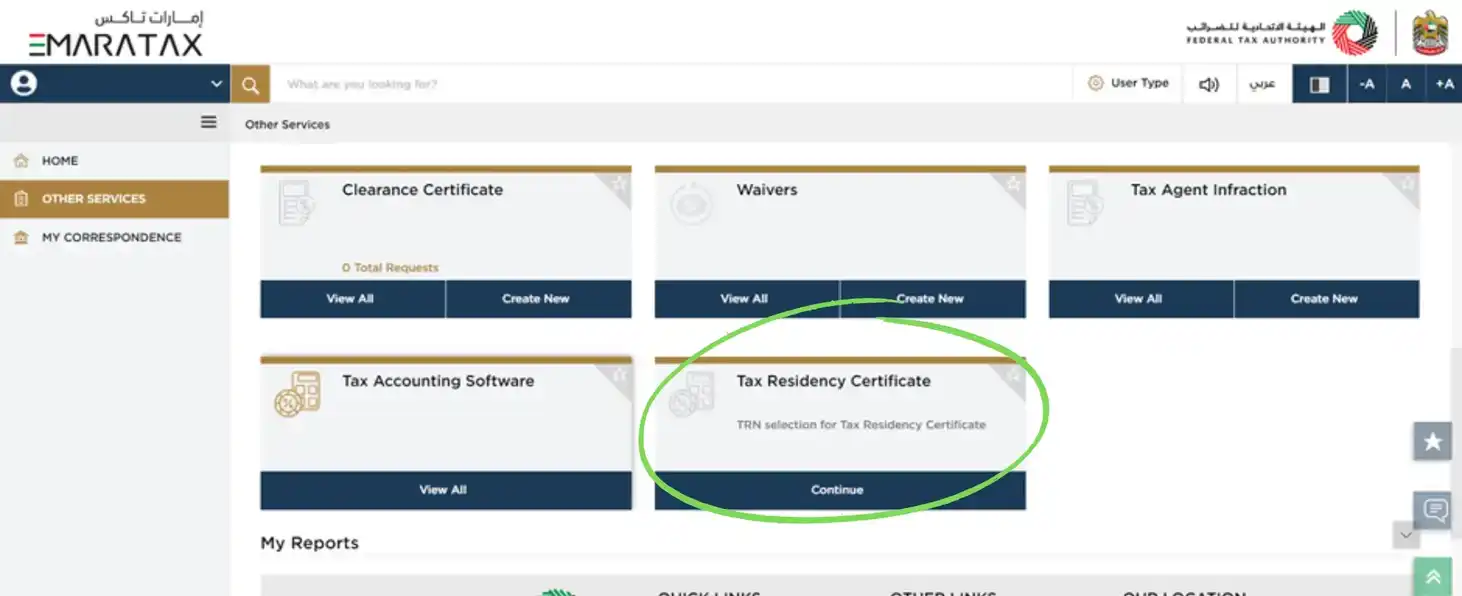
- Choose whether you require a TRC for Tax Treaty or Domestic Purpose
- Complete the creation process, pay the submission fees and submit the application
- After obtaining FTA's approval certificate processing fees are paid
In case of special Tax form, requires FTA's attestation: (For Tax Residency certificate for treaty purposes only).
In case of electronic special form it can be uploaded along with the application in the Tax Residency Certificate portal. The signed document will be returned to you via the application
- By mail with return service.
- By courier with return service
- The applicant will bear fees for sending and returning the documents.
- The form is to be filled by the Tax Payer and that shall correspond to the Application in the system with respect to the financial year of the Certificate.
Cost, Validity & Renewal for Individual Tax Residency Certificate
TRC - Cost
- Fee for Submission - AED 50
- For all Commercial Activity and Tax Registrants - AED 500
- Non-Tax Registered People - AED 1000
TRC - Validity
A Tax Residency Certificate shall be valid for 1 year from its date of issuance.
TRC - Renewal
There is no renewal for Tax Residency Certificate in the UAE. Each time you need a TRC, apply for a new Tax Residency Certificate
For assistance with the process of applying for a Tax Residency Certificate, speak with our qualified tax experts at Reyson Badger.
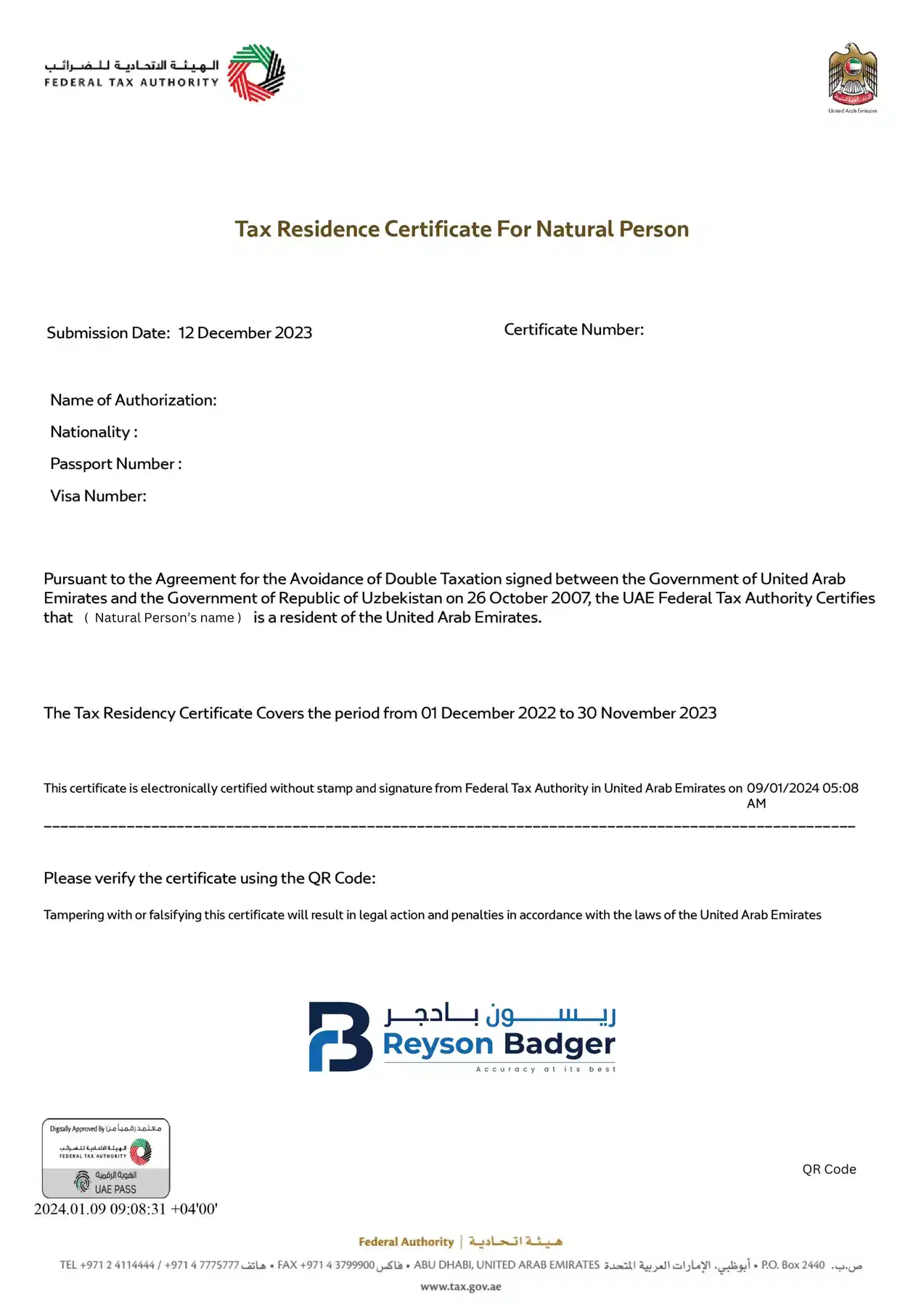
Individual Tax Residency Certificate in the UAE
VAT
Tax Consultant Services for Industries
- Tax Consultant Services for Insurance in UAE
- Tax Consultant Services for Event Management in UAE
- Tax Consultant Services for Manufacturing Industry in UAE
- Tax Consultant Services for Marine Industry in UAE
- Tax Consultant Services for Oil and Gas in UAE
- Tax Consultant Services for Real Estate in UAE
- Tax Consultant Services for Restaurants in UAE
- Tax Consultant Services for E-Commerce in UAE
- Tax Consultant Services for Logistics & Transportation in UAE
- Tax Consultant Services for Technology in UAE
- Tax Consultant Services for the Construction Industry
- Tax Consultant Services for Healthcare in UAE
- Tax Consultant Services for the Education Industry in UAE
- Tax Consultant Services for Retail and Wholesale Trade
- Tax Consultant Services for Automotive Industry
- Tax Consultant Services for Hospitality and Tourism in UAE
Request a Quote
We’ll get back to you shortlyLatest Blogs

12
Jun
How UAE Accounting Services Help Businesses Stay 100% FTA Compliant
Discover how expert accounting services in UAE reduce filing errors, prevent FTA penalties, and keep your business audit-ready and compliant.
READ MORE →
11
Jun
Do UAE E-Invoicing Need QR Codes? Explained Simply
The right E-invoicing Services in UAE, businesses can ensure smooth compliance, improve efficiency, and stay ready for the future of digital taxation in the UAE.
READ MORE →
10
Jun
The Importance of Audit Services in UAE for Manufacturing Businesses
READ MORE →
10
Jun
How to Close a Business in Dubai: Complete Guide to Company Liquidation
Learn how to close a business in Dubai with this complete guide to company liquidation. Understand the legal requirements, liquidation process, document preparation, license cancellation procedures, and compliance obligations to ensure a smooth and hassle-free business closure in the UAE.
READ MORE →
16
Jun
Anti-Money Laundering Regulations in UAE: How AML Compliance Services Keep You Protected
AML Compliance Services in the UAE help businesses meet anti-money laundering rules, reduce financial crime risk, and avoid regulatory penalties.
READ MORE →
04
Jun
In-House Accountant vs Outsourced Accounting in Dubai: Real Cost Comparison for 2026
Our outsourced accounting services Dubai are structured around each client's business size, transaction volume, and compliance requirements, not a generic package.
READ MORE →
29
May
Mandatory vs Voluntary VAT Registration in the UAE: Which One is Right for Your Business?
Understand mandatory vs voluntary VAT registration in the UAE, including turnover thresholds, compliance requirements, benefits, and how to choose the right VAT registration option for your business.
READ MORE →
29
May
Difference Between Regular and Golden Visa in UAE
Learn the differences between Regular and Golden Visas in the UAE, including eligibility, duration, and benefits.
READ MORE →
26
May
Corporate Tax Year-End Accounting Checklist for Dubai Businesses: What to Prepare Before the Deadline
Professional support through accounting services in Dubai and corporate tax services in UAE makes the difference between a smooth, compliant year-end and a stressful.
READ MORE →
25
May
Understanding Your Rights: Legal Services for Individuals in UAE
A guide to legal services for individuals in the UAE and the importance of understanding your legal right.
READ MORE →