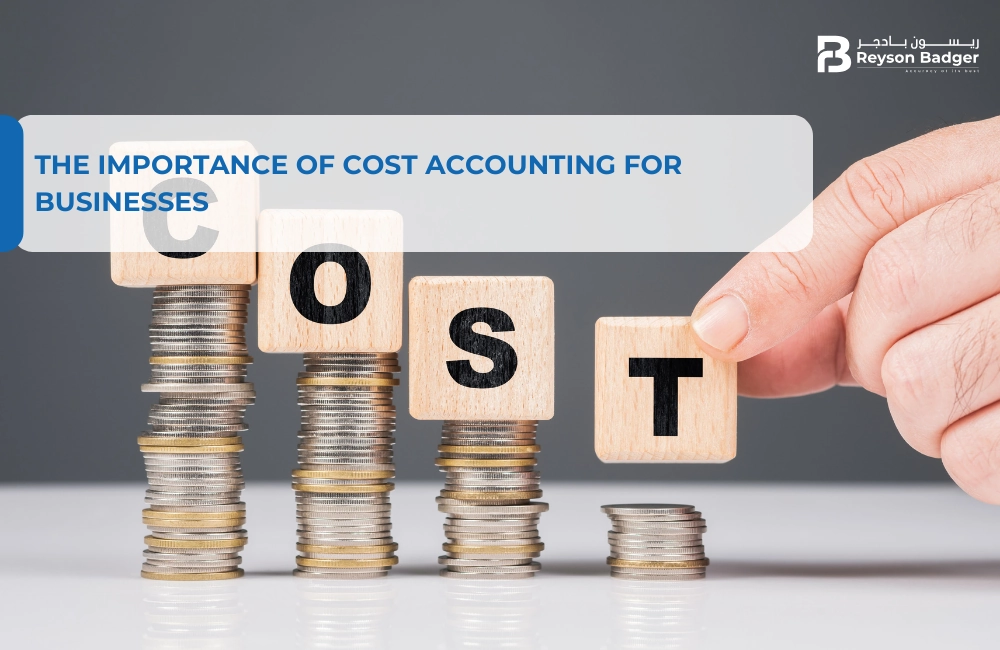


It is every entrepreneur’s goal to make a profit when they start a business. To ascertain if your company is profitable or not, you must understand how much money it spends. Cost accounting becomes important to firms at this point. It makes it possible for you to understand where your company spends money, how much it makes, and where it loses money. Doesn’t it sound like a vital factor in business? Yes, it is. Are you interested in learning more about the nuances of cost accounting and how it applies to your business? Accounting firms in the UAE can help. In this blog, we will discuss the importance of cost accounting to firms in the UAE.
Cost Accounting
A sort of managerial accounting that focuses on the cost structure of a business is known as cost accounting. As a result of cost accounting, the company can determine its total cost of production by assessing both variable and fixed costs. Costs are assigned to goods, services, projects, and related activities in cost accounting.
Entrepreneurs can acquire vital information through cost accounting that can help them create better budgets, work more efficiently, and make more money. Cost accounting is mainly used internally by managers and employees to boost a company's efficiency and profitability. The three principal elements of cost accounting are as follows:
- Materials cost: Materials costs or inventory costs refer to the direct costs used to produce or manufacture a product or service. They can be divided into three categories: raw materials, work-in-progress, and the finished product or service.
- Labour cost: The labour cost is the payroll of those employees who contribute directly to the maintenance, transportation, and production of a finished product. While Direct Labor is typically treated as a variable cost that changes with the volume of production, it often contains a fixed component (like permanent salaries) and may be classified as a mixed cost in some business models.
- Overhead Cost: Supplies, utilities, equipment depreciation, advertising, rent, repairs, taxes, travel costs, and other continuing operating costs are included in overhead costs. These costs are indirect since they cannot be linked to or associated with a specific cost unit, yet they are nevertheless essential for a company to conduct its profitable operations. These expenses are essential for operations and are classified as Fixed Overhead (costs that don't fluctuate with production volume, like rent), Variable Overhead (costs that do fluctuate, like indirect supplies), or Mixed Costs.
Types of Cost Accounting
- Standard Cost Accounting: In standard cost accounting, labour, materials, and overhead are assigned a standard cost rather than an actual cost. Standard costs are those that are determined by how well labour and materials are used in a certain situation. Once the production is over, the actual costs will be compared with the estimated expenses.
- Activity-Based Cost Accounting: In activity-based costing (ABC), overhead and indirect costs are calculated based on the actual consumption of each product and service. This method is frequently employed in the manufacturing sector in order to determine the true cost of production per unit.
- Lean Cost Accounting: Lean accounting can be seen as an extension of lean manufacturing and production principles applied to the financial and management reporting systems. Lean accounting aims to optimise and enhance an organization's internal financial management procedures. The idea of lean accounting is an extension of its stated objective intention of minimizing waste while maximizing productivity. By getting rid of pointless procedures and transactions, firms can save time, money, and resources.
- Marginal Cost Accounting: Marginal costing, also called the cost-volume-profit method, is useful for short-term decisions. Marginal costing specifically calculates the cost variation for each new unit of production that is added. The purpose of marginal costing is to aid management in short-term decisions by identifying the Break-Even Point (BEP) and analyzing the relationship between sales volume, variable costs, and profit.
Need help?
All businesses, whether they offer services, produce goods, or sell goods, have costs. Hence, cost accounting is necessary to keep track of their operations. In a nutshell, cost accounting is the procedure that enables managers to comprehend what it costs to operate a corporation. Without a reliable cost accounting system, businesses may face inefficient use of resources, poor pricing decisions, and reduced profitability — potentially increasing financial risk over time.
Not sure if your cost accounting system is trustworthy? One of the best accounting and auditing firms in Dubai, United Arab Emirates, Reyson Badger, can assist you with this. The professionals at our firm have years of experience in accounting and auditing. Our cost accountants at Reyson Badger will offer top-notch accounting and management solutions.